

This member brief is designed exclusively for Executive Members, to make membership easy, you can click below and gain access to hundreds of reports, our DTC Power List, and other tools to help you make high level decisions.
Memo: Regenerative Beef Trends, Marketing, and Reality
Beef is the most interesting topic in retail. By the end of this, you may agree.
Will Harris is the principal at White Oak Pastures. A fourth-generation cattlemen, Harris cultivates land and cattle that was passed down to him from descendants as far back as 1866. Educated at the University of Georgia, Harris was trained on industrial farming techniques that were popularized in the 1940s to feed a booming, middle-class economy. These methods include the typical pesticides, antibiotics, hormones, feed, and herbicides customary to American diets. Today, Will Harris is a regenerative cattle rancher whose detailed approach to farming is measured down to the microbe. I listened to a recent interview of his shared by a friend and cattle rancher. This soundbite has shaped the present and future of beef:
What you’re doing is fine, Will, but you can’t feed the world like that. And my response is, “I don’t know that I am supposed to feed the world, I think I’m supposed to feed my community.
In recent years, the term “regenerative beef” has emerged as a popular marketing buzzword, heralded as a sustainable solution to environmental concerns associated with beef production. This essay examines the science and work that defines this word, one that has the potential to become a disingenuous marketing term, especially in light of the challenges the farming practice faces when scaled up.
This includes Walmart’s new initiative to redefine itself as a regenerative company; the economic realities of beef production and consumption, and the broader context of sustainable development all serve as critical lenses through which to understand this issue.
Started raising cattle at [the] Ko’olau ranch on Kauai, and my goal is to create some of the highest quality beef in the world.
These were the words of the owner of Ko’olau ranch, a 1,400-acre compound on Hawaii’s oldest island, according to a recent report by The Guardian. That property owner and modern rancher is Meta billionaire Mark Zuckerberg, who aims to raise the Rolls-Royce of beef.
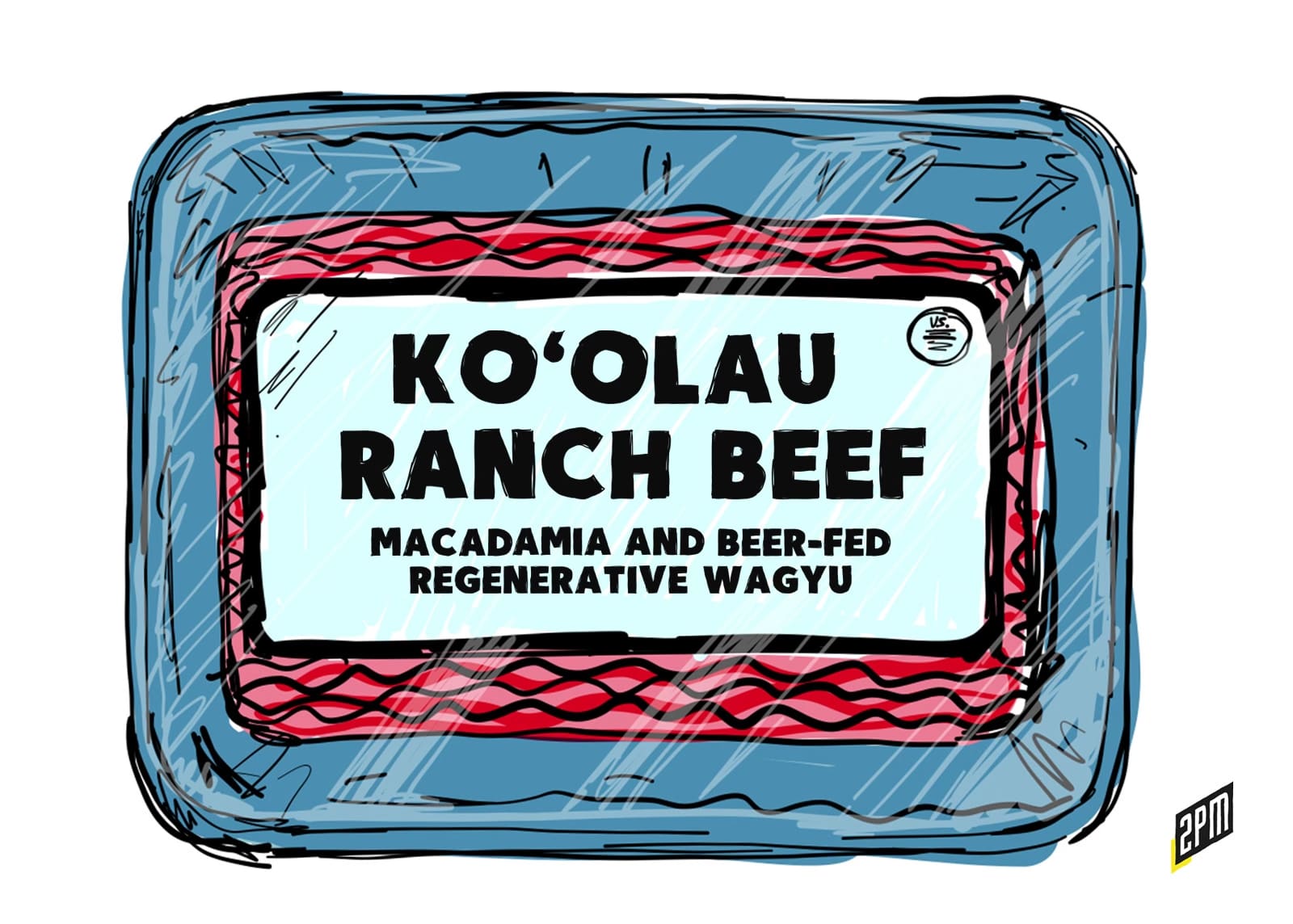
Rolls-Royce manufactured 6,000 vehicles in 2022 up from 5,586 in 2021. In 2022, Ford manufactured 1.8 million vehicles. One car company manufactures for quality and the other manufactures for industrial scale. If this analogy was used for the production and marketing of beef, by the growing number of modern retailers, it would look something like this:
Over one dozen brands are vying for market share to be the Rolls-Royce of meat producers which requires production to look more like Ford’s, defying the ideals of the practices that established Rolls-Royce over decades.
The bottom line: there is only so much space in the regenerative meat market before it’s not regenerative at all. This means that companies should assume that the market is fixed and that expansion of supply either comes by degrading production or acquiring the supply of a competitor’s.
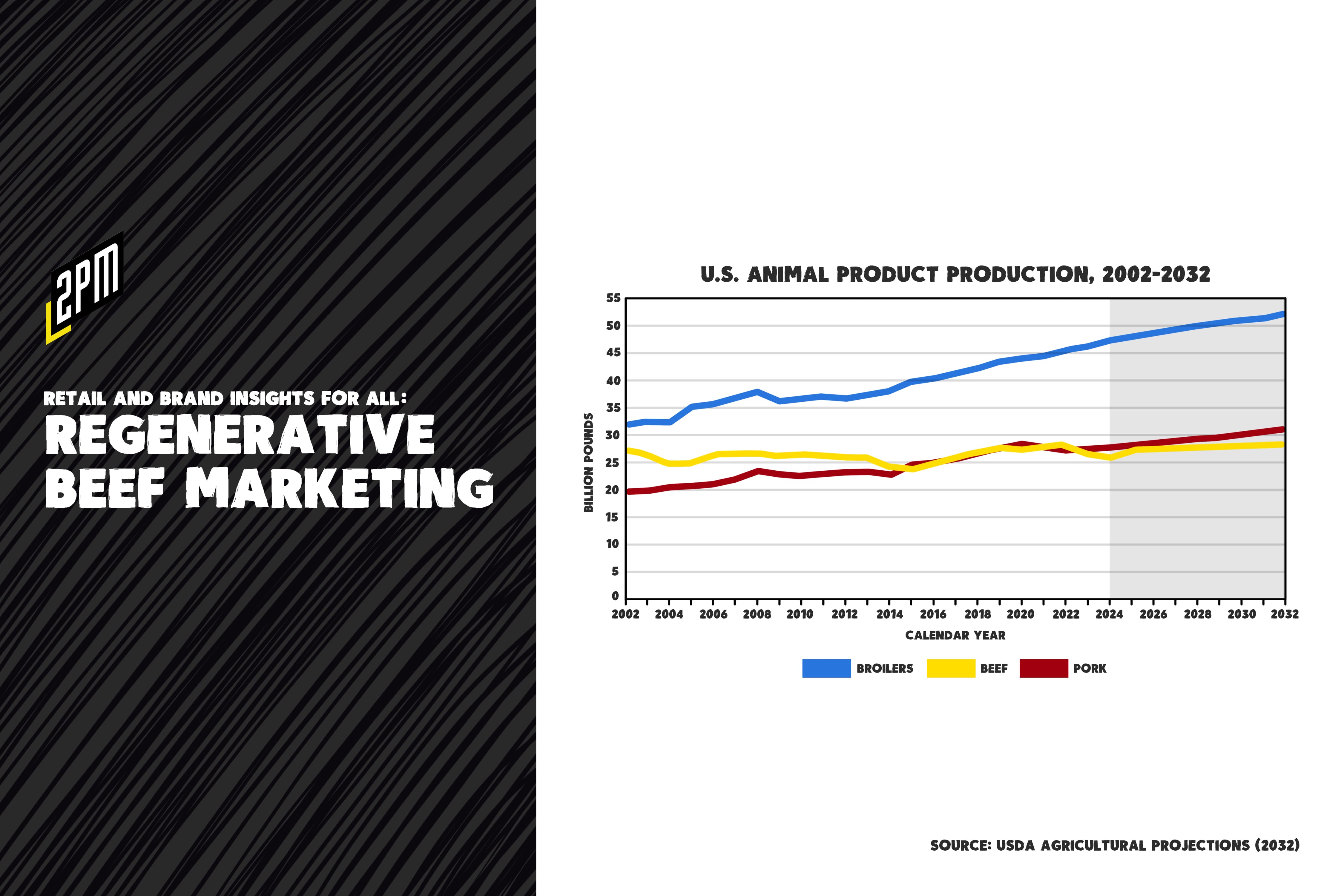
In short, there are now dozens of meat-based brands (across CPG and fresh foods categories) that are competing for market share in a segment where the supply is level, the demand is level, but the merchants are growing by the year. Look no further than the projection by the USDA, pictured above: chicken production will grow, pork production will inch up, beef production will remain the same.
Recent developments in both the traditional and alternative meat sectors suggest an ongoing struggle for market dominance, with each segment grappling with unique challenges. [Just Meat]
The use of the “regenerative” tag in beef production can be seen as a worthwhile initiative. The use of the tag in marketing is a form of virtue signaling, a term used to suggest that capitalism can be aligned with a corporation’s moral values, often with little regard to the totality of their impact. This use of the term can dilute its meaning and potentially mislead consumers about the environmental impact of their food choices.
Walmart’s Regenerative Foodscape
Here is a case in contradiction. Walmart, the world’s largest retailer, is now attempting to position itself as a leader in regenerative agriculture, despite the inherent contradictions with its low-cost business model. The Walton family, owners of Walmart, have made vast investments in regenerative agriculture. While these efforts might seem commendable, they potentially reshape the marketplace in a way that undercuts the true essence of regenerative practices. The Walton family’s influence over the food system, reflected in their substantial investments, does not align with the fundamental principles of regenerative agriculture, which prioritize environmental sustainability over profit and scale. Regenerative methods and capitalism rarely align. So for Walmart to attempt to own the narrative is especially concerning for those who are authentic about their duty to the regenerative agriculture movement.
It’s important to note that Walmart faced tension between two dueling concepts, once before: the organic produce market and its low-cost model. Organic produce economics and regenerative agriculture are systems with overlapping values, restrictions, and aspirations. As a foretelling of sorts, Walmart sells organic produce at a cost as much as “25% cheaper than any other grocer,” according to the company. From Walmart’s ‘Regenerative Foodscape’, a November 2023 report by Civil Eats:
Even if the Walmart fortune is truly creating a rising tide toward a more regenerative food system, it may be unlikely to lift the most battered of boats: those small, regenerative, diversified farms selling healthy food to their neighbors. Because at the end of the day, it costs more. And not only have they been losing money for years, they’re still caught in the everyday-low-price hurricane, trying to stay afloat within a system that rewards producers who scale up to sell at Walmart’s prices.
The expansion of Walmart’s grocery business, with its emphasis on low prices, has historically encouraged practices that are antithetical to regenerative agriculture’s ethos of ecological balance and sustainability. So the question becomes, if regenerative agriculture-based companies partner with Walmart – can they too be considered antithetical?
The Economic Realities of Beef Production
The beef industry’s economic landscape adds another layer of complexity to the notion of regenerative beef. Inflation in the beef sector, as noted by Haden Comstock of NCBA, has led to a decrease in beef availability per capita in America.

This reduction in supply, coupled with a rise in prices, highlights the challenges of transitioning to a truly regenerative model. Beef, as a protein source, has maintained its demand despite rising prices, but the economic pressures on consumers, especially those with diminishing savings, indicate a possible future shift in consumption patterns. The tension between maintaining affordability and adopting sustainable practices poses a significant challenge for the beef industry, particularly in the context of ongoing environmental changes like droughts in the Midwest.
Regenerative Agriculture: Promises and Limitations
A July 2023 whitepaper by the American Farmer’s Network stated the following:
By choosing grass-fed beef, individuals can contribute to a more sustainable food system, support local economies, and enjoy the health benefits associated with this responsible and mindful choice. As we move forward, it is crucial to prioritize the adoption of sustainable farming practices and raise awareness about the positive impact of grass-fed beef for a healthier and more sustainable future.
The concept of regenerative agriculture is rooted in practices that enhance soil health, biodiversity, and ecological balance. However, the applicability of these practices to larger-scaled regenerative beef industry remains questionable. Proponents argue that regenerative agriculture can mitigate climate change and improve environmental sustainability.
However, this optimism overlooks the inherent limitations of such practices when applied to cattle farming. Regenerative grazing, while marketed as a solution to environmental degradation, often requires significantly more land and may not effectively reduce greenhouse gas emissions or address biodiversity loss as a result of the lack of necessary land. From “The Promises and Pitfalls of Regenerative Agriculture, Explained,” a recent report by Sentient Media:
“Regenerative grazing” of cattle has been marketed to consumers […]. However, research shows that cattle grazing in any form is a major source of climate pollution that contributes to biodiversity loss, and regenerative ranching requires up to 2.5 times more land than conventional beef production.
The industrial-scale application of regenerative techniques faces challenges. The current trends in regenerative agriculture, driven by private funding (including by the Walton family) and government investment, risk perpetuating a model of agriculture that falls short of its environmental promises due to the changing priority from effectiveness to scale.

Brazilian President Luis Inácio Lula da Silva was recently quoted at COP28 in Dubai of all places:
We want to convince the people who invest in agriculture … that it is completely viable to keep the forest standing and (still) have land to plant whatever we want.”
There he detailed a plan to regrow 99 million acres of deforested land within the decade. – an area roughly the size of Sweden – within a decade. Context Magazine notes that this exceeds the landmass of Sweden. And it comes at a time when Brazil faces potential EU regulations banning commodities produced by acts of deforestation.
There are critics that suggest that regenerative agriculture, specifically beef production, would require far more land than we currently maintain for cattle raising. This is the simplest limitation but it isn’t the only one. While Mark Zuckerberg plans to use his 1,400 acre ranch to produce some of the world’s best beef, the masses will another 99 million acres over the next decade to keep supply at a place where the growing number of demand-generating DTC brands and other retailers in the space are taking the industry (assuming that the all grow with proper unit economics). This is why the regenerative tagline seems lofty at best, disingenuous at worst.
Regenerative Beef: A Marketing Ploy?
The labeling of beef as “regenerative” often serves more as a marketing strategy than a reflection of genuine sustainability. Hopdoddy, an Austin-based chain of fast-casual restaurants, just grew its vendor-partnership with Force of Nature – another Austin-based venture. Hopdoddy’s vice president of culinary Matt Schweitzer explained that part of the objective for switching meat vendors is to bring attention to regenerative agriculture:
We felt like we could really take a stand and look to move our entire supply chain in a regenerative fashion, so we could really be proud of the work we’ve done and we could hopefully leave the animals, the farmers, the ranchers, the native grasslands, and our planet a better place than before we started.
The term suggests a level of environmental stewardship that may not align with the realities of scaling beef production for mass-market ventures. This misalignment raises concerns about greenwashing, where the ecological benefits of regenerative practices are overstated to appeal to environmentally conscious consumers. The regenerative beef narrative may give the impression that consuming beef, regardless of its production method, is compatible with a sustainable food system. This perspective neglects the broader environmental implications of beef production. But more importantly, it fails to mention the limitations of supply.
****
The rise of “regenerative beef” as a marketing tagline represents a complex interplay between environmental aspirations and economic realities. While the concept of regenerative agriculture holds promise, its application to beef production at scale is fraught with challenges. Companies like Walmart, despite their investment in regenerative practices, operate within a framework that prioritizes scale and cost-efficiency, potentially undermining the principles of regenerative agriculture. The economic pressures on the beef industry, coupled with the need for environmental sustainability, call for a nuanced understanding of what regenerative practices can realistically achieve.
If the number of companies are growing and the strain on growers intensifies, is the corporate boom of direct-to-consumer meats true to its stated claims? As the global population grows and the demand for sustainable food systems only intensifies, it is important to look at this growing tagline with a critical eye and assess the claims of “regenerative meat” and the companies that rely on it to achieve scale.
By Web Smith | Edited by Hilary Milnes with art by Alex Remy and Christina Williams
Continue reading “Memo: Regenerative Beef Trends, Marketing, and Reality”
Deep Dive: 2024

A casual understanding of foreign policy would suggest that retail is facing a point of concurrency, where three influences intersect at once.
The intersection of commerce and national security has emerged as a complex and multifaceted challenge for retailers and marketplaces navigating the pressures of pricing, shipping, supply chain, and forecasting demand. This essay explores three key dimensions of this confluence: cybersecurity (as told through Shein), shipping vulnerabilities (as told through the Suez Canal conundrum), and concerns in the Indo-Pacific (as told through the Taiwan conflict). Each of these areas underscores the need for a comprehensive and strategic approach to safeguarding national and corporate interests while maintaining a thriving global economy.
A telling example of this phenomenon arises from the world of e-commerce and data collection. While this issue was explored in-depth in a previous report titled “Where NATSEC Meets Commerce”, it bears revisiting due to its profound implications.
The rise of Chinese tech companies, such as TikTok, Shein, and Temu, has significantly influenced the global commerce landscape. These companies have leveraged their direct-to-consumer models to rival and even surpass American competitors. What’s noteworthy is the symbiotic relationship between Chinese commerce giants and tax incentives. Packages worth less than $800 have long been allowed to enter the United States duty-free, incentivizing Chinese firms to sell their products in the American market while bypassing warehousing them stateside (until very recently). Furthermore, the Chinese Communist Party (CCP) has waived export taxes on these products, facilitating market share expansion in the United States.
China’s expertise in data collection predates that of the United States, with a relentless focus on first-party data. The Chinese tech ecosystem has harnessed first-party data to refine search algorithms, assess creditworthiness, and enhance its digital finance industry. This extensive data collection raises concerns about privacy and data security, given the potential for misuse and abuse.
It becomes increasingly evident that national security and commerce experts should converge. Understanding the depth of knowledge possessed by both sides is paramount, as the ancient wisdom of Sun Tzu’s “Art of War” suggests: “If you know the enemy and know yourself, you need not fear the result of a hundred battles.” While government officials may raise alarms about tangible tools required for battle, such as warships, the modern battleground also encompasses data and the vast knowledge it represents.
It becomes increasingly evident that national security and commerce experts should converge.
The implications of this confluence of commerce and national security are far-reaching, affecting not only the global economy but also the sovereignty of nations and the privacy of individuals. As we delve deeper into the complexities of this interplay, the need for a nuanced and strategic approach becomes evident.
Shein vs. The American Stock Market
Shein has risen to prominence, particularly among a younger demographic that craves affordable, trendy clothing delivered promptly to their doorsteps. Shein’s unboxing videos, showcasing $5 shirts and $10 bikinis, have become a hallmark of its marketing strategy.
The company made waves in the retail industry by adopting a unique approach. Unlike traditional retailers that produce large quantities of a single item for a season, Shein opted for small-batch production, often making only 200 pieces of a particular item initially. This strategy minimized excess inventory, reduced costs, and maximized the likelihood of selling each piece—a feat made possible by Shein’s adept use of data-mining and AI to gauge consumer demand and preferences.
Founded in China in 2008, Shein’s appeal extended to a broader audience during the pandemic, as even parents began exploring the brand’s affordable options. By every available measure, Shein has climbed the ranks to become one of the most popular brands among teenagers, rivaling the likes of even Nike. For now, Shein remains a privately held company, making it challenging to pinpoint its exact market share. But that is about to change.
Shein has taken steps toward becoming a publicly traded company, with reports indicating that it has filed for an IPO. The company has started addressing concerns such as sustainability, issues related to the treatment of independent designers, and transparency about its influencer partnerships — efforts seen as necessary when entering the public market in the United States. However, the most important issue remains: data security concerns.
Despite being a private entity, estimates of Shein’s value have ranged from $100 billion to $66 billion, outpacing the annual revenue of established retailers like Macy’s. However, the company faces significant controversies that could impact its IPO journey. One critical concern centers on allegations of forced labor in its supply chain. Reports have suggested that Shein may have sourced cotton from Xinjiang, a region in China associated with forced labor, raising questions about its compliance with US law.
Another issue relates to customs duties, where Shein benefits from the de minimis trade rule, exempting imports under $800 from fees. Critics argue that this provision was intended for personal items, not as a loophole for corporations relying on low-cost, high-volume shipping.
Additionally, Shein’s rapid and inexpensive production model aligns with the fast fashion industry’s negative environmental impact. While the company has made some efforts to introduce sustainable materials, critics view these steps as insufficient to counteract the disposable nature of ultrafast fashion. Concerns persist about the extent of data access the Chinese government may have to Shein’s customer information, given the company’s origin and current headquarters in Singapore. I wrote this in October 2023 with little understanding of its significance in 2024:
The combination of China’s global espionage campaign, Russia’s invasion of Ukraine, and the Middle East crisis has raised doubts about the intelligence community’s ability to effectively address these challenges and confront what seems to be an insignificant eCommerce problem. Driven by China’s autocratic government and advanced technology, that “insignificant problem” undermines the rule of law and poses a major threat not only to the United States but also to its allies. The situation calls for increased vigilance and coordinated efforts to counter this multifaceted threat.
Shein faces growing scrutiny not only for its business practices but also for its potential implications on national security. The intricate web of challenges and opportunities surrounding Shein’s ascent underscores the complex landscape of modern retail and its broader societal and geopolitical implications.
The Symbolism of The Suez Gulf
As we delve further into the complex web of global events poised to shape 2024, one cannot overlook the growing tension surrounding the Suez Canal. The strategic significance of this historic waterway, connecting the Indian Ocean to the Mediterranean Sea via the Red Sea, cannot be overstated. Approximately 12 percent of global trade and a staggering 30 percent of the world’s container shipping traverse this maritime corridor, serving as the quickest route between Asia and Europe.
In recent weeks, the Suez Canal has faced severe disruptions due to attacks on shipping traffic, precipitating ripple effects throughout the global supply chain. This ominous development arised from the actions of Iranian-backed Houthi rebels, primarily based in northern Yemen. These rebels, citing support for the Palestinian cause amid the Israel-Hamas conflict, initiated a campaign targeting commercial vessels in the Bab al-Mandab Strait. This waterway connects the southern end of the Red Sea to the Indian Ocean, making it a vital access point for maritime trade.
The Houthi rebels’ audacious first target was the Galaxy Leader, a Japanese-operated cargo ship reportedly partially owned by an Israeli investor. Their actions raised concerns about the safety and stability of shipping routes in the region. In response to these escalating threats, Secretary of Defense Lloyd Austin recently announced a 20-country coalition, with the United States at the forefront, to safeguard the Suez route. China is not a part of said coalition, raising concerns that could be perceived as adversarial.
The initial plan involves deploying warships close to the Yemeni coast to deter and defend against potential Houthi attacks. However, the severity of the situation may necessitate more comprehensive actions by the US military, including naval escorts for vulnerable ships and potential air strikes against Houthi military infrastructure.
The implications of these events are profound and far-reaching. With the vital flow of global trade hanging in the balance, past missile attacks have already led shipping companies to divert over 100 vessels from the Suez route, re-routing them around the treacherous Cape of Good Hope, situated at the southern tip of Africa. This drastic measure adds approximately 6,000 nautical miles and potentially three to four weeks to the journey, causing considerable delays and disruptions in shipping operations worldwide.
History reminds us that disruptions in the Suez Canal, such as the extended closure following the 1967 Six-Day War and the high-profile grounding of a massive vessel in 2021, are costly and risky endeavors for global shippers. The maritime industry’s ability to adapt to such challenges underscores the vulnerability of this vital route.
The ongoing mission to secure shipping traffic through the Suez Canal, aptly named Operation Prosperity Guardian, raises questions about the use of military force to protect economic interests. However, framing this mission as a defense of global commerce is a prudent approach. Ensuring the safety and stability of this maritime artery is not only essential for countries less affluent and powerful than the U.S., but it is also an investment in long-term global security. Until industry stakeholders are convinced that the Suez route is fully secure (Maersk has resumed operations), the retail world will continue to bear the brunt of disruptions.
The Suez Canal conflict stands as a stark reminder of how the intertwined spheres of geopolitics, commerce, and national security can converge in unexpected ways, shaping the world’s outlook in the year 2024 and beyond.
China, Supply Chain, and the Third Proxy War
As we explore the final globo-retail challenge that will define the commerce landscape in 2024, one issue looms large and unprecedented: the prospect of a proxy war involving the United States and China. This scenario, more likely today than at any point since World War II, stems from the highly contentious issue of Taiwan. Chinese President Xi Jinping’s unwavering stance on unifying Taiwan with mainland China poses a significant risk, one that could ignite a major conflict in the Indo-Pacific region.
The strategic significance of Taiwan extends beyond its geographical boundaries. A successful Chinese invasion of Taiwan would undermine the U.S. and allied defenses in the region, thereby weakening America’s strategic foothold in the Western Pacific. Moreover, such an invasion could disrupt the global supply chain, cutting off the United States’ access to crucial components like semiconductors produced on the island nation. In response, President Joe Biden has emphasized his commitment to defending Taiwan against external aggression.
However, the risks associated with this geopolitical flashpoint go far beyond the military dimensions. While U.S. citizens have grown accustomed to wars fought on distant shores, China represents a fundamentally different adversary, capable of exerting its influence in unprecedented ways, including within the American homeland.
The military aspects alone paint a grim picture. China’s hypothetical strategy for capturing Taiwan would likely involve a rapid and overwhelming assault through air, sea, and cyber means, targeting key strategic locations before the U.S. and its allies can mount an effective response. The relative size of Taiwan, comparable to the state of Maryland, underscores the speed at which such an operation could unfold.
Adding to the complexity, China possesses an arsenal of over 1,350 ballistic and cruise missiles aimed at U.S. and allied forces in the region, further complicating the defense scenario. The United States would find itself waging a war across the vast expanse of the Pacific, confronting an adversary boasting the world’s largest navy and Asia’s most substantial air force.
Beyond conventional military operations, China has cultivated an array of political and cyber warfare capabilities designed to penetrate, manipulate, and disrupt American society. This multifaceted campaign would involve disinformation campaigns, cyber-attacks, and potentially, attacks on critical infrastructure like satellites.
In addition to these challenges, China could leverage its control over global supply chains and shipping routes to inflict severe economic consequences on the United States. The U.S. economy’s reliance on Chinese resources and manufactured goods, including those with military applications, is substantial. A war would disrupt this intricate web of trade, leading to potential shortages, inflation, unemployment, and economic uncertainty.
China’s ascendancy as the dominant global industrial power has transformed the strategic landscape. It has outpaced the United States in manufacturing output and production capacity for essential military components. The recent Ukrainian conflict highlighted America’s inability to meet the demands of even a smaller-scale war, depleting critical military supplies. As this story plays out, the signs of this inability are omni-present:
The U.S. on Wednesday announced what officials say could be the final package of military aid to Ukraine unless Congress approves supplemental funding legislation that is stalled on Capitol Hill.
The general public, retail world, and greater United States must begin to consider the economic uncertainty facing consumers in 2024. This includes fortifying domestic defenses against disinformation campaigns, reconfiguring supply chains for critical goods, and pursuing a long-term strategy to regain dominance in global manufacturing. Until then, it is imperative for Washington to exercise caution, avoiding provocations, and engaging in constructive dialogue with adversarial nations.
****
In a world where the stakes have never been higher, the challenge posed by a potential conflict with China is unparalleled. The events unfolding on the global stage in 2024 will undoubtedly be shaped by the intricate dynamics of this emerging geopolitical landscape.
In the complex tapestry of commerce, national security, and the digital age, the concerns outlined in this essay reverberate far beyond geopolitical borders. As we seek to safeguard national interests and protect the integrity of our economies, we must also consider the impact on consumers and their welfare. Disruptions in supply chains, cyberattacks, and threats to maritime trade can have direct consequences on consumer prices and accessibility to essential goods. Striking a balance between security and affordability is paramount, as our interconnected world relies on the uninterrupted flow of commerce.
The flow of commerce faces further disruption.
By Web Smith