
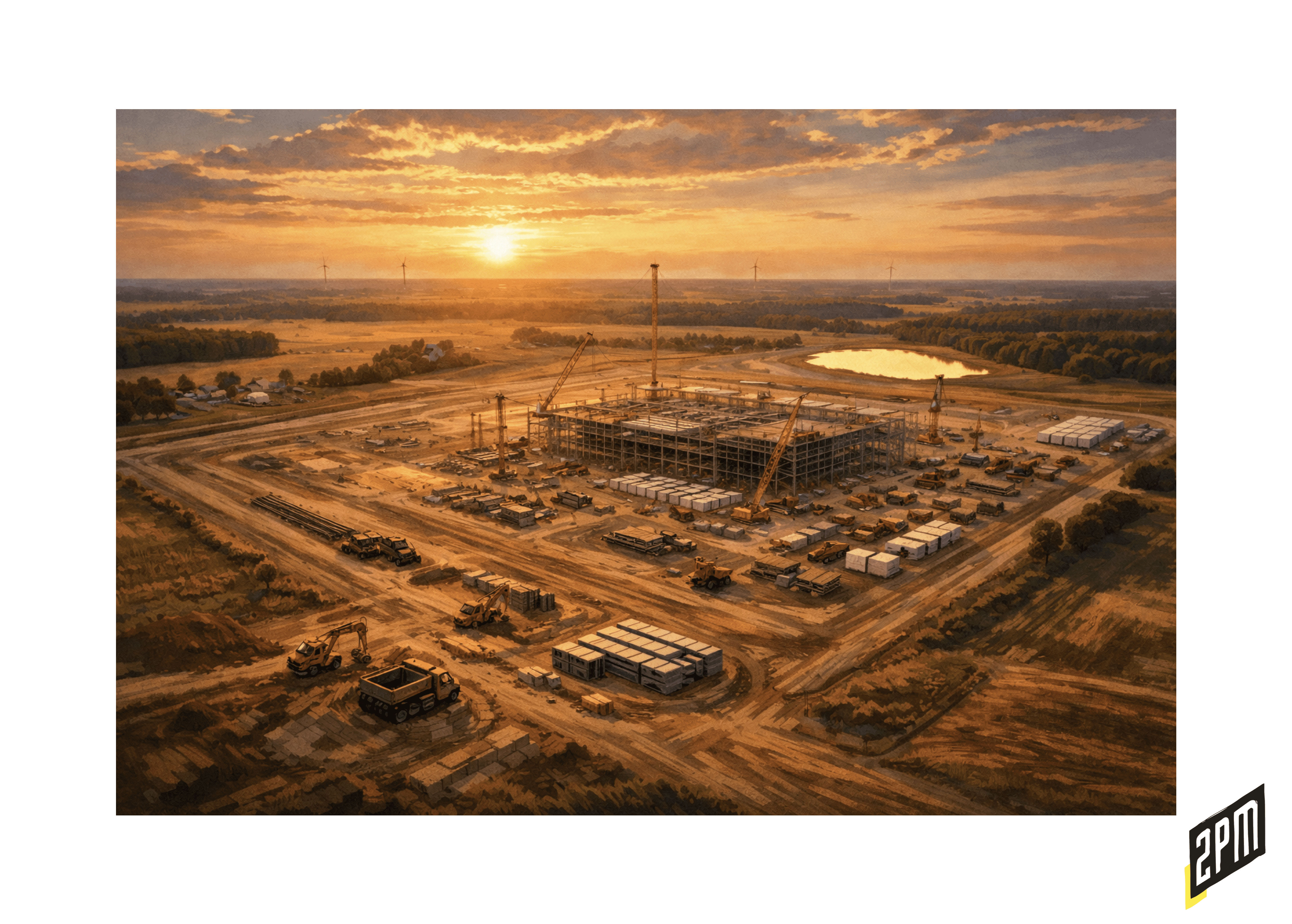
Why Financial Infrastructure Is Now National Infrastructure
Over the past several years, my writing under the NATSEC banner at 2PM has explored how American commerce has quietly become inseparable from national security. From artificial general intelligence and biometric identity systems to re-identifiable consumer data, weaponized supply chains, and the industrial resurgence triggered by companies like Anduril, the through line has remained consistent. The battlefield is no longer confined to geography. Rather, it has expanded into markets, logistics networks, data ecosystems, and capital structures. The modern conflict is being waged inside the machinery of the economy itself. Finance is another layer of this machinery, one best explained by quantum mechanics:
A ‘superposition’ is a particle that can exist in multiple states or locations at the same time until it is measured. Mathematically, a particle’s wavefunction spans many positions at once. Frontier companies in defense, energy, AI, aerospace, and industrial tech exist today in a similar state of economic superposition. They are simultaneously:
- Engineering organizations
- National security assets
- Commercial entities
- Policy instruments
- Sovereignty projects
But they cannot fully realize all of those states at once because capital is the measurement device. The deeper I have gone into this convergence, the more one conclusion has crystallized. America does not have a technology problem. It does not have a talent problem. It does not even have a will problem. What it has is a capital architecture problem. The financial systems that are supposed to fund, scale, and stabilize the next generation of American industry are misaligned with the reality of the world they now serve. Until that changes, everything else remains downstream.
If those primitives are financed on venture timelines, the United States inherits venture risk at the level of national infrastructure.
We are entering a period where the United States is being asked to rebuild industrial capacity and defense capability at scale under conditions of permanent geopolitical instability; this is not a cyclical adjustment. It is a structural transition. The systems that govern capital allocation were built for a world of short wars, long peace, and slow moving technological change. That world no longer exists; what replaces it is an environment where risk never resets to zero, where supply chains are weaponized, where data flows are strategic terrain, and where industrial production itself becomes a form of deterrence.
In that environment, the greatest constraint on American power is no longer innovation or engineering. It is finance.
The weakness of the current defense and industrial financing model is subtle but devastating. Defense technologies and industrial platforms require long timelines, heavy capital investment, regulatory endurance, political fluency, and sustained workforce development. Yet the dominant sources of private capital remain optimized for fast iteration, short duration risk, rapid exits, and financial optionality. Venture capital expects hypergrowth and liquidity events; not every venture firm thinks like In-Q-Tel, for instance. Public markets impose quarterly discipline and private equity extracts cash flow and compresses operating horizons while government procurement remains bureaucratic and slow. Each of these systems evolved in rational isolation. Together, they form an ecosystem that is structurally incompatible with the demands of modern national security.
This mismatch produces cascading consequences. Companies are forced into artificial business models that optimize for investor optics rather than strategic durability. Engineers and operators are pulled toward projects that satisfy capital timelines rather than national needs. Startups burn precious years waiting on government contracts while government waits for startups to de risk themselves. The entire system stalls inside its own incentives.
In my recent essay on existential risk and growth at 2PM, I argued that once systemic danger exists, time itself becomes the most dangerous variable in the system. Slowing down does not stabilize risk. It compounds it, as I explain below.
Risk is not eliminated by waiting. It is outrun. The brands that survive disruption do the opposite. They accelerate through it. They ship faster or they learn faster. They adapt faster and they reach stable ground first. Specific industries have internalized this logic completely. Defense technology never pauses. When the threat increases, acceleration becomes the strategy. Data infrastructure behaves the same way: rising complexity demands faster buildout, not slower. Entertainment follows the same pattern. Fragmented attention requires aggressive output, not restraint.
The longer a society remains exposed to structural vulnerabilities, the greater the cumulative probability of failure becomes. That logic applies directly to American industrial and defense finance. The world is not becoming safer; the hazards are already embedded. The correct response is not to pause or retreat. It is to build faster, scale faster, and reach the next equilibrium before exposure compounds.
The problem is that our financial institutions punish exactly that behavior.
Venture capital in particular is the wrong tool for a significant portion of frontier technology. Venture was built to fund software, networks, and platforms that scale with minimal capital intensity and deliver liquidity within a decade. It is extraordinarily effective at that task. It is deeply unsuited for sovereign-scale infrastructure, advanced manufacturing, defense systems, energy grids, space platforms, and industrial AI. These domains demand patience, stability, and commitment. Venture demands velocity, optionality, and exit.
When those incentives collide, the nation pays the price. Dual-use companies contort themselves into enterprise abstractions. Hardware firms chase SaaS narratives. Defense startups chase recurring revenue optics while delaying the hard work of physical scale. The financial structure, not the mission, becomes the primary constraint.
This is not an abstract concern. In the NATSEC essays at 2PM, I have shown how surveillance technologies, identity systems, consumer data markets, and global supply chains have already become national security primitives. If those primitives are financed on venture timelines, the United States inherits venture risk at the level of national infrastructure. That is not merely inefficient. It is strategically dangerous.

A handful of companies have already broken this model. Palantir, SpaceX, and Anduril did not succeed simply because of superior technology. They succeeded because they rejected the existing financial architecture and forced capital to adapt to the mission rather than the reverse.
Financial infrastructure is no longer a neutral service layer of the economy.
Palantir embedded itself inside the government long before it ever approached public markets. SpaceX refused short-term economics and compelled investors to accept decade-scale risk. Anduril rewrote the defense contracting playbook entirely, building manufacturing with the speed of software and anchoring production inland as a sovereignty play, a transformation I explored in depth in the Anduril essay at 2PM.
What these companies created was not simply a new category of firm. They created a new category of capital relationship. Not venture, not government, and not defense prime. Something hybrid, long-term, and sovereign-aligned. A financial structure capable of sustaining national objectives at industrial scale.
Once you see this pattern, it becomes impossible to ignore its implications. Financial infrastructure is no longer a neutral service layer of the economy. It is now a national infrastructure. The architecture of capital determines which technologies survive, which regions grow, which industries remain resilient, and which supply chains harden under pressure. It determines how quickly a nation can adapt under stress and how deeply it can absorb shocks without cascading failure.
In modern conflict, wars are often decided before the first weapon fires. They are decided in capital markets, data markets, manufacturing pipelines, energy financing, and talent flows. Whoever designs the financial infrastructure controls the true battlefield.
This is where a new class of institutions begins to emerge. Entities that do not merely lend, invest, or underwrite, but that engineer capital as strategic infrastructure. Institutions that understand that sovereign intent and financial architecture must be fused if American power is to remain durable.
The next phase of American industrial resurgence will not be led solely by engineers, policymakers, or military leaders. Financial architects will lead it.
The work of commercial operators becomes central in this transition: engineers build systems, policymakers define objectives, but the world breaks or holds in the space between them. It breaks in supply chains, hiring pipelines, revenue models, capital stacks, and institutional trust. Commercial operators live inside those fault lines. They understand how incentives distort behavior, how systems fail under stress, and how narratives shape capital flows. They operate at the intersection where mission meets market and where theory becomes execution.
Commerce, as I have argued repeatedly in the NATSEC series, is no longer neutral. It is strategic terrain.
America’s next century of power will be built inside this convergence of finance, industry, and national security. The country does not lack ambition. It lacks the financial systems capable of carrying that ambition to scale without collapse. Fix the capital architecture and the rest accelerates. As Trammel and Aschenbrenner recently quantified in Existential Risk and Growth, “risk is not eliminated by waiting. It is outrun.”
This work will be addressed, at least partly, by a dragon-guarded mountain of treasure and the people or companies enabled by it.
Written by Web Smith | LinkedIn Profile