
On occasion, we unlock member briefs for wider consumption. To support 2PM’s wider work, you can become a member.
This essay was originally written on an October day while seated on a bench in New York’s Madison Square Park. When I would travel to the city, I would visit museums with people who inspired me. But on that particular day, time was short. I had two hours to spare and I wanted to make them count, so I chose to make my own museum of sorts. I put my AirPods in, hit play on what would turn out to be one of Virgil Abloh’s final DJ sets.
For the first hour and 14 minutes, I researched his years between 15 and 41. And then the tone of the DJ set’s flavor of music shifted for a few minutes and inspired me to write what you’ll read below.
To me, the moment represented the feeling in a museum when you feel spoken to by art. You relate to the context of what you see t in front of you and you look over to the person to your right and you explain it with a passion. As I switched from research to writing, I was “talking” to the person (you) on my right through written word.
These are my thoughts on one of the great polymaths of our time. The final three paragraphs were added upon his passing. This is for Virgil Abloh.
“An Idea I Had”
We are so quick to put women and men in a box that we fail to see the beauty when they do not fit in either one. For me, this is the fascination with polymathic types and there are few who fit the mold more than you. You are a mix between left brained and right. How did you strike a balance between the two?
I have so many questions.
How did the son of a Ghanaian seamstress and painter fit in at Boylan Catholic High School? Did you make yourself small for those years or did your prized grandiosity breakthrough the monotony of high school sameness? Did you say that you were from Chicago even though you were a suburban kid? What were your influences while you were there? Did you enjoy the school’s philosophy curriculum and its theology courses?
As an engineer at the University of Wisconsin, what was more difficult for you: Multivariate Calculus? Linear Algebra? Probability and Statistics? Differential Equations? Was earning your Civil Engineering degree your happiest moment at the time?
When you were at Illinois Institute of Technology studying for your Master of Architecture, which was a more important moment for you? Was it observing the construction of the building designed by Rem Koolhaas or the classes themselves? What, in you, made you look at the civil engineering in front of you and choose fashion for your primary form of expression? Did you ever get to speak to Koolhaas about his brand philosophy of selling a brand instead of marketing clothes? Did you visit his Beverly Hills Prada store?
I found your first moment of culmination. This is where your inspiration meets your influence meets your education meets your will.The blog that you called home, The Brilliance, highlighted the fact that nearly 13 years ago to the day, your first T-shirt entitled “Medallions en bleu” sold out in a week at Colette. Did you know that you could build a fashion empire before this moment or is this what it took to confirm it within yourself?
It was a smart first approach: a venerated name in fashion’s first city, a blank Champion, a beautiful design, and the extra care to redesign the size tag. Hypebeast wrote about it in 2008; back then, they needed to use your whole name.
Nearly one year later, Kanye West interrupted Taylor Swift on stage at the 2009 MTV Music awards. What did you say to the television when you saw the man who you met at a Chicago print shop make himself a villain before millions? Did you discuss it with West en route to Fendi in 2009? So many moments happened for you in this year. Fendi signed you to an internship alongside Kanye West. It was the year that this famed image was snapped by Tommy Ton during the Paris Fashion Week. You became the Creative Director of DONDA. At the time, few understood what you’d done, who you were, or what you would become.
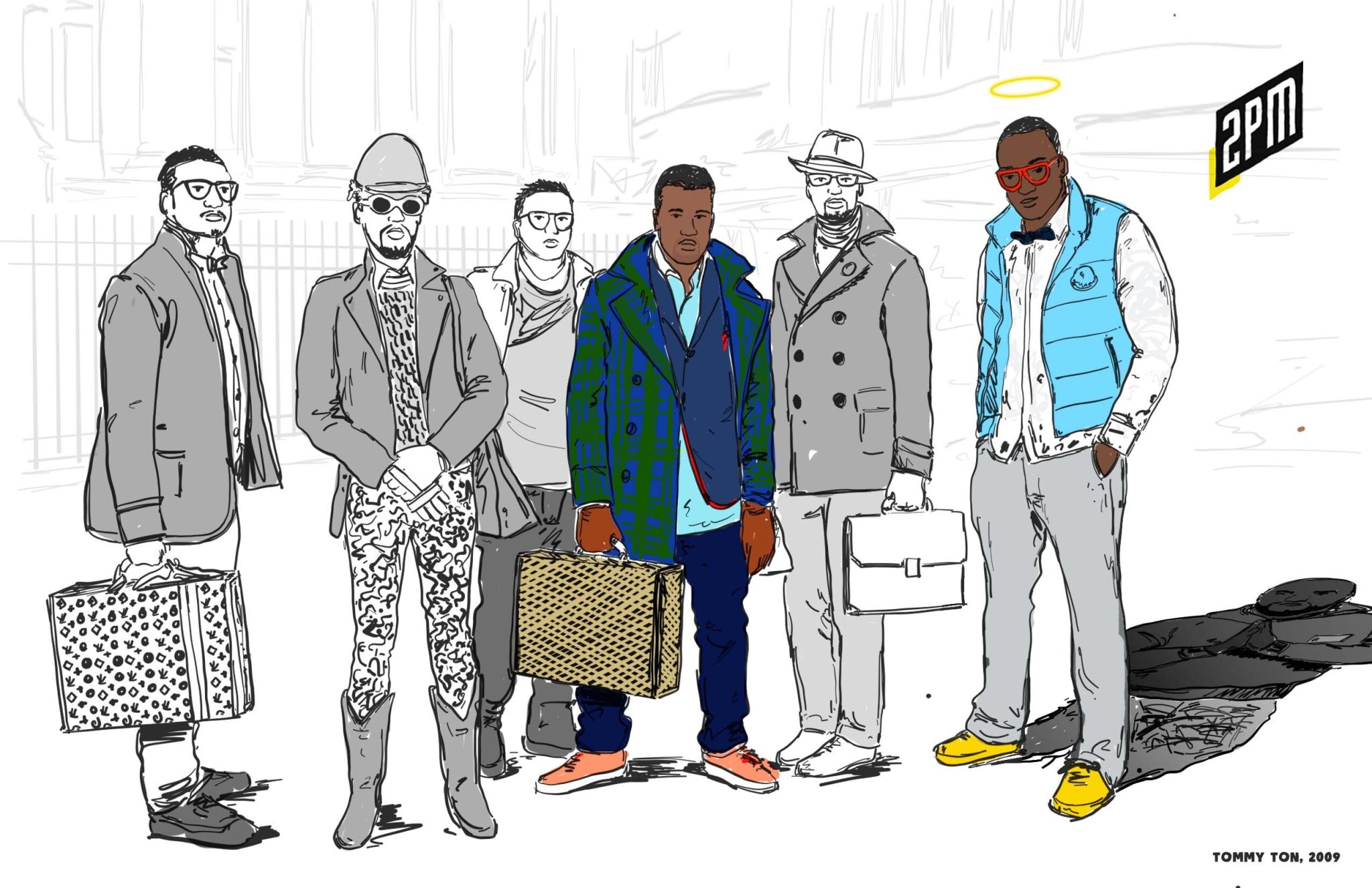
LVMH recognized you for the first time, that year, however. And you opened RSVP Gallery with Don C in Chicago. I attempted to run there from my hotel once, earlier this year. The Milwaukee street stretch to your storefront was a hard bargain and I ended up turning around at mile five. That’s about as close as I got to being in your presence, indirectly of course.
Did you become fast friends with Jay-Z when you designed the Watch The Throne album cover? Was the Ralph Lauren deadstock for your Pyrex Vision project your best investment? Is this the moment when you realized you were a true artist? For those who do not know, you shut down a company that was selling $40 tees for $550; you called it “an artistic experiment.”
Your next project is how most of us began to know you. You said this about Off-White.
In a large part streetwear is seen as cheap. What my goal has been is to add an intellectual layer to it and make it credible.
You accomplished this right as the tide began to shift in 2012, especially for women and men of color who wanted their contributions appropriately accounted for. Today, streetwear is widely applauded but back then, it was still a part of the streets.
The Gray Area Between Black and White
That’s the origin of the name Off-White, a brand that propelled you towards collaborations with Nike, Ikea, and a consumer sentiment that outranked Gucci’s. Nearly every American has seen your work by now, even if they didn’t know that it was you.
It would be just nine years since the moment LVMH CEO Michael Burke recognized your brilliance when on March 25, 2018 you stole the dream of your former mentor Kanye West. What was it like becoming the artistic director of Louis Vuitton’s menswear division? Was he upset with you? Did your friendship suffer?
I remember your first Louis Vuitton fashion show. I remember the Serena Williams outfits designed by you for that year’s US Open. And I remember how you helped Rimowa’s rise as the premiere luggage brand continue unabated.
Posthumous
I am sorry, Virgil. Cancer has deeply affected me and my family and I have a special hatred for it. I am not sorry for you, I am sorry for it. In the two years that you fought the disease with vigor and valor, you launched a monthly internet show devoted to your love of DJing. You launched your first solo museum exhibit at the MCA in Chicago. I had the book with me in Madison Square Park that day. Had I known you were in excruciating pain while producing for family, friends, and fans, I would have never set the book on the dusty park ground. I remember during the summer of 2020 when you were facing extreme scrutiny for a $50 donation that you made to that Miami-based art collective to cover George Floyd protestors’ legal costs. The internet skewered you while you were probably writhing in pain, silently and valiantly. You continued to contribute, you never made excuses for what was blown out of proportion, and God only knows what donations you contributed behind the scenes.
Today, Sotheby’s launched its official entry into the world of streetwear. Nine years ago, the affluent in your midwestern city would have laughed at the idea of your turning the tide of culture to include more faces, more types, more colors, and more styles.
You were an engineer-turned-architect who excelled in music and culture. You expressed your art and love of culture through fashion. The New York Times wrote:
In recent years, it could often appear as if there were several Virgil Ablohs, all working at the same time. [1]
And the New Yorker’s tribute to you began:
For the polymath, there is always a cardinal subject, a chief preoccupation around which all the other interests spin. For the fashion designer Virgil Abloh, the polymath of his cohort, who died on Sunday of a rare cardiac cancer, offensively too young, the center was architecture. [2]
You were a polymath but you likely never referred to yourself as such. We are so quick to put women and men in a box that we fail to see the beauty when they do not fit in one. Society wants us to fall within one of two categories, black or white. You created your own in off-white, the grayscale between the two colors. The masters are those who can travel between the two sides of the brain. What your life showed us is to keep yourself as close to the middle, using both sides at once.
I am sorry for your family’s pain but I am comforted knowing that you passed away knowing that you finished work that will make your life timeless. Your pace was exceptional and so was your life.
By Web Smith | Editor: Hilary Milnes | Art: Alex Remy and Christina Williams


