

Este informe está destinado exclusivamente a Miembros ejecutivos, para facilitarle la afiliación, puede hacer clic a continuación y acceder a cientos de informes, a nuestra lista DTC Power List y a otras herramientas que le ayudarán a tomar decisiones de alto nivel.
No. 300: Content Before Commerce

DTC growth efficiency and paying it forward. There’s a relatively new documentary on HBO called Momentum Generation. The short film chronicles a group of young surfers who were pursuing the dream of monetizing their craft (turning pro). They wanted to become professionals at a time when Americans weren’t making a living off of the sport. There is a key point in the documentary when one of the surfer’s mothers professes her appreciation for providing an informal shelter to the motley crew of young men. In her home, they wouldn’t have to worry about food or a roof over their heads. These comforts allowed them to focus on honing their abilities and building their audiences. But it also provided outsized commercial opportunity that wouldn’t have otherwise existed.
If you’ve ever followed action sports, you may recognize the names: Kelly Slater, Rob Machado, Taylor Knox, and Shane Dorian. These are but a few of the household names from that home of then-amateur surfers. The group and its household was credited with defining a sport for an entire generation. They pushed each other, they collaborated, the competed, and they complimented each other’s talents and abilities. It was the perfect storm of opportunity.
Everyone who paid attention to surf media in the 1990s will have heard of Momentum, not because it was artfully made—it wasn’t—but because the 1992 film’s screechy punk/metal soundtrack and hyper-aggressive slash-and-aerial surfing really did announce the arrival of a new generation of young dudes who shredded waves into way smaller pieces than the reigning old dudes.
Momentum Generation is Postmodern by Accident
What’s the point? We are entering a phase of online consumerism that makes it ever harder to sell, grow, and retain customers effectively. Costs have risen and attention spans have dwindled. One solution that brands often ignore is long tail and risky: building an audience early on. Curating a community and then selling to it. From Issue No. 277 – The Law of 100:
Without a strong group of early adopters, you will not efficiently achieve the attention of the masses. The first 100 are the foundation. Without the support of the 100, the masses will not adopt. Made famous by Simon Sinek, heed the diffusion of innovation theory: the early majority will not try something until someone else tries it first. Brands are judged by this early majority.
A deeper dive into the hysteria around the pioneering group of surfers and you may recognize that this well-done HBO documentary doesn’t get made without the incredible b-roll and spare footage from the shooting of the 1991 short film and 1992 short film, “Momentum.” Produced, shot, and directed by one of the surfers themselves – Taylor Steele, he wanted a way to broadcast the lifestyle. Steele was just 20 years old at the time. His early film work catapulted his household of friends into relative stardom. And then the endorsement deals, media partnerships, and merchandising opportunities followed closely behind.
Content Before Commerce
Neistat’s intentions are largely similar to Warhol’s, albeit updated for the digital age. He laments that NYC has no real community for creators, and what it does have, frankly, “sucks.” Its his contention, however, that this is not due to a lack of energy or creative prowess, but a lack of a central location, a hub of creativity. 368 Broadway, he hopes, will fill that void. “What if,” he says, gesturing to his newly acquired fortress, “this can become the space for all creators?”
Brands should consider launching their media and community operations long before their first products hit the shelves. Whether intentionally or not, 368 is doing just that. Founded by Casey Neistat and Paul Leys, 368 is a new age spin on building the creative center of New York City and beyond. With a capable Director of eCommerce and headless commerce capability, 368 has the potential to build a customer acquisition engine. The entire organization is built to systematize the serendipity of its community member; it is a flywheel for creation, content and (eventually) commerce. And it’s an organization that many to-be entrepreneurs in the DTC space should observe.
368 on Twitter
@overtime brought 🏀 to 368 last weekend. They also brought Rachel and Larry.
When you walk into the New York building operated by Casey Neistat, you’ll feel a sensation of serendipity and opportunity. 368 is just a shared workspace to many observers, many of whom view the YouTube star’s business acumen through a skeptical lens. But it serves as more of a creative haven – a place born when its creator believes that the end is more important than the growing pains of its means.
Beme was Neistat’s venture prior to 368. This time last year, CNN and Neistat decided to part ways and you could see the anguish on his face in Neistat’s farewell video. It’s no coincidence that 368 operates within the same walls of the now-defunct headquarters of Beme. Neistat isn’t one to back down from psychological challenges. But the decision to heavily invest in 368 wasn’t just about the physical space; the space is home to competition, collaboration, and community. From our recent Member Brief, The Pivot to Tradition:
For DNVBs to position themselves for scale, it helps to have a built-in audience. Consider the successes of Fenty Beauty (Rihanna’s audience), Kylie Cosmetics (Jenner’s audience), Fashion Nova (Cardi B and 13 million Instagram followers), and Glossier (Into the Gloss).
368 has the make up to duplicate the successes of several of the top 30 community-driven brands in direct-to-consumer industry. One trait that the aforementioned brands share: they are driven by personality and relationships, not performance marketing. As such, paid marketing and advertising costs are relatively inexpensive for direct to consumer retailers like Kylie Cosmetics, Fenty Beauty, Fashion Nova, and Glossier – several of the foremost examples of DTC brands that run without the constraints of skyrocketing customer acquisition costs (CAC).
Wilson Hung on Twitter
1/ The golden era of DNVB is over. The times of inefficient growth enabled by first movers advantage & low ad-costs are over. Rising ad-costs will require brands to focus on operational excellence to maintain strong LTV:CAC ratios to sustain growth.
Adjusting to a dying era
Glossier is the child of Into The Gloss, the website Weiss started in 2010 to chronicle what women had in their beauty cabinets. It may sound simple, but there was a time when nobody curated their collections. For most, a bunch of (mostly expired) products took up all the shelf space.
There is a bit of irony in the story of the surfers of the “Momentum Generation”; they didn’t expect the appreciation for their lifestyle to leave the boundaries of their niche. But the content was superior and the lifestyle was appealing, even to those who’d never touch a surfboard. They validated their brand before ever selling a product, sponsorship, or media deal. A casual observer could say the same about Neistat and his 368 team. There is a $90 million / year retail operation that is ready and waiting to exist.
It’s not uncommon for early-stage DTC brands to raise $3.5 million before their first product is sold. These early-stage retailers are often in stealth mode for up to a year, developing product lines, establishing partnerships, and refining their online branding through agencies like Gin Lane, Wondersauce, and Red Antler.
Savvier brands will take this opportunity to build their own flywheels of content, community, and momentum. In doing so, founders have the opportunity to address one of the greatest limitations of this era of eCommerce – head on. Instead of buying an audience, brands should consider investing in growing authentic digital communities around their interests and product categories. Both options – paid CAC v. organic CAC – have their complications; but paying it forward offers sustainability, predictability, and an efficient path forward.
Read the No. 300 curation here.
Informe de Web Smith | About 2PM
Nº 297: El complejo industrial DtC

Hay toda una industria de comercio electrónico que fomenta la ideación, el lanzamiento y el crecimiento temprano de las marcas directas al consumidor (DtC). Cuando te fijas en una nueva marca nativa digitalmente vertical en 2018, hay un aura de plataforma alrededor de muchas de ellas. Primero verás el sensacionalismo de relaciones públicas temprano. Luego, los fundadores deben vivir en la ciudad correcta, tener los inversores correctos y pagar el anticipo correcto de $ 25,000 / mes de PR. El complejo industrial DtC que fomenta las marcas aspirantes ha aislado, hasta ahora, a muchas de ellas de la realidad de las fuerzas de desgaste del mercado.
Los consumidores primero se dan cuenta de que las marcas utilizan Shopify o BigCommerce. Entonces estos clientes objetivo preguntan: ¿Red Antler? ¿Acelerador de Valor de Marca? ¿Partners & Spade? ¿Gin Lane? Y luego la excelente presencia de envases. ¿Lumi? ¿Esa otra? En muchos casos (pero no en todos), lo que está en juego ya no son los productos físicos. Se puede argumentar que en el mundo del DtC 2.0, el producto real es el prólogo.
Después de trabajar con Warby Parker, Partners & Spade entabló relaciones con la marca de maquinillas de afeitar Harry's (antes de su lanzamiento), Shinola, Hims y Peloton. Para una marca ya establecida como Peloton, Partners & Spade trabajó en su primera campaña publicitaria nacional, pero para una marca como Harry's, la empresa intervino desde el principio y ayudó a presentar la marca al mundo (y desde entonces ha lanzado la marca secundaria de Harry's para mujeres, Flamingo).
Adweek, 19 de noviembre de 2018
Hasta ahora, el complejo industrial DtC que envuelve a las marcas aspirantes ha aislado a muchas de ellas de la realidad del desgaste provocado por las fuerzas del mercado. La financiación de riesgo es el agua vital del complejo industrial. Cuando las marcas se lanzan hoy en día, muchas de ellas lo hacen con una financiación que oscila entre los 3,5 y los 17,5 millones de dólares. Esto significa que los días de la prueba social orgánica (que demuestra la eficacia del producto real) han quedado -en su mayor parte- atrás. Nuestras opiniones nos las cuentan, en masa, los mejores moldeadores de mentes del marketing actual. Esto no quiere decir que los nuevos productos de marca no sean estupendos. O que no haya oportunidades por delante. A continuación se muestra la tasa de crecimiento anual compuesto estimada hasta 2022.
2PM Datos
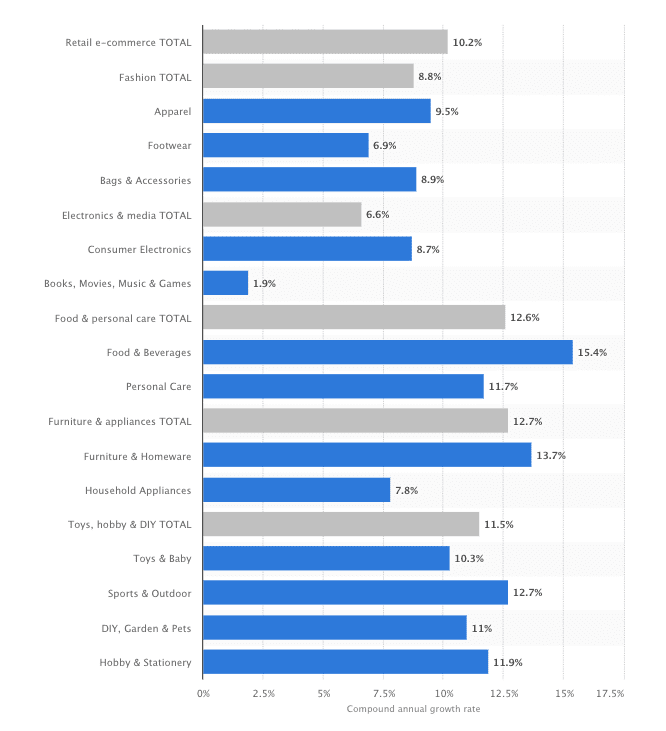
Observará que se espera que los bienes de consumo envasados, la belleza y la alimentación y el cuidado personal crezcan enormemente. Esto, unido a la abundancia de capital y a la relativa facilidad para fundar un DNVB en 2019, significa que es probable que aún no hayamos observado un volumen máximo de marcas aspirantes compitiendo en categorías anquilosadas.
Desde el nº 290: defensibilidad de la marca:
- marca: la reputación del fabricante del producto. Pero también, la impresión que causan en los consumidores los evangelizadores más visibles de la marca.
- producto: el valor creado por el producto. Pero también el valor creado por la facilidad de compra, el proceso de entrega y el seguimiento del cliente tras la compra.
- nueva distribución: ¿cómo se vende? Cuanto mejor sea el producto, más probable será que el consumidor tenga una relación 1:1 con la marca.
- Modelo de adquisición: ¿cómo consigue la marca un tráfico peatonal significativo? ¿Y cuál es la combinación adecuada de crecimiento orgánico y de pago? ¿Es sostenible el crecimiento orgánico?
- la colmena: ¿quiénes son los 100 primeros del producto? ¿Ha experimentado la marca un crecimiento orgánico sobre la base de esta comunidad digital? ¿Defenderán los "100" la marca cuando los escépticos critiquen el producto y la marca?
Si hay algo que preocupa es que la práctica de lanzar una DNVB hace que los ambiciosos fundadores desplacen recursos desde dentro de los muros de la empresa hacia fuera de ellos. Las marcas pueden externalizar la ingeniería del producto, el mensaje de marca, las relaciones con los medios y la captación de clientes. Todo ello ignorando los beneficios de los "100 primeros del producto" para el primer día, el crecimiento tipo palo de hockey: una estrategia que ha funcionado para Warby Parker, Harry's, Away pero para muy pocos otros. Una estrategia que a menudo se alimenta de la molesta abundancia de capital inicial. Una cantidad de capital que a menudo se justifica por los costes del complejo industrial. ¿A medida que el ciclo? Los fundadores tienen que hacer frente a una amalgama de costes que antes se consideraban opcionales y eventuales. Pero hoy en día, son esencialmente apuestas de mesa para jugar el juego en el primer día.
Entre los ganadores habrá seguramente un pequeño puñado de marcas de consumo que derroquen el dominio del mercado de las marcas heredadas de sus categorías. Pero si lo que se busca es volumen, los verdaderos ganadores de la era DTC son las agencias que rodean a los productos. Ellas elaboran las narrativas de los productos que todos los creadores de tendencias editoriales y editores impulsados por los afiliados nos dicen que nunca debemos dejar de tener. Esas entrevistas con los fundadores no son baratas, lo sé. Estos son los productos que se dirigen a nosotros de forma experta en todas las plataformas. Y cuando nos convertimos, recibimos el encantador correo electrónico de bienvenida a la familia. Esto optimiza la relación LTV / CAC. Y entonces lo recibimos; la caja bien diseñada nos deja sin aliento y la tarjeta encajada con el CTA de redes sociales bien probado que consigue que piquemos.
Esta es la experiencia que nos desea cada marca aspirante que adorna las publicaciones que cubren el consumo. Y sólo entonces nos damos cuenta de que cada experiencia tiene indicios de otra. No porque las agencias no sean expertas en la ejecución, que lo son. Sino porque sólo hay un número limitado de formas de hacer que las categorías -que no eran emocionantes en los pasillos de las tiendas Target- sean revolucionarias en la red de consumo. Ha habido productos tremendos lanzados a la estratosfera de los consumidores estadounidenses. Pocos productos me han impresionado más que las agencias que los construyen.
Lea aquí su última curación: Nº 297.
Informe de Web Smith | Composición Ejecutiva