
This member brief is designed exclusively for Executive Members, to make membership easy, you can click below and gain access to hundreds of reports, our DTC Power List, and other tools to help you make high level decisions.
Member Deep Dive: The Tale of Cactus Jack

This member brief is designed exclusively for Executive Members, to make membership easy, you can click below and gain access to hundreds of reports, our DTC Power List, and other tools to help you make high level decisions.
Memo: The Great Divide

War Games, continued. We often believe a partisan divide to be a purely American phenomenon, but there may be no greater example of the volatile intersection of politics and global economics than the state of trade policy of China and the United States. Perhaps it’s always been this way. But this new competitive precedent has been established upon new ground.
In 1979, the US and China established a new order of diplomatic and bilateral cooperation. Between that year and 2017, exports and imports grew from $4 billion to $600 billion. However, the trade deficit and the unfairness of trade practices are lingering issues between the two countries. Their persistence is a stain on the rest. I’ll explain.
A new trade war has been born of alternative asset classes like software, film, brand, and digital community, some of which is influenced by the politics of mainland China and some by our own state of politics. Platforms like Snapchat, Twitter, Reddit, and Google have been barred from operating in mainland China in the name of government-sponsored censorship. Until recently, we have never threatened reciprocity. The government-sponsored forced sale of TikTok changes that. Oracle, led by major Republican donor Larry Ellison, has won the bid for TikTok’s US operations.
It’s not a clean acquisition of operations, and Oracle is expected to be positioned more as a national overseer of operations – a “trusted tech partner” in the US – rather than fully in charge of the reins. In an unsettling new setting of precedences, the White House will get to have final say over whether or not it’s a done deal. [2PM, 1]
With questions remaining on what the acquisition (or partnership) entails, the official dispatch from Beijing stated that TikTok parent ByteDance will not sell the algorithm with the creative community. The value of the platform is that algorithm. In essence, we are willing to let die an economic engine for creators and commerce just to return fire at China. For decades, trade policy between the two super powers mostly excluded soft industry but with piercing language from the highest rungs of government. That has changed. In War Games, I explain:
But with the US Secretary of State signaling that more actions are coming, the crackdown is looming. Cited earlier this month, Secretary Mike Pompeo stated that American businesses should be wary of “untrusted” Chinese technology. He also cited the dangers of Alibaba’s cloud networks. [2PM, 2]
Geopolitical tensions are accelerating trends that will have damning effects on American small businesses and venture-backed growth companies alike. The trade war has continued for nearly two years, Beijing and Taiwan are at odds over military activity in the South China Sea, China’s early handling of an epidemic-turned-pandemic has led to distrust between its business peers, and China’s relations with Hong Kong are further complicating trade matters in international business. Not to mention, potential of an American Spring has left international observers questioning the authenticity of it all. Action here and inaction elsewhere is a confusing position. America’s largest corporations supporting activism domestically and not abroad further complicates matters.
The calculus works in America where companies like Nike, Disney, and Apple skew younger and liberal. That same calculus falls flat in China where the wrong type of support for an identical form of activism can thwart business advances. Look no further than the release of Mulan.
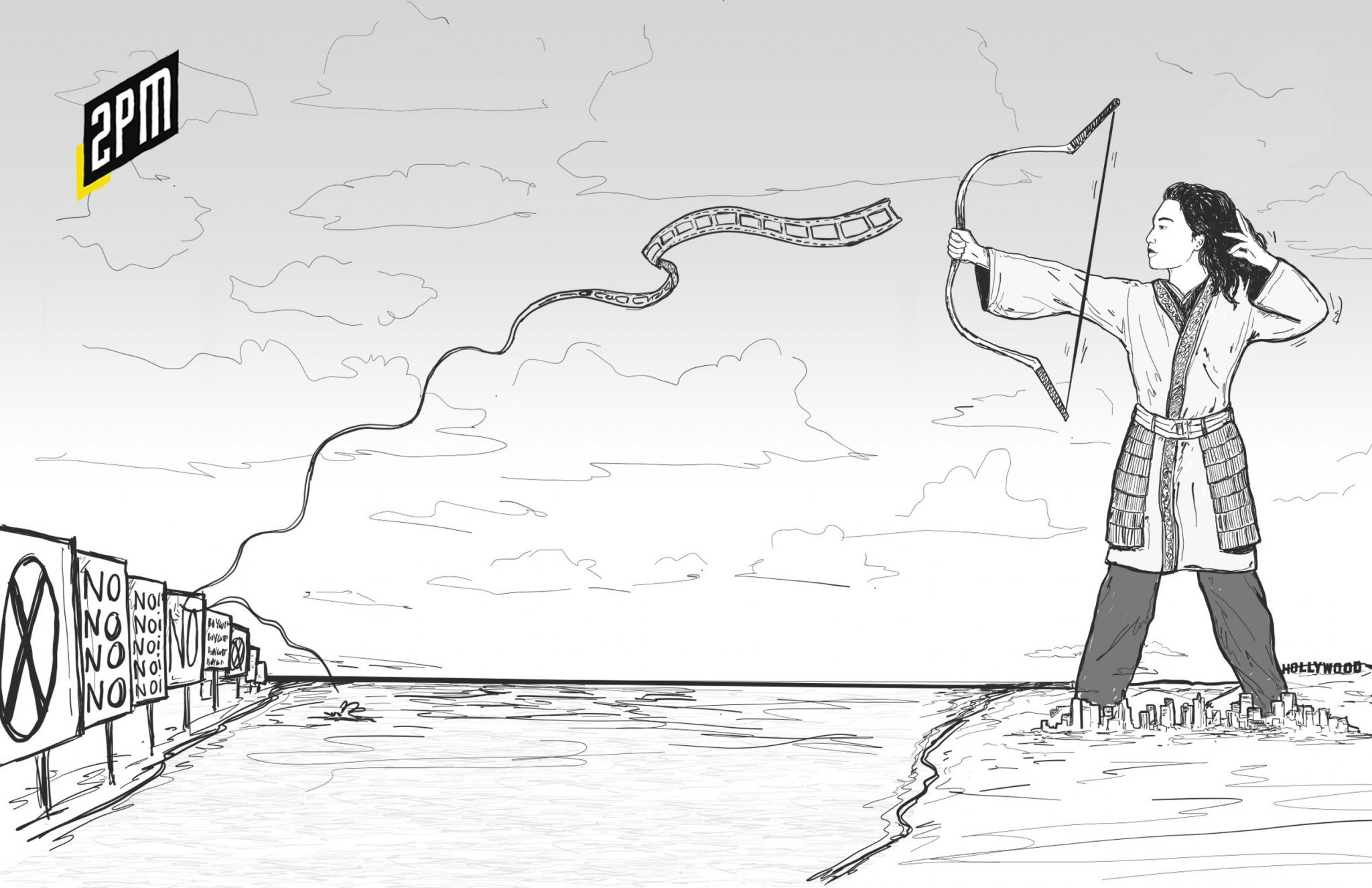
This week, Mulan held the No. 1 position on Disney+’s trending tab. According to CinemaBlend, the film had a 15% share of all streams vs. Hamilton‘s 10% share in its first full weekend. Additionally, Mulan improved Disney+’s downloads by 68% with in-app purchases up 193%. This is in addition to a reported $30 million American opening for the film hosted exclusively on Disney+. In mainland China, the reception was not as positive, stemming from a report that the film required cooperation with officials in Xinjiang, a region that houses alleged mass internment camps for ethnic minorities and has been accused of forced labor practices.
Activists rushed out a new #BoycottMulan campaign, and Disney found itself the latest example of a global company stumbling as the United States and China increasingly clash over human rights, trade and security, even as their economies remain entwined. [3]
The result was an effective boycott of the film, which opened to an underwhelming $23 million in China. Last week, Alibaba’s Taopiaopiao movie review platform published poor social scores, shorting demand for the film and reflecting a disconnect between Disney’s efforts to premiere a calculated movie that required data, focus groups, and government approval to film. Disney’s Mulan was made for Chinese audiences by the Chinese and with the Chinese. The disparity between its American reception and its Chinese failure is an indicator that not even Disney can navigate the great divide between the two nations.
US Senator Josh Hawley (R-Mo) condemned Disney for filming in the region, in what he called an effort to “whitewash” the region’s wrongs. The politics of the global economy are growing more and more complicated. Of the Fortune 500, the following businesses have also been connected to Xinjiang: Amazon, Exxon, Ford, General Electric, Citigroup, Dell, PepsiCo, FedEx, Coca Cola, Nike, Heinz, Abbott Laboratories, and Oracle – the reported owner of TikTok’s US operations – according to a 2018 article by ChinaFile, an online magazine on US-China relations.
We’ve blurred the lines between socio politics, human rights and corporate business to the point that we’ve failed to realize the implications caused when those blurred lines are no longer acceptable. The United States has the most incarcerated population on earth. The private prison system is a big business with outposts near our homes, our stadiums, our factories, and our office centers. As far back as the 1990s, American prison labor employed industries like telemarketing, technical manufacturing, and for brands like Victoria’s Secret [4]. It would take us years to separate our corporate culture from this system and yet, our corporations present with an heir of virtue here and abroad.
Not to mention, a potential American Spring has left international observers questioning the authenticity of it all. Action here and inaction elsewhere is certainly a confusing position. America’s largest corporations supporting activism domestically and not abroad further complicates matters.
In War Games, I concluded with, “Businesses must begin to account for these shifts in geopolitics.” Now that corporatism and politics are so intertwined, it is only a matter of time before scenarios like these – unforeseen just a few years ago – become commonplace. The great concern for American business is that it will become too difficult to account for these variables at any scale.
Disney’s international box office numbers for Mulan flopped in historic fashion for reasons in and out of its control. But consider the long-tail effects of the discourse around its suffering performance. I’d surmise that fewer American corporations will be willing to compete on foreign grounds given the growing sociopolitical complexity. And with new precedent set in the United States by the TikTok acquisition, we can expect reciprocity in that respect. It’s important to remember that we have sociopolitical complexities of our own and in this era of global economy, that makes our physical exports, Hollywood films, and software platforms just as vulnerable. Consumer confidence could use paths for efficient corporate growth, but the two great national economies seem to be at odds more so now than ever. The great divide will grow. And more than ever, the American consumer will notice.
By Web Smith | Editor: Hilary Milnes | Art: Alex Remy | About 2PM
Read part 1 of 2: War Games