

This member brief is designed exclusively for Executive Members, to make membership easy, you can click below and gain access to hundreds of reports, our DTC Power List, and other tools to help you make high level decisions.
Deep Dive: Value and Volatility (CPG Lending)

In the dynamic landscape of fintech lending, one leading lender initiated a strategic collaboration with 2PM. This partnership aimed to leverage 2PM’s deep insights into consumer behavior and brand performance, utilizing key data points to refine lenders’ approaches to credit offerings.
By analyzing detailed market data, the lender was better positioned to assess the financial health and potential of individual brands, enabling more informed decision-making processes. This collaboration not only underscores this particular lenders’ commitment to “outside-of-the-box” data-driven strategies but also enhances their capability to support sustainable brand growth in an increasingly competitive market. All is not well in the market.
Confirmed by subsequently published reports, the pressure on fintech lenders like Ampla is mounting. This is evidenced not only by their reported financial struggles but also by the outreach from competitors seeking to capitalize on Ampla’s vulnerabilities. A recent LinkedIn post by a Paperstack employee highlighted the concerns within the CPG industry and their competitor’s potential failure. It specifically acknowledged the deep financial challenges Ampla might be facing and extending a helping hand to those affected. This situation underscores a larger trend in the fintech sector, where companies are both competitors and crucial lifelines, offering necessary capital to businesses navigating the capital-intensive journey of eCommerce.
By analyzing detailed market data, the lender was better positioned to assess the financial health and potential of individual brands, enabling more informed decision-making processes. This collaboration not only underscores this particular lenders’ commitment to “outside-of-the-box” data-driven strategies but also enhances their capability to support sustainable brand growth in an increasingly competitive market.
****
Ampla’s notable clients include:
- MrBeast Feastables: A brand launched by the YouTube personality MrBeast, focusing on snacks.
- Cuts: A clothing brand known for its high-quality men’s shirts.
- Serenity Kids: A company that produces baby food.
- Hatch: A brand offering sleep-related products.
- Recess: A beverage company specializing in sparkling water infused with hemp and adaptogens.
- Glamnetic: A beauty brand known for magnetic eyelashes.
- Maev: A pet food company that provides raw dog food.
- MM.LaFleur: A women’s clothing brand focusing on professional attire.
- Toybox: A company that offers 3D printers designed for kids.
- Wandering Bear: A coffee brand offering cold brew coffee.
- Stately: A men’s fashion subscription service.
- &Collar: A sustainable clothing brand.
****
According to recent reports, the pressure on fintech lenders like Ampla is mounting. This is evidenced not only by their reported financial struggles but also by the outreach from competitors seeking to capitalize on Ampla’s vulnerabilities. A recent LinkedIn post by a Paperstack employee highlighted the concerns within the CPG industry and their competitor’s potential failure. It specifically acknowledged the deep financial challenges Ampla might be facing and extending a helping hand to those affected. This situation underscores a larger trend in the fintech sector, where companies are both competitors and crucial lifelines, offering necessary capital to businesses navigating the capital-intensive journey of eCommerce.

In addition to this particular blog from Paperstack, I’ve personally received similar messages a few of Ampla’s other competitors, each presenting their services as stable, long-term financial solutions. Other publications and smaller consultancies have reported similar activity. These interactions tell a tale. For one, they mark a significant shift in how digital capital is being approached in today’s market. The competitive market was difficult for these lenders, as early as February 2023 (according to this Betakit report on the growing lender – Paperstack). It can only be more difficult now.
Amid these conditions, Toronto’s Clearco and Dublin-based Wayflyer—two of the biggest FinTech firms providing revenue-based financing to e-commerce brands—have undergone significant layoffs. In Clearco’s case, the company has also changed CEOs and exited overseas markets, handing this portion of its business to London-based competitor Outfund.
The much smaller Paperstack faces the same conditions that forced bigger players to regroup, from mounting inflation and interest rates, which have made it difficult for many startups to raise capital, to slowing e-commerce growth.
Fintech lenders are operating in an even higher-pressure environment marked by several intersecting challenges:
Macroeconomic Shifts: The end of historically low interest rates has significantly impacted fintech lenders, increasing their cost of capital and forcing them to reassess their lending models. As borrowing becomes more expensive and economic growth cools, both lenders and borrowers face heightened financial stress.
Increased Competition: As traditional banks tighten their lending standards, more businesses have turned to revenue-hungry fintech startups for solutions, intensifying the competition among these lenders. Each platform strives to offer more attractive, flexible, and innovative financing solutions to stand out, as evidenced by the proactive outreach efforts from companies like Paperstack, Ampla, Kickfurther, Clearco, Shopify, Stripe, and others.
Sector-Specific Challenges: For fintechs focusing on CPG brands, like Ampla, the shift in consumer behavior towards more cost-effective purchasing and the rise of white-label products presented additional hurdles. These changes affect the financial stability and growth prospects of their clientele, directly impacting the risk assessments and business models of the lenders.
Regulatory Environment: Increasing scrutiny from regulators on lending practices adds another layer of complexity, pushing fintechs to innovate within the confines of new financial regulations. This requires continuous adaptation and compliance efforts, further straining their resources.
Technological Advancements: To stay competitive, fintech lenders must continuously invest in technology to improve their financial products and services. This includes enhancing risk assessment models with AI and machine learning, and developing more user-friendly platforms that can integrate seamlessly with the businesses they serve.
These challenges collectively contribute to the high-pressure environment that defines the new era of digital capital. Fintech lenders are not only required to be financially robust but also agile and innovative, capable of quickly adapting to changing market conditions and customer needs.
The public and private outreach from companies like Paperstack is indicative of the broader strategic shifts occurring within the fintech sector. As companies vie for leadership in this tumultuous market, their ability to provide reliable, flexible, and efficient financial solutions will likely determine their success. For consumer businesses reliant on these financial services, the landscape offers both potential risks and rewards, emphasizing the importance of choosing partners that align with their long-term financial goals and operational needs.
The Core Target of the Fintech SAAS Lender
The core target industry is undergoing significant transformation due to evolving consumer behaviors and economic pressures, which in turn are impacting the CPG lending industry. In a recent deep dive on CPG, I reported:
The landscape for CPG brands is undergoing a seismic shift, marked by increased challenges in distribution avenues, market consolidation by retail giants, diminishing venture capital interest, and heightened cost pressures. This confluence of factors is rapidly closing the window of opportunity for CPG brands to achieve widespread distribution and visibility.
As the financial landscape shifts, fintech companies that specialize in lending to CPG brands are facing unique challenges but, also, new opportunities that necessitate strategic adaptation to stay competitive and relevant. Here are the key points influencing the changing role that debt financing is playing in the role of CPG brands and beyond.
By nature, this makes debt a much higher risk to the brand and the lender.
As eCommerce continues to expand, small retailers are finding the space increasingly challenging to navigate, contrary to the expectations set by eCommerce’s growing adoption. This complexity is rooted in various structural changes in consumer behaviors, market dynamics, and intensified competition, particularly from dominant industry players.
The CPG Struggle
The story of Foxtrot Market’s failure illustrates a critical issue many small eCommerce retailers face: misalignment with consumer expectations. Foxtrot aimed to differentiate itself with a unique, upscale product mix and aesthetic appeal but neglected to integrate essential items that meet daily consumer needs, which are crucial for driving repeat business in the convenience sector. This example highlights a broader narrative where small retailers struggle to balance unique offerings with the essential expectations of convenience and necessity. Their focus on specialty items rather than staples, combined with high operational costs from city center locations, rendered Foxtrot’s business model unsustainable in a highly competitive market.
Moreover, the digital advertising landscape, once a boon for small eCommerce ventures, has become prohibitively expensive. As costs escalate—with 96% of CPG companies managing spends across multiple networks—the already tight budgets of smaller players are further squeezed. Additionally, the consolidation of market power by retail giants such as Walmart, Costco, and Kroger further narrows the window for smaller brands to gain visibility and shelf space. Data show a significant concentration of CPG spending among these major players, which captures a substantial portion of U.S. CPG expenditures, creating formidable barriers for smaller companies.
Evolving consumer preferences complicate the entry of new or smaller brands into the market, particularly the preference for purchasing groceries from established retailer websites over new online marketplaces or direct brand channels. As eCommerce grows, especially in sectors like food and beverage, small retailers must navigate the challenging waters of gaining consumer trust and visibility amidst dominant competitors.
The landscape for entering eCommerce has also become tougher, with diminishing venture capital interest in new, unproven markets. The shift in economic conditions, increased interest rates, and a demanding profitability path have led to a more cautious approach from investors. This financial backdrop makes it increasingly difficult for small eCommerce retailers to secure the necessary capital for growth and sustainability. By nature, this makes debt a much higher risk to the brand and the lender.
Another dimension of the challenge for small retailers is the blurring of lines between high-end and mass-market offerings on major e-commerce platforms. The presence of luxury brands on platforms like Walmart underscores the difficulty of maintaining brand integrity and visibility in an overcrowded online space. This juxtaposition creates a confusing marketplace where small retailers struggle to position themselves effectively.
In an eCommerce environment described as “junkified,” (a direct quote to Vogue Business by Neil Saunders) where the proliferation of products overwhelms consumers, small retailers must find ways to stand out. The necessity for strategic innovation, effective curation, and clear brand positioning has never been more critical. Marketplaces need to balance the breadth of offerings with curation, ensuring consumers are not overwhelmed but rather guided to quality and relevant products.
These challenges collectively depict an eCommerce landscape that is becoming more complex and less accessible for small retailers, demanding a strategic recalibration and innovative approaches to consumer engagement, product offerings, and market positioning.
Consumer Shifts to Cost-Conscious Buying
Economic constraints have led consumers to become more cost-conscious, increasingly opting for white-label or generic products over branded goods. This shift is driven by a squeeze on household budgets, where affordability has begun to trump brand loyalty. A Forbes article from May 2024 highlighted that over half of consumers are concerned about their personal finances, influencing their purchasing decisions towards cheaper alternatives. This consumer behavior shift impacts the revenue streams and stability of CPG brands, which are critical factors that lenders consider when evaluating creditworthiness.
Impact on CPG Brands and Their Financing Needs
As CPG brands adjust to these market changes, their need for flexible and responsive financing solutions increases. Traditional lending models, which rely heavily on stable and predictable revenue streams, may no longer be adequate. Fintech lenders, therefore, need to adapt their products to accommodate fluctuations in CPG companies’ cash flows and provide more tailored financing options that can adjust to a more volatile market environment.
The Role of Fintech in Adapting Lending Practices
Fintech companies like Ampla have been at the forefront of providing innovative financial solutions tailored to the needs of CPG brands; this is both a gift and a curse. These companies leverage technology and data analytics to offer dynamic credit products that can adapt to rapid changes in the market. For example, fintech lenders might use advanced underwriting algorithms that take into account real-time sales data or seasonal fluctuations, allowing for more flexible repayment terms that align with a brand’s cash flow patterns.
Increased Competition and Market Pressure
The tightening of lending standards by big banks, as reported by Bloomberg in May 2024, is creating an additional layer of complexity. As banks become more conservative in their lending practices, particularly in response to economic instability and previous bank failures, CPG brands may find it more difficult to secure traditional financing.
Lenders have generally been tightening credit standards since the second quarter of 2022, following a string of high-profile regional bank failures. The Fed lifted its benchmark rate last year to a two-decade high in a bid to curb inflation, and high borrowing costs have weighed on businesses and households.
This situation presents both a challenge and an opportunity for fintech lenders. While it opens the door for these lenders to fill the gap left by banks, it also puts pressure on them to manage risk more effectively amid an increasingly competitive landscape.
****
To effectively serve CPG brands under these new conditions, fintech lenders are increasingly looking towards strategic collaborations. For instance, partnerships between fintechs and retail data aggregators can provide deeper insights into consumer trends, brand performance, and market dynamics, enhancing the lenders’ ability to assess risk and customize financial products. Moreover, as CPG brands seek to differentiate themselves in a crowded market, fintech solutions that can support innovative retail strategies—such as DTC models and online marketplaces—become particularly valuable.
The evolving CPG industry, marked by a shift towards more price-sensitive consumer behaviors and the resultant impact on brand stability and growth prospects, is significantly influencing the CPG lending industry. Fintech lenders are responding with more adaptive, innovative, and risk-aware lending solutions that align more closely with the current needs of CPG brands, ultimately reshaping the landscape of financial services in this sector.
By Web Smith
Memo: Shopify Owns DTC
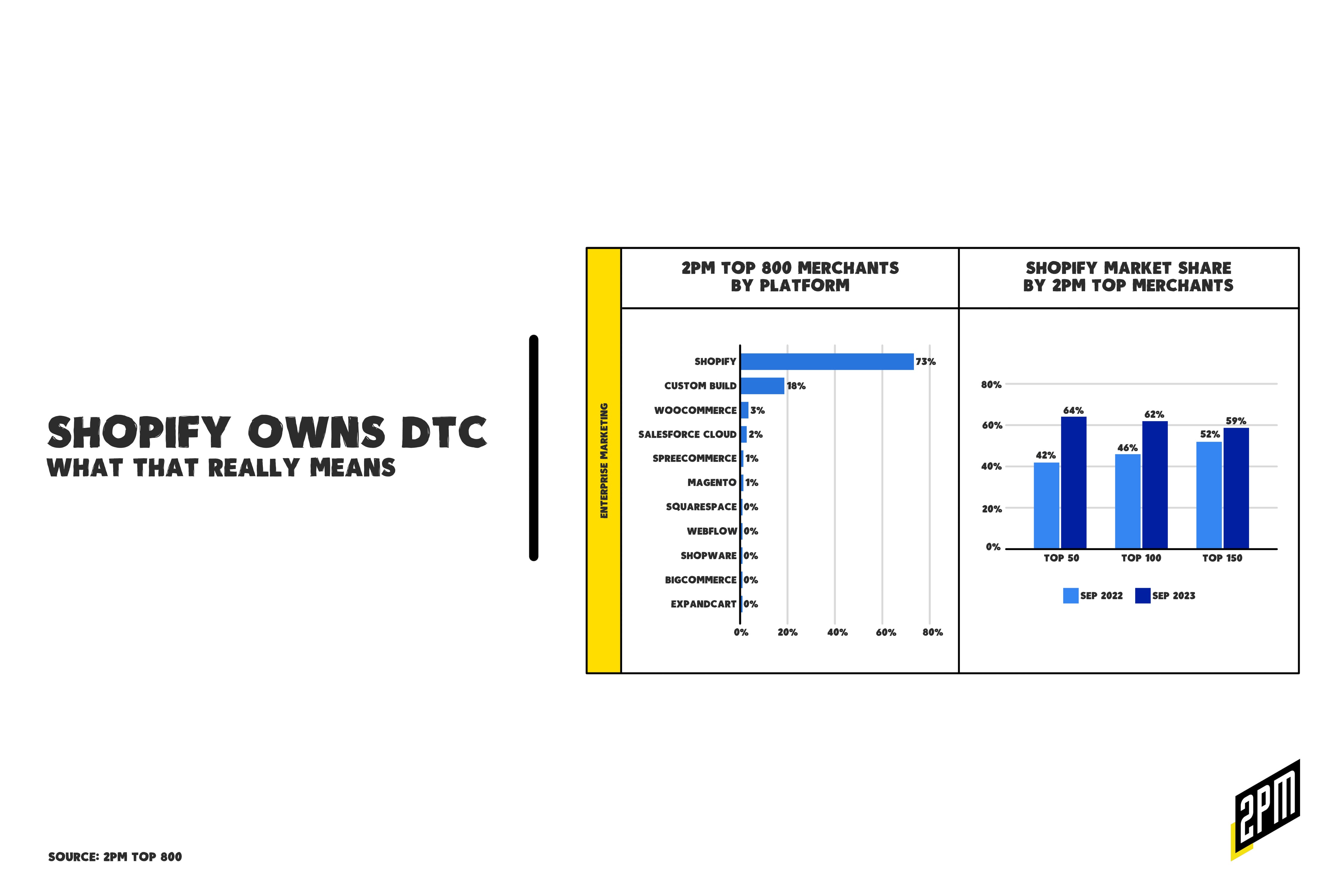
But what does that really mean? Increasingly, it’s something different than you may think. Let’s face it: October’s Nike Strength launch was underwhelming. Part of the reason was the site’s basic build on Shopify. That’s no Shopify diss; it’s representative of the state of direct-to-consumer retail.
Not only is Shopify’s year-over-year command of the DTC Power List impressive, it’s also indicative of the changes ahead. We are at the cusp of a transformative era in eCommerce technology, shaped in part by Shopify’s growing market share. Shopify’s ascent is a testimony to its robust platform, offering businesses the tools for seamless online store creation and management. While this surge underscores a democratization of eCommerce, providing both enterprise brands and small merchants with a streamlined path to digital sales, it also prompts a critical analysis of investment strategies in the online retail sector.
The convenience of Shopify’s lower barrier to entry may have inadvertently led to reduced investment in bespoke online retail infrastructures, posing a strategic dilemma as omnichannel retail and digital marketplaces continue to dominate consumer interactions. Examining Nike’s launch of Nike Strength on Shopify or True Classic’s expansion into physical stores, we uncover a complex landscape of opportunities and challenges.
In 2022, True Classic partnered with third-party platform Leap to open five pop-ups in Los Angeles, San Jose, Chicago and Washington, D.C. While the pop-ups will remain open, the company said it is taking its physical retail operations in house, enabling it to outfit its stores with an “elevated, approachable branding that resonates with their consumer.”
For a company of True Classics’ size and velocity, Shopify is a great solution that is relatively low cost and infinitely scalable. It doesn’t get in the way of other plans. Today, more than ever, brands see DTC as part of the strategy and in some cases, it’s the least significant of a multi-pronged approach. What does that look like? One recent example is Mars’s partnership with Uber on a Skittles ad.
Mars is displaying interactive Uber Journey Ads and Post-Check Out Ads to consumers taking a ride in an Uber vehicle or waiting for their Uber Eats order. The ads will enable consumers to seamlessly interact with the Skittles website and add Skittles products to their Uber Eats shopping carts. (CSA)
As marketing channels continue to merge with sales channels, we may see less of an emphasis on traditional marketing funnels (Meta or Google > Shopify.com > checkout) and more content-driven online destinations like the aforementioned Skittles site. But without this level of marketing and sales ambition, this architecture is no longer typical of DTC operations.
The Advantages of Shopify’s Market Share Growth
Lower Barriers to Entry. Shopify has revolutionized the eCommerce industry by making online store setup accessible and cost-effective. This advantage is palpable when observing Nike’s decision to employ Shopify for NikeStrength.com. The move suggests a strategic pivot, wherein agility and time-to-market are prioritized for new ventures. By lowering the technical and financial thresholds, Shopify has enabled countless organizations to partake in the digital economy with maximum agility and minimal investment.

Omnichannel Synergy. True Classic’s retail expansion illustrates Shopify’s potential to enhance the omnichannel experience. Their stores, armed with digital-first technology, are positioned to bridge the gap between online convenience and tactile brand encounters. This synergy is highlighted in a recent Inc. article, noting that brands like Bark and Bala are abandoning a pure DTC model in favor of a hybrid approach that amalgamates physical retail and online channels.
“We don’t consider ourselves a DTC brand,” said Kislevitz, whose company produces Bala Bangles – fitted exercise weights that strap to the body. “I’ve found that there’s a really virtuous ecosystem in an omnichannel approach,” he continued. (Inc.)
The virtuous cycle of in-store and online interaction creates a comprehensive brand ecosystem that can amplify customer reach and loyalty.
Potential Downsides of Shopify’s Dominance
Underinvestment in Online Retail. Despite advantages, there’s an inherent risk that Shopify’s ease of use could foster a minimalist investment approach in online retail infrastructures. Brands might neglect the development of distinctive and innovative online experiences like the one found at Skittles, leading to a market saturated with cookie-cutter stores that lack differentiation. Leaders must recognize that while solutions like Shopify are instrumental in launching online platforms, they are not a panacea for the competitive digital marketplace that demands uniqueness and brand identity. And while many are pursuing omnichannel strategies, when DTC-first strategies become popular again, brands may want more sophistication or individuality.
Omnichannel and Digital Marketplace Competition. The omnichannel model’s evolution calls for a reassessment of the direct-to-consumer approach. As noted in the Inc. article, the economic logic behind bulk shipments versus individual fulfillment cannot be ignored. This realization is prompting DTC players to diversify their sales model. Shopify’s ease might initially attract brands, but the demand for a more diversified, omnichannel strategy soon becomes evident, compelling brands to expand beyond digital-only models.
Case Studies: Nike and True Classic’s Strategic Moves
Nike’s Choice of Shopify. Nike’s foray into Shopify for a specialized product line reflects an agile, project-specific strategy rather than a wholesale platform shift. It illustrates that even established brands see value in leveraging Shopify’s simplicity for certain segments, without committing their entire online presence to it. This decision is strategic, targeting rapid deployment and flexibility over the heavy investment and bespoke customization of their main site.
True Classic’s Brick-and-Mortar Strategy. Contrastingly, True Classic’s physical retail venture, detailed in the Chain Store Age article, signifies a strategic pivot to ‘owned and operated’ locations. This move enables the brand to envelop customers in a controlled, brand-centric environment, supplementing their online presence with a tangible experience. The brand’s commitment to immersive, in-store digital engagement reveals a sophisticated understanding of modern retail dynamics, where the physical is propelled by the digital to propel the business forward.
Founded in 2019, True Classic is now focusing its efforts on rapid expansion of brick and mortar retail, a natural next step to engage their customer in person as well as reach a new audience, the company said.
The contrast here is stark and telling. True Classic leans into the value of customer intimacy that physical stores can cultivate, betting on the allure of in-person experiences to strengthen brand loyalty. Nike, conversely, leverages Shopify’s agility to extend its brand reach without the commitment of extensive infrastructure changes. Both approaches underscore a critical strategic understanding: that the future of retail is not a one-size-fits-all, but a tailored fit to brand identity and customer expectation.
These are two businesses at two different stages; both are using Shopify for contrasting reasons. Shopify’s expanding market share heralds an accessible entry point into the eCommerce realm, yet it simultaneously prompts industry leaders to deliberate on the long-term implications of such a model. The convergence of ease and ubiquity must not deter us from investing in distinct, immersive online and offline brand experiences. It’s incumbent upon us to forge strategies that leverage the strengths of platforms like Shopify while pursuing a holistic omnichannel vision. This dual approach will ensure that we not only thrive in the current marketplace trend but also maintain preparation for its future, one that may segue back to one where brands are proud to be categorized as DTC and run their businesses as such.
By Web Smith | Editor: Hilary Milnes with art by Alex Remy and Christina Williams