
But only for the brands and retailers that understand the new rules of the agentic commerce era.
I spent the better part of fourteen hours reading every page of Shopify’s Universal Commerce Protocol announcement. Not skimming it; not headline parsing it. I read the product notes, the architectural explanations, the developer implications, the platform logic, and then I sat down with the most technical person in my orbit and had them walk me through what Shopify is actually building. Not what they are saying they are building, but what the underlying principles of the system are: what the protocols mean, how the state machines behave, where the trust boundaries live, where human agency ends and machine agency begins. Most importantly what this infrastructure allows now and what it will allow five years from now.
When you do that exercise honestly, something becomes very clear. Shopify is not launching features. Rather, Shopify is laying the foundation for the next economic operating system and no one else has the horsepower to compete with them.
In the old economy, scale dominated. Whoever could buy the most traffic, flood the most channels, and sustain the largest ad budgets won. The new system does not care about your ad spend. It cares about your structure.
For the last twenty-five years, digital commerce has been built on persuasion. We optimized pages, funnels, copy, creative, attribution models, retargeting loops, and emotional triggers. We argued about brand and performance as if they were separate disciplines. We treated the internet like a mall. Shopify’s architecture makes it impossible to keep pretending that model survives the next decade.
We are entering a deterministic economy.
In a deterministic economy, outcomes are decided before the moment of choice. By the time a consumer sees a product, an increasingly large portion of the decision has already been locked in by structure, constraints, permissions, guarantees, and system design. This is the part of agentic commerce most people miss. They are still thinking about agents as new interfaces for old persuasion. They do not yet understand that the persuasion layer is becoming irrelevant.
When I first wrote about Agentic Commerce and AEO, I framed agents as the new homepage, the new SEO layer, the new point of sale. That framing remains directionally correct. But it understates the depth of the shift. The deeper change is not in discovery, it is in determinism. It is in who is allowed to win and why.
An agent does not browse, nor does an agent does not get tired. An agent does not feel brand affinity; an agent executes inside a defined constraint environment. That environment is shaped by what the user has permitted and what the business has declared. The business that fits the constraint environment best becomes the default winner.
This is what Shopify’s framework operationalizes.
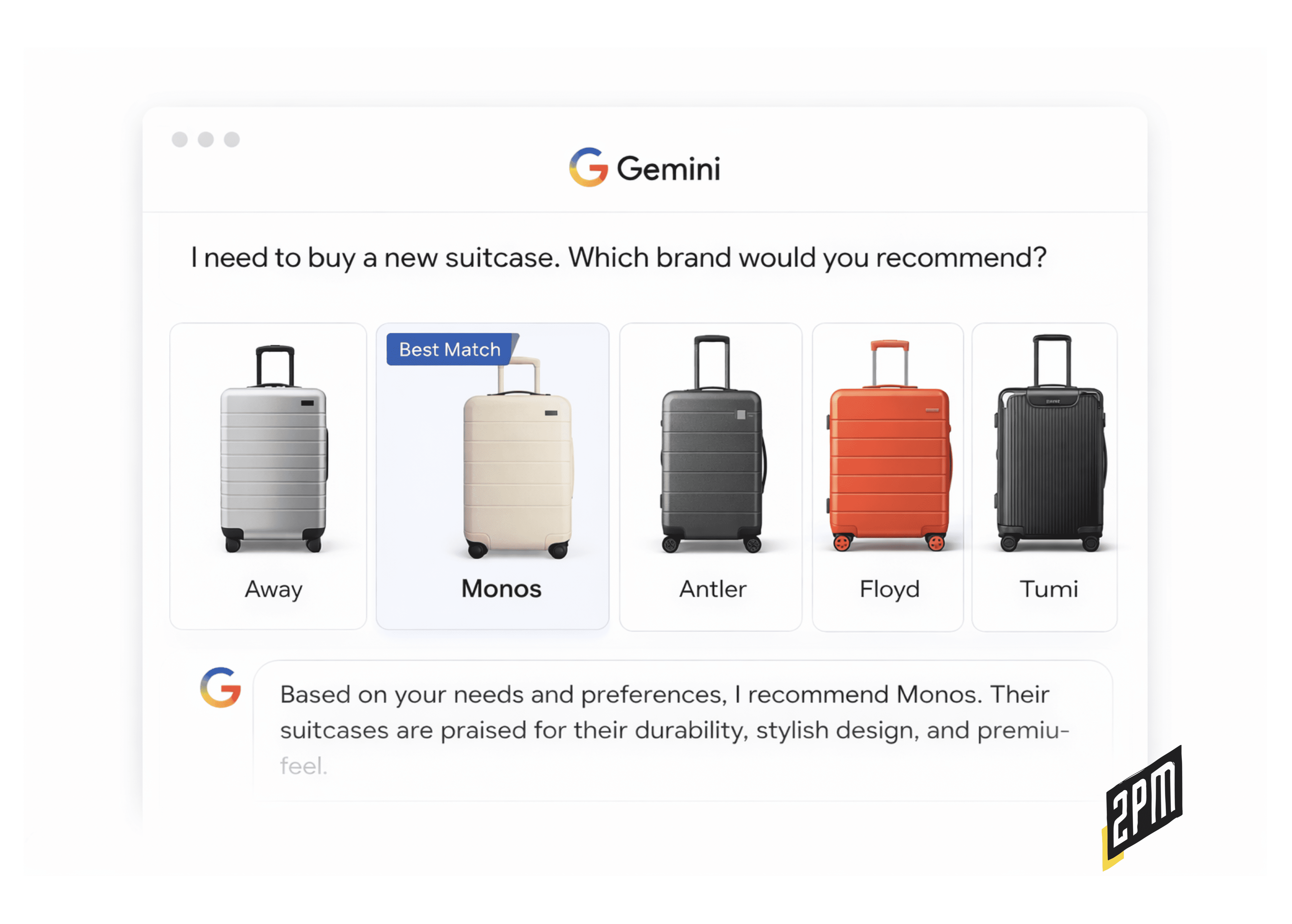
When Shopify demonstrates that Google Gemini consistently prefers Monos luggage over its competitors and that ChatGPT produces similar recommendations, this is not a coincidence and it is not marketing. It is a signal. It suggests that Monos satisfies the underlying framework of constraints better than competing brands.
At Monos, we’re excited about agentic shopping because it enables us to meet customers where they already are. It’s a new way for our story and product details to show up at the exact moment someone is asking real questions with real intent, in a format that feels helpful, not intrusive. For a brand built on thoughtful design, it’s a natural next channel for discovery and trust. [Shopify]
Victor Tam, CEO and Co-Founder of Monos
Their data is cleaner, their policies are clearer, and their guarantees are stronger. In additiona, their fulfillment is presumably more reliable. Their trust signals are easier for machines to verify; their product attributes are more consistent and their systems are easier to complete transactions with.
This is not about who has the prettiest site; his is about who has built the most compatible business.
This is where the democratization of commerce quietly emerges. In the old economy, scale dominated. Whoever could buy the most traffic, flood the most channels, and sustain the largest ad budgets won. The new system does not care about your ad spend. It cares about your structure.
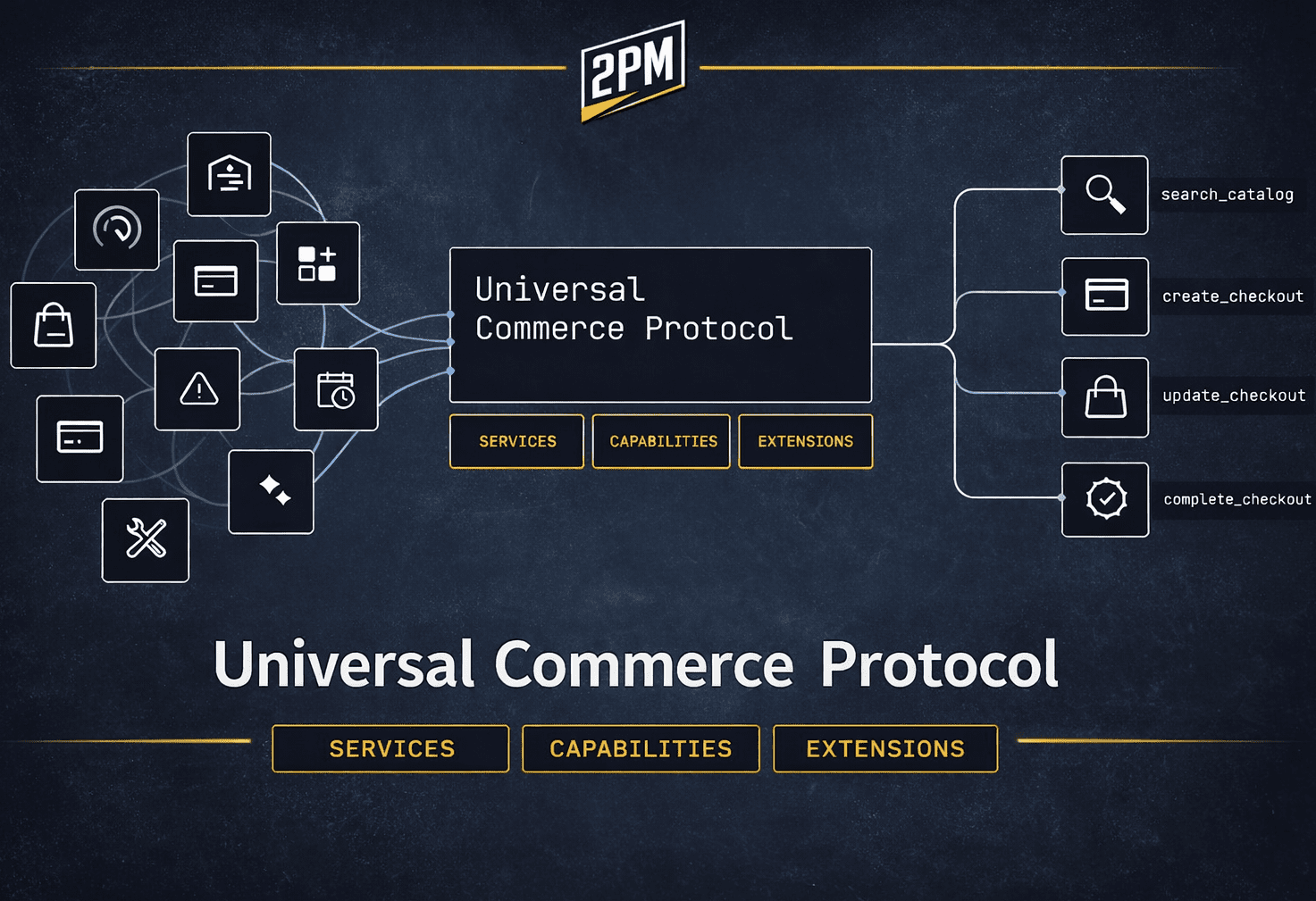
A small brand that publishes cleaner data, offers stronger guarantees, delivers faster fulfillment, simplifies returns, and maintains more reliable inventory becomes more attractive to an agent than a massive brand with messy systems and brittle operations. The competitive playing field shifts from capital dominance to operational excellence.
This is profoundly democratizing.
A founder with discipline, clarity, and strong systems can now compete with companies a hundred times their size, not because the agent is fair, but because the agent is ruthless. It selects the path with the highest probability of successful completion for the user. In the deterministic economy, small brands do not need to shout louder. They need to be built better.
This is why the entire idea of marketing as persuasion begins to erode. You do not convince the agent; you construct a business that the agent is allowed to choose.
At MTN Haus, we have been building in this direction for months, ironically. Yes, often without even naming it. We focused on membership systems that act like operating systems. We obsessed over data consistency, policy clarity, fulfillment logic, identity frameworks, subscription mechanics, and trust surfaces. We pushed clients to invest in boring things that did not feel like growth. Returns infrastructure, fulfillment reliability, inventory synchronization, policy transparency, and product data normalization. This is machine legibility.
Most agencies avoided that work because it is not sexy. It does not show up in creative decks; however, it is precisely what agents reward.
When we developed Snack Clock architecture, for a major CPG brand, the goal was not just to improve UX. It was to eliminate cognitive load and reduce friction in the moment of demand. That same logic now becomes machine-first.
Sometimes, the future is hard to explain to those living in the present.
Snack Clock was not just a UX feature; it is an early expression of deterministic commerce. Where most shopping systems force agents and consumers to infer urgency, Snack Clock required users to explicitly declare it. The moment someone turns the dial from “Now” to “Never Run Out Again,” they are no longer browsing; they are encoding a constraint. That constraint becomes the governing logic of the transaction.
Everything that follows is execution. Each path removes friction by design, routing the user or agent directly to the fastest, safest fulfillment channel available, whether that is local delivery, marketplace checkout, direct DTC, or subscription.
The result is a system that increases completion probability, which is the primary selection metric for agents. Snack Clock also makes the brand liquid by exposing multiple negotiation pathways at once. Agents prefer merchants that can adapt to more situations with fewer unknowns. Most importantly, Snack Clock transforms trust from a marketing claim into a computational guarantee by making outcomes predictable and verifiable. In an agentic economy, that structural advantage is decisive.
Agents will learn those temporal patterns and begin to recommend brands based on how well they satisfy time-based demand. The brand that understands when a problem emerges and can solve it with minimal friction becomes structurally superior.
This is not speculative. It is already happening. The deterministic economy operates on four hidden levers.
- Constraint engineering
- Friction elimination
- Negotiation bandwidth
- Trust as computation
The first is constraint engineering. MTN Haus’ Snack Clock architecture was an early example of this. Every business publishes rules: where they ship, how fast, what they guarantee, what happens when something goes wrong, and how disputes are resolved. Then, on to how identity is verified, how payments are handled, and how loyalty is honored. These rules define the feasible solution space the agent can operate within. Expand that space responsibly and the agent will choose you more often. Shrink it or complicate it and the agent will avoid you.
The second is friction elimination. Every additional step that requires human involvement reduces the probability of transaction completion. Brands that remove escalation points win. This is not about UX anymore; it is about computational efficiency.
The third is negotiation bandwidth. Brands that expose flexible pricing, dynamic bundling, loyalty conversions, and time-based logic give agents more degrees of freedom to optimize outcomes. Rigid businesses lose.
The fourth is trust as computation. Trust becomes verifiable, guarantees become cryptographic, and identity becomes machine-readable. Reputation becomes structural.
This is where my early AEO thesis was both right and incomplete. I was correct that structured data, schema alignment, policy transparency, and factual consistency would become the foundation of visibility. Where the thesis fell short was in recognizing that AEO is not just about being recommended. Rather, it is about becoming the easiest possible outcome for a system to choose.
Recommendation is a symptom. Determinism is the disease.
Outside media still matters, but not for the reasons most marketers think. Media does not persuade the agent; media reshapes the human’s constraint environment. It modifies trust, risk tolerance, ethical alignment, and long-term preference. Those updated constraints are then enforced by the agent. When the agent shops later, it is operating inside a newly defined rule set. Media moves the boundaries of what is allowed; it does not pull the trigger itself.
This is why public perception, cultural trust, and earned media remain critical in an agentic economy. They expand the computational reach of your brand.
Shopify’s framework confirms that commerce is no longer about storytelling at the point of sale; it is about system design at the point of possibility.
The brands that win the next decade will not be the most charismatic, they will be the most compatible. They will be the most verifiable, most reliable, the easiest to complete, the most negotiable, and the most machine-readable.
The deterministic economy is here. And the work required to survive it has already begun.
Research and Writing By Web Smith
[…] relevance and service quality inside agent-driven experiences, a thesis captured in the claim that Determinism is what this new architecture is trying to cure. The same analysis stresses that Outside media […]