

This member brief is designed exclusively for Executive Members, to make membership easy, you can click below and gain access to hundreds of reports, our DTC Power List, and other tools to help you make high level decisions.
No. 306: Platforms and Halo Effects
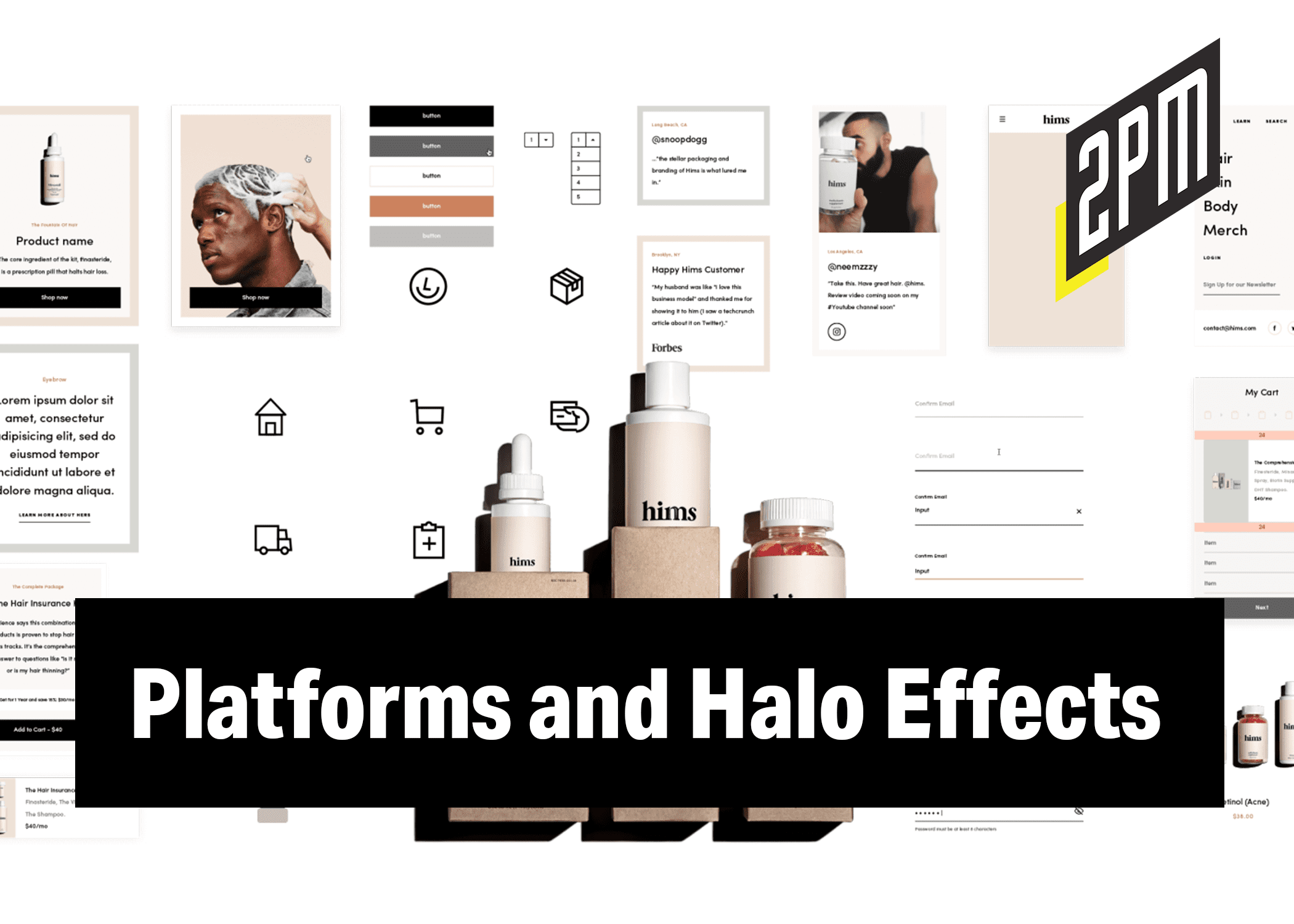
The commerce platform report. The term “halo effect” was first coined by a psychologist in 1920. Edward Thorndike used the moniker to describe the methods that military officers used to assess the performance of their soldiers. These assessments often revealed little variance across the categories of performance. Either the soldiers were good or bad; few performance evaluations noted “good” performance in one respect and “bad” performance in another. It is said that the halo effect is influenced most by a person’s first impression. If we see them as bad, they can do no good. If we see them as good, they can do no ill. Today, this phrase is most-often applied to brands and their equity.
The halo effect is a type of immediate judgment discrepancy. It is the tendency for an impression that is created in one category to influence the opinions of impressions created in another category.
Shopify is seemingly everywhere. In December, Digiday’s Hilary Milnes reported that Shopify’s ecosystem of 20,000 partner developers generated $800 million in agency business in 2017. It’s estimated that Shopify’s partners (several of whom are mentioned here) will earn north of $2 billion in revenue in 2019.
To build a Shopify-like eCommerce platform is not hard to do. What’s very hard to do is replicate the partnership ecosystem and the value they drive. It’s their moat. It’s not the software — their competitive advantage is the partnerships.
Jay Myers, VP of Growth at Bold Commerce
The halo effect of Shopify’s ecosystem will not be easily combated. With many of the partners becoming standout B2B brands themselves, Shopify’s group of independent eCommerce agencies serves many functions: recruiting, evangelizing, and perhaps a bit of espionage – often relaying word of advancements and initiatives proffered by competing platforms. This brand halo effect is amplified thanks to the era of the direct to consumer (DTC) brand.

The brand appeal and staff architecture of this cohort of internet-first companies are keys to understanding why so many challenger brands instinctively select Shopify. Though not a Shopify Partner, Gin Lane’s “work” page notes the many digitally native brands that they’ve steered to the platform. These names include: Harry’s, hims, hers, Sunday Goods, Ayr, Stadium Goods, Rockets of Awesome, Cadre, Recess, alma, Smile Direct, Dia & Co, Warby Parker, Everlane, Quip, Shinola, Bonobos, and Shake Shack. Similarly, Red Antler’s “work” page boasts partnerships with Burrow, Casper, Allbirds, Brandless, Crooked Media, Snowe, and Boxed. These brands, which skew mightily towards Shopify and Shopify Plus, serve as media darlings and public relations fuel.
Tobi Lütke on Twitter
I usually don’t highlight financial milestones here, but this one is worth mentioning: As Shopify passes the $1 billion-dollar revenue mark it does so with the highest growth rate of any SAAS company ever. 🎉
In this way, Shopify’s halo effect extends beyond the agencies with whom they partner. The challenger brands, themselves, become recruiting vehicles for like-minded companies looking to build brands from zero to one. As such, newer companies like Great Jones follow the same branding methods and staff architecture guidelines
On DTC Brand Architecture
It’s common for digitally native brands (DNVBs) to go to market with over $3 million raised. This pre-revenue war chest affords companies an early branding and public relations prowess that almost guarantees seven figures of revenue in the first year.
Partnering with a Red Antler or a Gin Lane can cost a brand up to $400,000. There are often added developmental costs that these challenger brands will have to incur. In addition to the cost for the brand standards, messaging, and the essence of the brand, the right PR contact can cost a young company another $180,000 to $240,000 per year.
No. 297 The DTC Industrial Complex:
There is an entire eCommerce branding industry that fosters the ideation, launch, and early growth of direct to consumer (DtC) brands. When you notice a new digitally vertical native brand in 2018, there’s a platform aura around many of them. First you’ll notice the early PR sensationalism that they can only garner if they graduate from the right school or leave the right corporation. Then, the founders must live in the right city, have the right investors, and pay the right $25,000 per month public relations retainer.
The challenger brand CEO is very well-educated and, at this stage, CEOs tend to start the brands post-business school. Founding teams tend to begin with some combination of a product developer, finance lead, and a customer acquisition lead. Software engineering is an afterthought for many of these young product companies; this competency is often outsourced to a partnering agency. Universally, the priority for challenger brands is two-pronged: (1) making a great product (2) find an efficient way to sell said products. This often reduces the urgency to partner with technical founders or hire early, technical employees. Whereas F = founder, B = early branding, and P = early product development:
F(marketing) + F(finance) + B(outsourced) + P(outsourced) = DTC founding architecture
Shopify’s ecosystem appeals to this particular architecture. The Ottawa-based company’s continued growth depends on their management’s ability to increase the percentage of challenger brands that grow into enterprise clients. And from enterprise clients to Top 1000 online retailers. Shopify’s volume-driven style of business is a mark of its commitment to small business retailers. But it’s not the only method of accelerating enterprise growth. There are several commerce platforms with notable gross merchandise volume (GMV) across their enterprise level of clients.
The Platform Landscape
From BigCommerce to Oracle and Salesforce, the DTC era of retail extends beyond the brands that are the most talked about in design, tech media, and public relations circles. Here is the data on the top nine by gross GMV. While Shopify generates the most media buzz in small business circles: Adobe, Salesforce, and Oracle are quietly leading the enterprise+ business. BigCommerce is often viewed as Shopify’s younger sibling, however their enterprise clients now generate a gross GMV of 2.5x Shopify’s enterprise clients. The following data is derived from a recent Digital Commerce 360 report (2019):
[table id=37 /]
The platform ecosystem is vast. Of the top 1000 retailers, the majority of brands are built in-house and on custom platforms. Nearly 450 retailers have outsourced their technical capabilities to these nine companies. Moving forward, we will likely see platforms like Adobe building tools and an improved halo effect to address Shopify’s key audience and vice versa. Shopify will build tools to address more of the needs of top enterprise plus clients, as well as continuing to support the needs of the DTC brands that are adopting physical retail channels.
Specializing for a particular segment of the SMB to enterprise to enterprise plus spectrum may have dire consequences for platforms in this increasingly competitive space. As Shopify has shown, there is value in building early loyalty. Shopify is counting on a number of their industry-leading number of DTC and SMB retailers moving through the funnel to enterprise services. Additionally, Shopify’s reach grows as brands transition to Shopify from Magento or custom builds. A trend that the Adobe acquisition of Magento has potentially impacted. This continued growth would begin to tip the enterprise / enterprise+ GMV scales in their favor.
Commerce platforms advertise new capabilities with the idea that the technical merits of a platform, alone, will attract new business. To this effect, many of these platforms have deprioritized brand marketing superiority and influential partnership development in favor of technical product development and traditional advertising. Whether or not the improvement of competitor platform capabilities will outlast Shopify’s hard-wired brand loyalty remains to be seen. Objectively speaking, the sheer volume and positive brand association plays in Shopify’s favor. As does their halo effect.
Read the No. 306 curation here.
Report by Web Smith | About 2PM
No. 301: Influencers and Transactional Authenticity

Just when we believed that we reached peak influencer, we are surprised yet again. We’ve favorably covered the “first family of influence”, in the past. And quantifiably, there isn’t a media conglomerate that comes close to the influence of the Jenner / Kardashian family. This week, one of them reached a new level by “bravely” discussing acne – the presentation and build up left a fractured audience in the wake of the brand partnership announcement when it was revealed to be a paid deal.
A day before the reveal, Kris Jenner, the model and entrepreneur’s mother, teased the reveal of her “deeply personal” issue on Twitter. Tabloid speculation run its course. The roll out was optimized for social media but many were left asking: is this really what’s become of influencer-driven advertising? Vox Media covered the advertising “bait and switch” in depth here.

Proactiv’s recent partnership with Kendall Jenner was a test of authenticity. It also may have been a watershed moment for influencer culture. Yes, it’s the most recent example of the status being used to present a vulnerable issue. In this case, adolescent acne. But authenticity is a currency all its own and volume of audience doesn’t always equal magnitude of impact.The controversy around Proactiv’s newest advertising campaign is an early sign that consumers may be beginning to discount command of advertising’s most influential family. Consumer skepticism is the antidote to influencer culture and it seems to be growing.
The focus on influencer authenticity comes as brands have begun to use more “real people” over models and entertainers. Brands are beginning to highlight people just like us but without the modelesque lighting, the photoshopping, or the narrative embellishment. Just scroll through the feeds of Andie Swimwear, Flamingo, or Chubbies for quality examples of this type of visual marketing.
These brands are succeeding because of, not in spite of, their focus on authenticity.
- Andie Swimwear: Swimsuits made by women, for women.
- Flamingo: We make body care, starting with hair.
- Chubbies: The Weekend Has Arrived.
For influencers, the understanding of how partnerships like Proactiv and Kendall Jenner’s come to life diminishes empathy and therefore trust in an ad’s authenticity. This is especially the case in the era of Netflix and YouTube, where star power (influencer marketing) is used to efficiently monetize audiences. Consumers want authenticity.
The successes of influencer marketing is saturating the market. From celebrity influencers to micro influencers, consumers are being inundated by influence. Some influencers are faking brand deals to gain credibility:
Transitioning from an average Instagram or YouTube user to a professional ‘influencer’—that is, someone who leverages a social-media following to influence others and make money—is not easy,” writes Taylor Lorenz for The Atlantic. “After archiving old photos, redefining your aesthetic, and growing your follower base to at least the quadruple digits, you’ll want to approach brands. But the hardest deal to land is your first, several influencers say; companies want to see your promotional abilities and past campaign work. So many have adopted a new strategy: Fake it until you make it.
There are sincere and authentic influencers who are not embellishing their lifestyles or influence. Often enough, these are the media personalities who are slowest to launch merchandise or product lines. Figures like Youtube’s Casey Neistat or pro surfing legend Kelly Slater are having to contend with a very cumbersome question:
How do you build an authentic advertising or commerce model? And how do you do it without ostracizing long time fans and newcomers?
As 2PM has previously covered, there are businesses that focus specifically on partnering with influencers and digital publishers to create, market, sell, and distribute merchandise. We’ve compiled a list of notable commerce partners:
[table id=8 /]
There is such a demand for appealing to influencers and influential moments that an entire industry has address demand.
Taking a page from the eCommerce playbook
As DTC analysts David Perell and Nik Sharma have often cited, the most resilient brands are audiences. And for influencers to maintain their audience, there must be an evolution from the existing structure of often-gimmicky merchandising and advertising via third-party transactors. And to a method that achieves an authentic experience bolsters user experience and belonging.
The technology seems to be mature enough to address this new standard. Headless Commerce services are offered by BigCommerce, Shopify, Adobe, and ElasticPath. These services are helping to define the possibilities of fully-integrated, content-driven commerce.
Alecia, an early headless commerce pioneer, has taken a first step in this direction with their proprietary video platform. From 2PM Member Brief – Headless Commerce:
Alecia is a company that films and streams original content, letting you shop what you see. The app and the site offer a seamless content and commerce presentation for the viewer. As the product appears on the screen, it is offered (in limited quantities) along the right side of the broadcast. If you’re logged in, purchasing is essentially a two click process. Consumers aren’t clicking to an eCommerce site or an external cart. Instead, the shopping cart is a component of a headless operation, an API call to the cloud-based shopping platform that is external to the featured content.
To date, no such solution exists for influencers on major platforms like YouTube, a place where it could have the most value. way content and commerce in media has begun to alter our understanding of which publications have the most loyal audiences. From 2PM No. 280:
The digital landscape is changing beneath our feet. For publishers to continue building organic readership, they must become brands. Operating as a source of content is no longer enough. To do that, efforts can no longer be siloed, the traditional factions of legacy-styled newsrooms must fall.
It’s no longer just about eyeballs and what influencers can charge for their collection of them. Optimizing for transactional engagement could have a positive effect on the influence ecosystem. In order to earn actual transactions, consumers – more often than not – must sense sincerity, community, and loyalty. By improving bottom-of-funnel operations, influencers can address the needs of community members (potential consumers) without disrupting their experiences.
Ready for increased interactivity?
Millennial audiences are ready for built-in video interactions as evidenced by Netflix’s recent success with Bandersnatch, the “choose-your-own-adventure” augmented film powered by remote or mousepad. These types of media experiences shorten the length between watching and interacting.
But Bandersnatch is more than just a blurring of games and TV. Such interactive adventures could easily become a new revenue source, too, through super-powered product placement and eCommerce. With interactivity comes a new slew of data, and the ability to layer in products, product information and ways to buy. You can bet Amazon is figuring out how to ties its billions of dollars worth of programming into its vast e-commerce operation. And just maybe so are Disney, Apple, Warner Media and Walmart.
One company that went unmentioned in Bloom’s rundown was Google. Google has the most to benefit from engineering a headless commerce solution for YouTube. Consumers and creators would both benefit from an experience that allows consumers purchase from the screen without an external redirection.There is one thing that YouTube has built into its platform that Netflix, Disney, Warner Media and Walmart do not: intuitive user control.
Expect to see a continued shift towards interactive formats; while headless commerce opportunities are further down the line – consumers are already being molded to welcome them. But the media engine of this age is the widely beloved influencer. We’re suggesting that we should reconsider how they’re influence is measured. No, influencers shifting to a headless commerce operation won’t immediately prevent media moments like the Proactive “bait and switch.”
Moving influencers away from optimizing for media impressions, social mention volume, and traditional publicity could alter things if and when creators see what can be accomplished when commerce transactions are closer to the starting line. Commerce relationships develop an authenticity that advertising doesn’t quite need. As interactive video technology continues along its adoption cycle, influencer-creatives would stand to gain a lot from building stronger relationships with their audiences.
By moving transactions closer to the top of the top of the funnel, fans and potential consumers won’t be left wondering: what’s the gimmick? Headless commerce can present that solution in a subtle but effective way by leaving the opportunity to transact to the viewer. Consumers demand authenticity from their influencers. This, especially as the lines between genuine interest and earned media continues to blur.
Read your No. 301 curation here.
Report by Tracey Wallace and Web Smith | About 2PM
Tracey is a 2PM Executive Member and Contributor, the founder of Doris Sleep, and the Editor-in-Chief at BigCommerce.