

This member brief is designed exclusively for Executive Members, to make membership easy, you can click below and gain access to hundreds of reports, our DTC Power List, and other tools to help you make high level decisions.
No. 295: Asymmetrical Warfare

The truth is somewhere in the middle. It involves nuance and an unbiased view at the industry as whole to understand what’s occurring, as things change with light speed. The recent article in The Economist paints a pretty picture of a DTC industry. The industry, as a whole, is a lot more difficult than newly-minted retail entrepreneurs would like to think. Two things can be true: (1) stodgy old brands are run by career executives that don’t understand agility or innovation (2) most DTC brands will fail because they are run by former management consultants or recent MBA grads who do not value the powers of brand, relationships, and community.
Asymmetrical warfare: warfare involving surprise attacks by small, simply armed groups on a nation armed with modern high-tech weaponry.
Direct to consumer brands are difficult to scale. The assumption often made is that you can spend on design, manufacturing, packaging, and then acquisition. Spend, spend, spend, spend. Thus, the endless VC raises of $30 million or $50 million or even $100 million. The problem is that while able entrepreneurs can outsource design, manufacturing, packaging, and even acquisition – incumbent brands were built on relationships, consistency, value, and trust. Traditional DtC acquisition channels cannot immediately facilitate trust or value. That part takes an insane amount of work and consistency. It also takes offline interaction, a phenomenon that we’re watching in real time as “nearly 850 stores are due to open in the next five years.” [Forbes]
Industry giants took time to begin worrying about the arrival of game-changing newcomers; barriers to entry in their business are high. But by now the incumbents are stagnating. According to Nielsen, a consultancy, the biggest 25 food-and-beverage companies, for example, generated 45% of sales in the category in America but drove only 3% of the total growth in the industry between 2011 and 2015 (see chart). A long tail of 20,000 companies below the top 100 produced half of all growth.
Economist: Growth of Microbrands Threatens CPG Giants
If you ask Publicis Groupe’s EVP of Innovation Tom Goodwin about direct to consumer (DtC) brands, he will give you an earful. To be fair, defending Procter & Gamble is one of his chief functions. P&G is so important to his employer that they just announced a Cincinnati office to support P&G’s advertising strategies. In a October 22nd article that he wrote, he includes this hearty passage:
DNVBs may be a flash in the pan, they don’t have moats, they have fickle brands, they can die as soon as they fade and we can’t keep talking to the 1/100 companies that make it as anything other than survivorship bias.
He’s not entirely wrong. Just a few days earlier, I’d published an article on DTC brand defensibility where I wrote on how surviving brands established the moats necessary to be more than a flash in the pan. This era of the consumer web is defined by two groups jarring over you: the affluent, intelligent, busy, and principled consumer. We are communicating many of the same elements while landing on two distinct conclusions: he believes that DNVBs cannot last and I believe that they can. Our professional experience shades our opinions here. Five years ago: Jeff Blee, the former VP of buying and planning for Brooks Brothers, commented on an early stage DtC shirt maker:
Unperturbed by the newcomer, there would always be a market for shirts he described as “newer.” And, “any competition was good news.”
The iconic menswear brand has since adopted a Joseph A. Bank discount strategy (four shirts for $200) and Mr. Blee now runs a DtC apparel startup. This war between old and new is not limited to consumer packaged goods, or luggage, or dress shirts, or wooly shoes. It’s everywhere. In a recent article by someone at Business of Fashion (no byline), they discuss the woes of L Brands’ Victoria’s Secret and how “it can save itself.”
And yet, Victoria’s Secret still feels as though it’s stuck in a time capsule: an era when it was okay, even expected, to openly project the male gaze on women’s bodies, when uncomfortable push-up bras with air pumps were viewed as innovative, when people still shopped at the mall. This season’s show felt like an homage to itself. Between set changes, archival footage played in the background.
Their article builds on an earlier report by 2PM, where we laid out the increasing competition faced by the legendary intimates incumbent. What we’re seeing here is an onslaught by new, cheaper-to-run brands that are appealing to the senses and wallets of communities primed to look elsewhere. Not only are companies like L Brands (Victoria’s Secret parent company) and P&G (Gillette’s parent company) and Brooks Brothers competing on a shifting grounds of price, ease, and selection; they are competing on culture (size inclusivity, the “pink tax”, and shifts in where / how we work).
Look no further than the pushback facing the Victoria’s Secret CMO, 70-year-old Ed Razek, who was quoted to have said, “we attempted to do a television special for plus-sizes [in 2000]. No one had any interest in it, still don’t.” Fighting a battle on multiple fronts takes sensible leaders within an organization built for agility. These leaders must also be empathetic to consumers and progress. Needless to say, Razek’s comments were tone deaf and aloof. Currently, several top brands are competing against the L Brands subsidiary by designing and marketing more inclusive products. In No. 271, I wrote that Victoria’s Secret needed an update:
In addition to intimates brands expanding into VS’ territory, there are adjacent pressures from the athleisure market, an evolving beauty market, and the rejection of lingerie by consumers looking for comfort, function, and individuality. Rather than continue competing against the likes of Adore Me (21), THINX, Inc. (31), and Third Love (51), or Savage x Fenty, Victoria’s Secret could re-invest in the brand, messaging, and end-to-end processes by following Wal-Mart’s lead.
The news around Victoria’s Secret’s latest fashion show was, by all accounts, a fiasco. But the solutions are right before them. They should observe the legacy CPG industry. There, innovation often involves: youth, acquisition, and agility. Procter and Gamble is doing just that. The CPG conglomerate recently restructured to form smaller, agile teams and the Cincinnati company is open to acquisitions.
The evolution of the DTC era has more and more brands competing in physical retailers, adjacent to the CPG, apparel, and shoe companies who’ve existed for decades. There are dozens of brands, in each market segment, looking to compete for your dollars. Tom Goodwin is correct in his assessment of many of the brands who have raised exorbitant amounts of capital to acquire customers via paid media.
But that’s not the characteristic of the entire DtC industry. As media buying becomes more difficult for challenger brands, more direct-to-consumer brands will shutter. And competition will become more symmetrical and predictable as the hundreds of new brands narrow down to the sturdier dozen. P&G will shake off much of the newfound competition by adopting many of challengers’ practices (and brand IP via acquisition), as many begin to compete on familiar territory. But there will always be room for the independent challenger brands that get it right.
Report by Web Smith
No. 270: For DNVBs, brand matters.
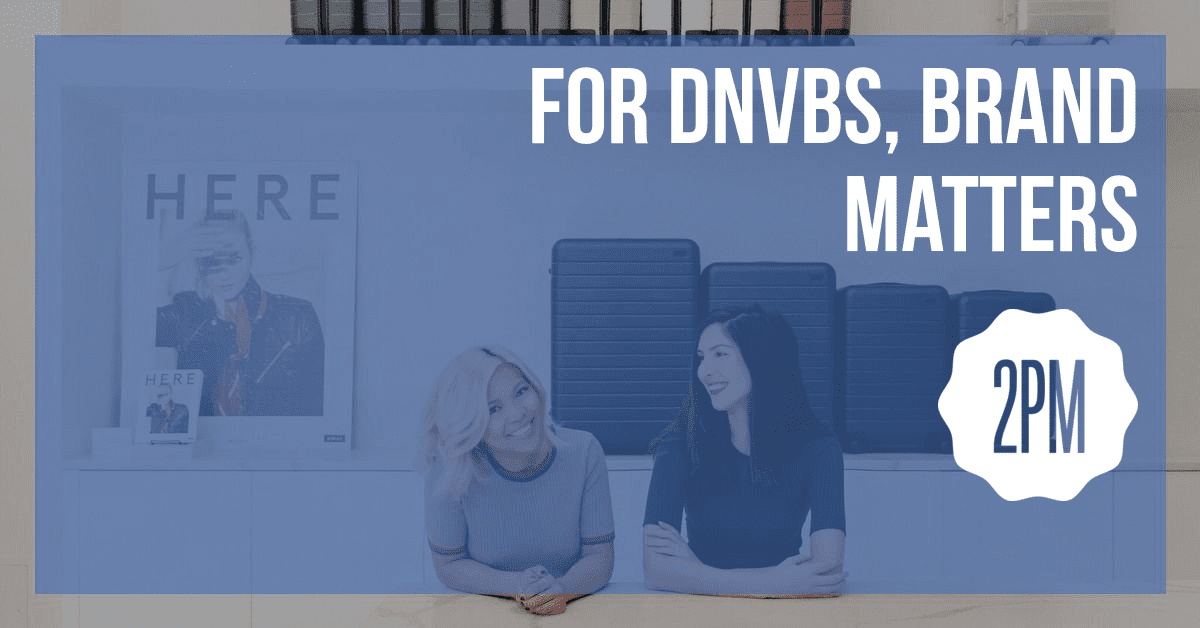
A look at Raden’s shuttering (DNVB No. 119) and Away’s persistence (DNVB No. 40). With the news of Raden shuttering and their founder’s commentary on the online luggage industry’s outlook, 2PM has a deep dive into what may have influenced Raden’s shuttering (it wasn’t just regulation). And Away cofounder and CEO Steph Korey provides commentary on what will shape Away’s bright future.
Founder of Raden, Josh Udashkin had this to say to Conde Nast Traveler about the future of the smart luggage industry:
I hate to say this, but I think [the future] is nonexistent. All these companies rely on word of mouth, but buying this product now gets you hassled. I don’t see how you can continue selling it.
We disagree. Millennial consumers are practical, savvy, and even slightly territorial. These consumers seek brands that appeal to their lifestyles, their timing, their values, and their personal preferences. The narrative matters because their lifestyle matters.
The key to building a strong DNVB can be attributed to perceived quality, price value, and ease of purchase.
Convenience Change + Price Change + Perception of Quality Change > 0
Convenience: ease of purchase, superior customer service, ease of return, and quality warranty.
Price: is the price comparable and or cheaper than the premium incumbent brand prices.
Perception of quality: how is the brand perceived? Is there an affinity for the product?
Whereas, if the DNVB’s sum “change” is greater than zero, the DNVB may be a better option than the incumbent. It’s through this lens that DNVBs and CPG brands have been able to position their products against stodgier, traditional brands. One of the keys to building an online retail presence is emphasizing both components of a winning formula: product and narrative. That narrative communicates quality, community, and brand equity around the product. For DNVBs with $5M or less in total funding, you can argue that the narrative is as important as the product itself.
Issue No. 254: An Open Letter to DNVB CEOs:
DNVB executive teams build two products from scratch, supply and demand:
- The product: the shirt, or the luggage, the pants, the shades, the coats, or whatever it is that people know you for.
- The brand: the aura of that product, the name recognition, the association, the behind-the-scenes partners, the spokeswomen, the ambassadors, the inevitability of success.
Both Raden and Away were founded in the early months of 2015. Raden raised a seed investment from Lerer Hippeau, First Round Capital, and Gin Lane – the famed and de facto kingmaker of DNVBs. Away raised a star studded seed round that included Andy Dunn, the now-Walmart executive who coined the DNVB acronym.
When Udashkin was interviewed by Loose Threads in 2015, Udashkin indicated that product was the entirety of his focus. He went on to add that the product’s narrative wasn’t something that Raden was going to emphasize.
After spending almost a year in the prototype phase, working out of San Francisco, Los Angeles, Montreal, and Taiwan, Raden emerged as a product company that rejected the imagery and celebrity of lifestyle brands.
Udashkin went on to say: “How can you have a lifestyle on day one around your product unless you’re faking it? I think that works in the short term, but over time the customer gets smarter. If you don’t keep working on your product, eventually you lose.”
Cofounders Steph Korey and Jen Rubio took a nearly opposite approach to building their competing brand. In a July 2017 segment in Inc Magazine called “How I did it”, here is what was said about the duo:
Steph Korey and Jen Rubio had a problem. Their planned launch of Away, a new luggage brand, was fast approaching–and none of their suitcases would be ready to sell in time. Luckily, the two had a social media trick packed in their bags. They turned a proven retailing tactic, the preorder, and an idea for a book into a campaign that went viral on Instagram and beyond.
This thinking permeates through their entire product position. Whereas Raden’s Instagram focused solely on the products being sold, Away’s Instagram account features as much lifestyle and usability as it does the products that Away sells.
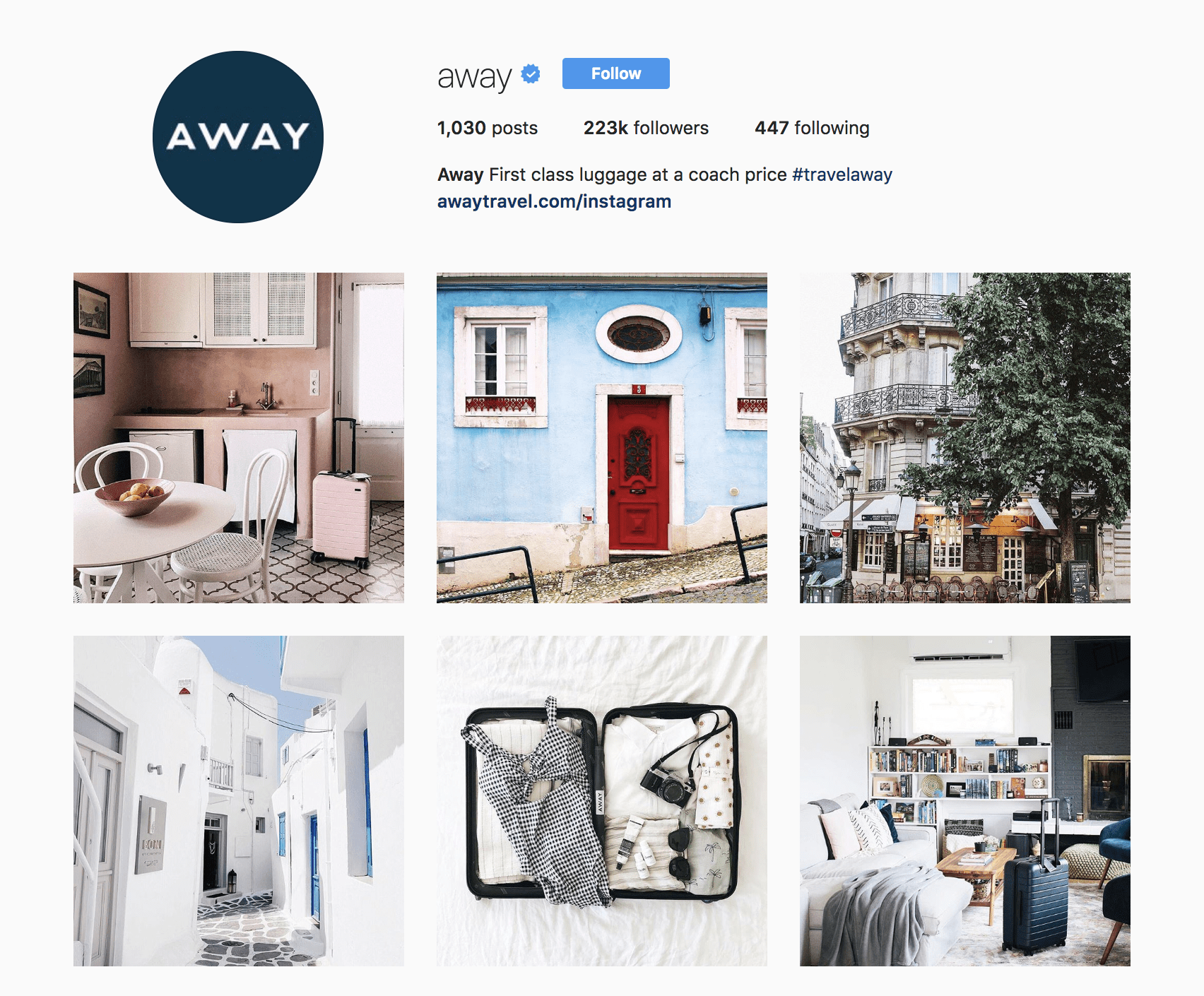
While Away focused on the destination and brand affinity (to include a print magazine called “Here”), the relationship that Raden maintained with customers was altogether different than the one that Away hopes to continue. The difference between the two approaches greatly affected each brand’s product offering: Raden’s was narrow, Away’s is wide. Here’s a pivotal point in today’s featured article by Fast Company:
He walks me through the math. The target market for a direct-to-consumer suitcase brand is relatively narrow. This is not a mass purchase. Your audience is people with enough disposable income to spend between $200 and $400 on a carry-on, but also be digitally savvy enough to be willing to buy the case online, rather than in a department store.
Once the startup has convinced someone within their target market to buy a carry-on, the relationship is basically over. With some persuasion, the brand can try to sell them a piece of checked luggage or perhaps another small travel accessory. But the lifestyle value of each customer is relatively small, compared to other categories. A direct-to-consumer luxury shoe brand like M.Gemi can sell a woman a new pair of $300 shoes twice a year for the rest of her life. Everlane can sell a customer wardrobe updates every month.
Elizabeth Segran, Fast Company
Here Udashkin suggests that he did the right thing by focusing on product superiority alone (just one of the three components to the DNVB formula). But because he saw no value in building a brand and narrative around Raden, there were fewer alternative products that he could offer to his existing customers. This, in addition to his luggage’s immovable battery and the startup’s shorter runway influenced his position that the luggage maker had no choice but to cease operations. He also suggested that there was no market for these types of products in the long run, a far-reaching assertion.
In an email to 2PM, Away CEO Steph Korey explained Away’s position:
A brand’s success isn’t determined by the amount of money it raises, or by any other one thing, but by the right combination of a lot of little things.
For us, it’s been the combination of having a customer-obsessed approach to everything we do (taking the time to listen to our customers, deeply understand what they’re telling us, and then quickly acting on it), being conscientious about the way we introduce them to the brand in the first place (ensuring what we’re marketing will be interesting to who we’re marketing it to, and simultaneously creating a narrative that’s authentic to who we are as a brand no matter the channel or intended audience), and not limiting ourselves to any one product or plan for the future (expanding from one suitcase to dozens of travel goods since launch, and setting our sights on fixing everything that’s currently wrong with the travel experience).
One of the early lessons in DNVB branding is one that cannot be explained by analytics and logic, alone. It’s too subjective. Phil Knight’s once-fledgling shoe operation sold shoes but Nike was never a shoe company: it was a company that enabled champions. Tesla sells cars but Tesla is a company for futurists. Apple sells computers but it’s a company for creators.
For aspirational products, consumers choose brands that fit their lifestyle, belief system, and goals. From the very beginning, Away achieved something that very few DNVB’s understand early on. Building the product is only half of the battle. This means that no matter what arduous regulations they may encounter, they will maintain a canvas to build products that are relevant to their community of passionate, millennial travelers. It’s likely that as traditional sales continue, you’ll see a growing number of SKUs, styles, and add-ons that are beloved by millennial travelers and commuters. Yes, Steph Korey and Jen Rubio sell luggage, but Away is a travel company. And Away will go where she wants.
Updates: On June 26, Away announced the Away x Dwayne Wade collaboration. On June 28, Away announced a $50M round of investment, one of the largest rounds by female founders in history. According to their Comms Director Cassi Gritzmacher:
With this latest round of funding, Away plans to further establish itself worldwide by extending to new markets; continue to expand its product line to create the one perfect version of everything you need to travel seamlessly; expand its physical retail footprint (opening 6 new stores by the end of 2018 in addition to its current New York, Los Angeles, San Francisco, and Austin locations); build on its existing social impact efforts (through its partnership with Peace Direct and through new initiatives); and create 249 new jobs over the next five years, transitioning the team into a 56,000-square-foot new Global Headquarters in its hometown of New York City.
Read more of the issue here.
By Web Smith and Meghan Terwilliger | About 2PM