第 346 期解读 Netflix 的繁荣

Screen Shot 2020-02-10 at 1.10.24 AM

To understand the explosion of the streaming media industry, look at in the context of digital-native brands. To understand the limitations of today’s digital-natives, look at it in the context of streaming media’s growth from fringe idea to Hollywood stalwart.

In 1999, Blockbuster Video was twelve years old with 9,000 stores. Just five years prior, Viacom acquired the company for $8.4 billion dollars. At the time, Netflix was the one-year-old challenger brand. Between the two, we saw the first of its kind. A dynamic between old vs. new and traditional vs. challenger that we would see play out over the next decades between traditional and direct brands.

Timing is everything when an incumbent challenges the titans. On an early January morning in Columbus, Ohio, the former-CFO of Enron Corporation stood before a group of nearly 60 of the city’s entrepreneurs. He narrated the infamous company’s successes, failures, and hidden truths. The Entrepreneur’s Organization commonly hosts keynote speakers but this session was different. We all knew his story. And Andy Fastow was frank in his narration of, he was deeply contrite and his messages illuminated the history in ways that a news broadcast wouldn’t allow – now or then. He walked the audience through the step by step of a company that was unstoppable until it was; he was even more candid in his personal shortcomings. But what you may not have known? Enron played a small role in determining the outcome of today’s streaming wars.

In 2000, Blockbuster Video declined to acquire Netflix for $50 million. Rather, it chose to compete. In doing so, the company agreed to a 20-year deal with that same Enron Corporation to deliver video on demand (VOD) though Enron’s fledgling broadband services division. With this agreement in tact, Blockbuster chose to delay the pivot from bricks and mortar to direct-to-consumer. This was a decision that the company would almost immediately regret.

The Blockbuster executives, who never liked the VOD concept themselves, used the lack of content as their excuse to abandon the partnership with EBS in 2001, saying that they wanted to stay focused on Blockbuster’s bricks-and-mortar stores rather than pursue an online business model. [1]

The difference between success or failure in a category comes down to three variables: (1) timing (2) technology (3) adoption rates. More, in a moment, on the third and final variable. Blockbuster’s timing couldn’t have been worse: Netflix’s DVD business model was catching on and Enron’s team would soon make a decision that would crater an entire company in epic fashion. It was a company that Blockbuster depended on, even if they weren’t in a hurry to do so. It was the typical case of an innovator’s dilemma.

When Enron crashed, Blockbuster’s hopes crashed with it. Their VOD technology was capable but their managers chose not to deploy it, eschewing long-term innovation for short-term profits.  Blockbuster was the first-mover in an industry that we didn’t even know we would need. But the company did not want to expand on that early advantage. By the time that Blockbuster’s c-suite identified the need to compete in the VOD (video-on-demand) industry, it was too late. The technologists of the company wanted to pursue a direct strategy, its managers wanted to maintain the company’s emphasis on physical retail.

The DTC Brand Parallel

The direct-to-consumer moniker has been called into question. You’ll find it used in digital media positioning and in retail branding, alike. But what does it mean to be a DTC brand anyway? One private equity investor called the previous month’s retail news “the trinity of doom” for a cohort of DTCs. You know many of them by name. A number of these brands are coveted portfolio companies held by the brightest consumer venture capital firms in Los Angeles, San Francisco, and New York.
SF3D8Zrw
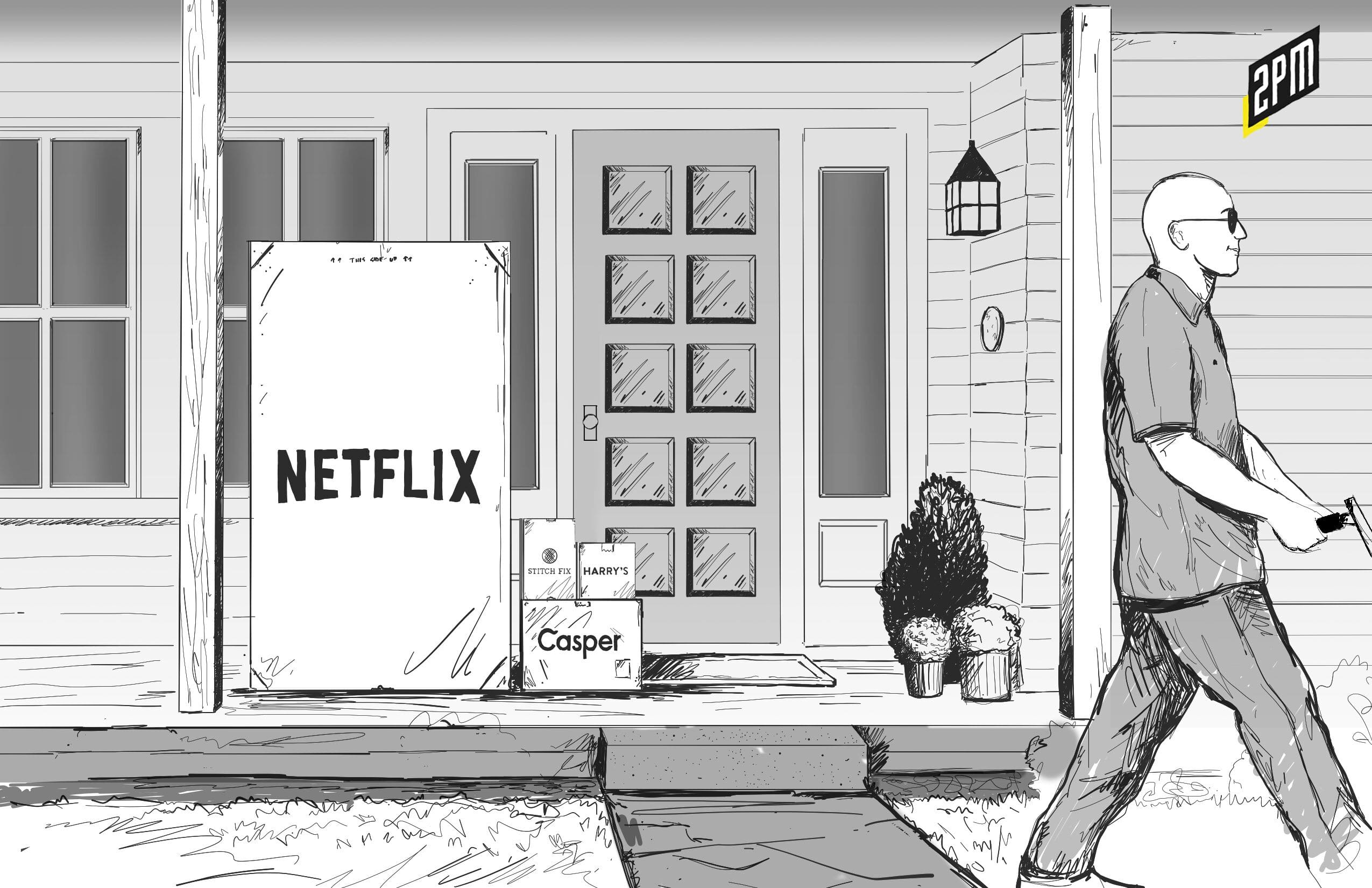
The boxes tell the story: “Ar” for Netflix: .73 / “Ar” for DTC retailer: .12

Venture firms like Forerunner, Lightspeed, Lerer Hippeau, or agency / venture hybrids like Bullish or Science Inc. have investment theses built on the internet as a primary acquisition tool for these modern brands. But in response to the Bain Capital investor who cited the trinity of doom, the veteran venture capitalist replied: “Harry’s is not a DTC brand. Casper is not a DTC brand.” More on this in a moment.

The conversation between Bain Capital’s Magdalena Kala and Bullish’s Mike Duda caught my attention because it illustrated a growing disconnect in the private market. Private equity is the traditional means of scaling a retail brand that one-day could enter public market. Rightfully, Kala sees things her way. It contends with the current state of the industry. Venture capital is about twelve years into democratization of eCommerce retail, a process that has seen more failure than success. Even so, Mike Duda is as gifted as it gets when it comes to picking early winners. In 2007, dozens of digitally-native brands existed. Today, that number has swelled into the thousands. With the accelerating democratization of DTC, both consumer P/E and venture financing roles have grown in complexity.

The first quarter of 2020 was consequential for the DTC industry. Walmart announced that it would no longer acquire brands, incubating them instead. Casper repriced its initial public offering. The stock is trading at just a third of the value that the retailer maintained just a few months prior. And Edgewell Personal Care abandoned the acquisition of Harry’s after it was thwarted by the Federal Trade Commission.   

As was the case in the early competition between Blockbuster Video and Netflix, timing was a factor – Blockbuster was doomed regardless. Here is a super simple visualization of what I see.

(T * Tr) / (Ar)

T represents timing of the product’s development. If the timing is correct, place a “1” at variable T.  Tr represents the technological capabilities of the product. If the technology is good enough, place a “1” at variable Tr. The third and most important variable is adoption (Ar). I wonder if we could say the same about today’s market for DTC exits? Objectively, the percentage of success has been dismal at best.

Emerging industries rely on the adoption rates of key technologies and or behaviors. In Netflix’s case, the higher the adoption of streaming technologies, the easier it becomes to market their services. In this context, around 60% of Americans consume Netflix programming, according to Statista data. The adoption figure (Ar) would be .73 [5]. As adoption climbs, the figure is closer to “1.” The three key variables for emerging technology: timing, technology, and adoption rates for key technology.

Nearly every DTC narrative will be influenced by these three variables: technology (T), timing (Tr), and adoption rate (Ar). Blockbuster’s management would have devoted an enormous amount of energy and resources to influence T and Tr without the Ar to make good on its investment. Streaming, in 2001, was an innovation that the market wasn’t yet ready for. In fact, it would be another six years before Netflix pivoted away from DVD and towards video-on-demand (VOD).

The introduction of streaming was truly radical for that time. Netflix’s pivot to streaming wasn’t all that radical—as we’ll see, it was actually a logical extension of what the company had already been doing. The fact that Netflix was willing to essentially bet the entire company on streaming, however, definitely was radical. [2]

Consumer demand for streaming video was practically non-existent in 2001. Even in 2007, streaming technologies were sub-par. Consumer broadband connections lacked capacity to handle high-resolution video. Even worse, when Netflix went live with VOD, it could only work on computers that were running Windows with an Internet Explorer applet to download before the application would work. Twenty years later and the Ar reflects an ecosystem that is dependent on streaming as a primary source of entertainment.

Jeff Bezos, Netflix, and The 2020 Oscars

推特上的网络史密斯

Netflix outranks ALL studios in 2020 Oscar nominations.

In the first 30 minutes of the 2020 Academy Awards broadcast, Netflix’s programming, Amazon’s technology, and Amazon’s polarizing founder stole the show. Between Netflix’s record number of nominations or the comedic barbs pointed in Bezos’ direction, viewers were reminded that two technology companies maintain a stake in Hollywood’s future. Netflix earned 24 nominations while Amazon earned one. However, Netflix exists on Amazon Web Services, a fact that anoints Bezos the benefactor of Netflix’s seamless growth and the beneficiary of its Hollywood promise.

With the help of AWS and an unparalleled marketing flywheel, Netflix began and remained a pure DTC product and their marketing has become an efficient funnel that reflects this acquisition structure. Hilary Milnes writes:

After leading the Academy Award nominations, Netflix took home two prizes last night at the Oscars: One for Best Supporting Actress, which went to Laura Dern in Marriage Story, a Netflix movie; the other went to American Factory for best documentary. Other entrants, including The Irishman and The Two Popes, were snubbed. [3]

The Oscar telecast was uncomfortable for Netflix, in this sense. The Irishman earned ten nominations and won zero, leading many Hollywood insiders to suggest that Netflix should go the way of DTC brand retailers, eschewing the direct model for the proverbial omni-retail blend. As one Academy member explains, Netflix should leave their DTC model behind:

If Netflix walks into cinema chain offices with a barrel of cash and, say, a 30-40 day window, that might be a game changer. Financially it would behoove them to give away most or all of its box office receipts on one or two movies a year in exchange for a distribution release that doesn’t rely on music halls and sub-basement art houses for its theatrical run, which might in turn result in a date with the Oscar podium every February. [4]

This would be a grave error. While winning awards is always the preference, I’m not entirely sure that it should be Netflix’s KPI. Awareness and mentions are the key performance indicators; in this way, award nominations and traditional hype cycles may suffice. This allows Netflix to continue growing without spend attrition: advertising for an outcome that may not affect bottom line sales. A theater distribution model increases spend attrition, lowering the LTV of Netflix consumers by allowing viewership without membership tie-in.

There is only one way that viewers can consume Netflix content. Any organic mention of its programming operates as a super-charged sales funnel. The award show appearances have and will continue to grow Netflix users while solidifying the platform as a venue for original, Hollywood-caliber content.

This strategy also allows the media company to continue its unparalleled data collection practice, perhaps the one true advantage of a pure, DTC strategy. Similarly, Harry’s and Casper initially set out to build direct-to-consumer companies but eventually yielded to traditional distribution as customer acquisition costs rose and growth became less efficient. One could argue that the market wasn’t yet ready for direct brands. While the two sub-categories have similar delivery mechanisms, the Ar was drastically different: .73 vs .12.

Netflix, Amazon, and the cadre of streaming services have a future in critically-acclaimed film production; the market is accelerating in that direction. In 2023, Statista projects that Netflix will have 177 million viewers in America. In contrast, cable channels like ESPN have lost nearly 20% of subscriptions in the previous five years. This trend plays in streaming industry’s favor.

Meanwhile, analysts like Matthew Ball suggest that theaters have their own concerns to consider. Frankly, film-goers are showing up for fewer Oscar-quality performances. The box office is growing thanks to “theme park movies.” Ticket sales are falling, however.

The challenge is more fundamental: The role of the movie theater has changed. What used to be a forum for all types of art is now largely the domain of “theme park movies”—Avengers: Endgame or Star Wars: The Rise of Skywalker—and “museum pieces,” such as 1917 or Get Out. And audiences have ruthlessly high thresholds for both. [5]

In 2020, Netflix led all studios in Academy Award nominations and yet, the platform has yet to realize its “Hollywood Boom.” It merely hasn’t happened yet. As the economics continue to shift in Netflix and Amazon’s favor, there could be a future that requires Netflix economics for critically-acclaimed works. Ar is moving closer and closer to “1.”

And this is the difference between Netflix’s fortunes and that of today’s direct retail brands. Whereas as 60% of America streams Netflix content, only 12% of retail is transacted through eCommerce. Technological adoption rates are critical. Consider if the foot traffic of American malls, at mall retail’s peak. Now imagine that horse and carriage was America’s primary means of family travel, at that time. Or imagine the lacking network effects of Twitter, Facebook, or Snapchat in an America that chose to stick with the tech stack of the Motorola Razr. Or remember that General Magic was well-ahead of its time, inventing touch screen dynamics before processors allowed for their prowess.

Consider this excerpt from the FTC’s comments on the now-thwarted Harry’s acquisition:

Any new entrant would lack Harry’s early-mover advantage in the now-mature DTC space and on the now-crowded shelves of brick-and-mortar retailers.

As Mike Duda mentioned, DTC is a misnomer for most physical goods. Harry’s early-mover advantage wasn’t much of an advantage at all. Neither was Casper’s. Like many of their venture-backed peers, both companies set aside their DTC strategies for costly omni-channel growth. Imagine if the United States was at a point where, like China, eCommerce was closer to 40% (Ar = .4) of all retail volume. Harry’s wouldn’t have needed shelves of brick-and-mortar retailers at all. And it’s likely that the FTC would have permitted the acquisition to move forward. The competitive pricing effect of Harry’s moving into physical retail was the primary citation against the brand.

In this way, Netflix’s current success is somewhat of a glimpse into the future of brand retail. Reed Hastings’ instincts were special; he evolved his technical specifications for a market that was awaiting the Netflix that we know today. Timing is everything when challenging the titans. The direct-to-consumer strategy works. As history suggests, the adoption rate of consumer technology is a greater influence than we give it credit. Study those figures and you may understand the future of an industry.

The shift from physical-to-digital commerce is evident within the streaming media industry. Actresses are thanking Netflix in acceptance speeches and Jeff Bezos is laughing at divorce jokes in an A-list audience of awards shows. By comparison: thousands of direct brands are competing over what amounts to just 12% of all retail volume. In this way, DTC brand retail is closer to the Blockbuster Video phase than the Netflix era that succeeded it. The writing is on the wall in yellow and blue.

Report by Web Smith | Art: Andrew Haynes | About 2PM

第 344 期首次公开募股与 "前沿理论"

2PM-前沿-民主

成千上万的淘金者乘坐飞机和轮船来到加利福尼亚,追逐财富。他们被称为 "49人"。1848 年 3 月,800 名非本地人前往加利福尼亚。到1848年底,这一数字激增至2万人。到1849年,这个数字达到了10万。淘金热是美国最早的边疆理论 范例之一历史学家弗雷德里克-杰克逊-特纳(Frederick Jackson Turner)于1893年撰写了一篇文章,阐述了美国的经济实力和活力与走向边疆息息相关。

我对 "前沿 "的定义是,在开放式、高潜力的金矿开采中,大量拥有不同技能、教育水平和阶级背景的人在大致平等的条件下并肩工作,由此产生的社会分化。[1]

这条 边界线是已知与未知的分界线,它推动了商业、行为经济学、政府和社会科学领域的创新。当然,现在已经没有任何物理边界了。如今,这条界线已经具象化。对于任何新兴产业而言,这些行为都会以可见和不可预见的方式重复出现。直接面向消费者的品牌已经开始在风险投资的支持下走向成熟。与过去的实体边界一样,这条新的分界线也具有许多相同的特征--不确定性就是其中之一。

在淘金热中,真正赚钱的不是矿工。他们是工具制造商,是为成群结队的矿工制造致富所需工具的工人。 我们记得列维-施特劳斯公司,但很少有人记得当时的顶级金矿工人。工具制造者发财了,而绝大多数矿工却空手而归。他们甚至连工具都没有带回去。俗话说:要么挖金子,要么卖镐头。 与商业工具本身一样,风险资本最终也涌入了品牌零售业。这不仅影响了谁能扩大规模,也影响了公司扩大规模的方式。

不过,所有技术驱动的客户渠道的问题在于,人人都可以使用这些渠道。事实上,当涉及到平台和聚合器时,技术集中的反面就是堆栈中其他所有人的民主化和商品化。截至 2019 年 8 月,共有 175 家不同的在线床垫公司。[2]

在一架从俄亥俄州飞往明尼苏达州的航班上,坐在我右边的是一位推销员,我们称他为戴夫。"你想开一家床垫公司吗?"他似笑非笑地说道。喝完第三杯威士忌后,他打开笔记本电脑,露出一张有近 100 行数据的电子表格,说:"看看这个。"我很感兴趣,眼角的余光立刻认出了其中的几家公司。其中,Casper 名列榜首。戴夫是一家为许多顶级品牌生产床垫的公司的员工。我惊呆了。"等等卡斯珀不生产自己的床垫?我问道。戴夫接着问我是否想知道如何开始。我很好奇,他就给我讲了一遍。

建立一个网站,使用 Spotify [SIC] 或其他软件。预售 800 美元的床垫。以 400 至 500 美元的价格从我这里购买。我们会在售出后三周内给你送货。如此反复。

戴夫是众所周知的 "锄头贩子",DTC 时代是他的淘金热。据他说,卡斯帕是他公司的众多客户之一。我不相信戴夫的话,直到我读了卡斯帕公司的 S-1 文件。他说得没错,卡斯帕公司自己并不生产床垫。近 200 家竞争对手中的绝大多数也不生产床垫。相反,卡斯珀团队从供应商那里购买床垫,然后再标价转售。

虽然我们的大部分产品设计都是内部开发的,但某些泡沫配方目前是根据我们与某些合同制造商签订的生产协议从他们那里获得许可的,其中有些协议包含不同程度的独家代理权。[3]

这家制造商并不是唯一的镐卖家。虽然Casper.com是一个定制购物车,但大多数数字原生代都是在 Shopify 生态系统中建立的。这反映了现代零售业的整体情况,它受到了最伟大的镐卖家的影响。

风险投资以多种方式颠覆了零售业。想象一下,在 20 世纪 90 年代,一位企业家通过筹集风险投资来创办一家服装、鞋类或床垫公司。这种想法是不可思议的。但零售品牌并不是新事物,其工具才是。2006 年以前,这类企业寻求其他资金来源:私人贷款、信用额度或亲朋好友融资。他们在开始时往往认为单位经济效益是最重要的。有些企业决定依靠现金流发展。盈利越早越好。

如果这些公司真的上市了,那也是在几十年后,而不是几年后。拉尔夫-劳伦公司(Ralph Lauren Corporation)成立于 1967 年,30 年后才上市。耐克公司也是如此,这家零售商在成立近 16 年后才上市。在俄亥俄州哥伦布市,也有许多专业零售商走过了同样漫长的上市之路:Express、L Brands、DSW 和 Abercrombie & Fitch就是其中几家。

推特上的网络史密斯

关于品牌上限和价值。1967:RL 成立。1994:高盛以 5.2 亿美元的估值收购了 @RalphLauren 28% 的股份。1997:RL 在 30 年后以 24 亿美元的估值首次公开募股--其中有不少是亏损的。2020:88 亿美元市值(1.3 倍收入) 摘自 S-1:

就像寒武纪大爆发 一样风险投资为各种平台、应用程序、物流服务和包装解决方案打开了大门。它还开发了一种新的零售业态,一种基于超高速增长的零售业态。进而,风险资本家开始为建立在此基础上的公司提供资金。对于未来的零售业创始人来说,创业门槛达到了历史最低点。而在同一时期,风险资本的融资能力也达到了历史最高点:2014 年。过去十年的电子商务既是工具的销售,也是金块的挖掘。

不过,虽然风险投资对镐头的破坏是好的,但也可以说它对矿工的破坏是坏的。在 DTC 时代,并购很少,上市更少。即便如此,Stitch Fix 总裁迈克-史密斯(Mike Smith)认为,保持私有化是许多此类品牌的最佳选择。他向Recode 的Jason Del Rey 解释道:

你应该成为一家上市公司吗?在很多情况下,我的答案是否定的。你必须在公开市场上拿出你的看家本领。你可以躲在私人市场,把大量风险资本花在 Facebook 上。

对于今天的数字原生品牌来说,当他们接近新的前沿领域时,他们的思维和行为将与当代同行大不相同。因此,Casper 的首次公开募股将成为数字原生品牌时代的风向标。在没有现实盈利途径的情况下,它们能上市吗?这种想法有其不利因素。在下面这些推文中,我总结了大部分熊市论点。

无标题

无说明

卡斯珀的管理层必须让华尔街相信,他们有能力做到很少有品牌做不到的事情:他们必须 "拥有这个品类",并且能够盈利。这其中有两个障碍。这就有点技术性了。

相似之处卡斯珀和床垫公司

基于消费者的企业估值。 在公司的 S-1 中,他们选择不报告同期收入数据。但有几个关键数据非常突出14%的顾客在购买后一年内退货。在 S-1 报告中,Casper 引用的是回头客,而不是销售额。据风险投资家亚历克斯-陶西格(Alex Taussig)称,该公司的年美元留存率仅为 6%。他们的回头客几乎为零。

根据市场营销学教授丹尼尔-麦卡锡(Daniel McCarthy)的研究,Casper 的平均订单价值(AOV)为 867 美元,重复 AOV 为 87 美元。这是基于 80% 的订单都是主要 AOV,重复 AOV 为 87 美元的假设。867 美元销售额的客户获取成本(CAC)为 324 美元。 在引人入胜的营销数学中,麦卡锡教授列举了五年客户价值为 455 美元,终身价值(LTV)为 131 美元:

看涨者可能会指出,商店是降低 CAC、追加销售和提高供应链效率利润率的一种方式。熊市则会指出,后期采用者更难引入,竞争也会加剧。

回到我们开始的地方。 卡斯珀以直接面向消费者的送货方式颠覆了传统零售业,而现在,它的最大希望是实体零售业。在 Casper 推出的一年内,出现了两起值得注意的事件。当然,Casper 很快就扩大了其直接面向消费者的模式。而床垫公司(Mattress Firm)则投资了一家实体公司,因为卡斯珀的 DTC 产品在第一年就创造了近 1 亿美元的销售额。

[床垫公司]在2015年以7.8亿美元收购零售连锁店Sleepy's的决定制约了它的发展。Mattress Firm没有投资数字工具和运输基础设施,而是在错误的时机扩大了门店数量。[4]

Mattress Firm 的零售收购使该公司的零售店数量过多(近 1000 家),而当时床垫盒装零售的客户收购套利正达到顶峰。仅一年后,Steinhoff International 以约 1 倍的总收入收购了 Mattress Firm。

南非零售商斯坦霍夫国际控股公司(Steinhoff International Holdings)和美国最大的专业床上用品零售商 Mattress Firm Holding Corporation 周日表示,双方将以 38 亿美元(包括债务)的价格收购该公司。这笔交易将创建全球最大的床垫零售分销公司。[5]

2018 年,Mattress Firm 申请破产保护,开始重组进程,关闭了公司 3230 家门店中的近 700 家。实际上,破产开始抵消了 2015 年收购Sleepy的糟糕时机。随着 Mattress Firm 的收缩,Casper 希望获得自己的份额。根据卡斯珀的 S-1,实体零售是其增长的主要组成部分。

事实证明,我们在实体零售店的业务与我们的电子商务渠道相辅相成,因为我们相信与多种渠道的互动产生了协同 "网络效应",从而提高了整个系统的销售额。零售店扩张的持续成功将对我们未来的增长和盈利能力做出重要贡献。

问题在于,卡斯珀能否说服华尔街的投资者,让他们相信他们攫取 Mattress Firm 价值的计划是可行的。虽然卡斯珀的睡眠经济愿景更为宏大,但 Mattress Firm 2019 年的年收入为 32 亿美元(根据 Steinhoff International 的数据)。为了抓住这一机遇,他们可能必须从内到外重建公司。

卡斯帕公司拥有近 700 名员工,没有自己的产品制造部门,是一家不生产自己产品的大型产品公司。这一点在其一般及行政费用类别中显而易见。卡斯珀的一般及行政开支是销售额相近的紫罗兰的 5 倍(1.062 亿美元对 1910 万美元)。为了抓住现有竞争者的价值,抵御挑战者,卡斯帕必须提高竞争力。卡斯帕要想成为 "品类拥有者",就必须在内部变得更像耐克。耐克创始人兼首席执行官菲尔-奈特(Phil Knight)说得好

战胜竞争对手相对容易。战胜自己则是一项永无止境的承诺。

更精益求精的 "睡眠耐克"


屏幕截图 2020-01-13 at 5.17.05 PM
在线床垫零售份额 | 资料来源:Rakuten Intelligence:乐天情报

比较始于《福布斯》上的一段话。2016 年,也就是 Mattress Firm 被收购的同一年,Casper 的联合创始人 Luke Sherwin 阐述了他对公司的愿景。在接受罗恩-罗夫(Ron Rofe)的采访时,谢尔文解释道:

卡斯伯对睡眠的贡献就像耐克对运动的贡献一样。我们希望让睡眠成为一种生活方式,让睡眠环境成为您生活的重要组成部分。

在提交的证券文件中,卡斯珀通过扩大床垫以外的可寻址市场总量,为解决产品商品问题奠定了基础:

随着健康等式越来越多地包括睡眠,睡眠业务也在不断增长,并演变成我们所说的睡眠经济。我们正在帮助加速这一转变。我们的使命是唤醒一个充分休息的世界的潜力,我们希望卡斯珀成为改善我们睡眠方式的一流产品和体验的顶级品牌。

耐克公司拥有 17.9%的鞋类产品,其营销和广告支出占总收入的 10%。卡斯珀拥有 5%的床垫,却将高达 33%的收入用于市场营销。如果没有资本效率和短期盈利能力,Casper 就无法模仿它所向往的品牌。要想成为 "睡眠界的耐克",卡斯帕必须变得更像营销和销售界的耐克。他们必须在高效获取客户的能力方面领先于行业。我的建议很简单:完全抛弃 DTC 行业。有了与亚马逊、塔吉特、沃尔玛和好市多(Costco)的合作作为坚实的基础,卡斯伯可以通过以下方式向更精简、更有利可图的模式转变:

  • 强调与第三方销售商的销售和分销关系
  • 从短期绩效营销转向品牌营销战略

尽管卡斯珀的融资估值已达 11 亿美元,但就在 2019 年 3 月,该领域内及其周边的大多数公司的 EBITDA 或收入的交易价格为 10-20 倍或 1-2 倍。对 Casper 来说,这意味着初始市值为 5-6 亿美元(他们已融资 3.39 亿美元)。仅在这份报告中,就有两个可比公司值得考虑:拉尔夫-劳伦公司(Ralph Lauren)的息税折旧摊销前利润为 1.4 亿美元,市值达 20 亿美元。Mattress Firm 上市一年后,市值为 19.1 亿美元,EBITDA 为 24 倍。

为了实现盈利,Casper 必须 "战胜自己",就像战胜市场上的其他挑战者和现有竞争者一样。他们必须像以前的早期零售商一样建立自己的公司,那时候风险资本还不充裕,CAC 也还没有上升。只要每年将总务和行政开支减少哪怕 5000 万美元,他们就能接近收支平衡。通过将营销支出从数字优先转向第三方合作,Casper 可以在第一年就实现息税折旧摊销前利润(EBITDA)正增长。

卡斯珀采用了多年来一直困扰 DTC 行业的技术邻近型模式:募集巨额资金、在纽约或洛杉矶设立办事处、过多的营销支出(相对于总收入而言)、高昂的高管薪酬、优质房地产租赁以及初创企业的福利待遇。通过减少这些开支并转向第三方销售,Casper 可以成为向华尔街宣传的上市品牌。Mattress Firm 等现有竞争对手将欢迎 Casper 与Sleepy's、Purple 等公司合作。与上述每一家零售商合作,卡斯珀都能为他们的商店带来新的顾客。

以 5000 多万美元的息税折旧摊销前利润(EBITDA)计算,Casper成为他们憧憬的价值 10 亿美元的品牌。就像开疆拓土的淘金者一样,菲利普-克里姆(Philip Krim)和他的团队可以为Away和Glossier这两个有IPO意向的数字原生品牌规划前进的道路。为了在公开市场上竞争,这些品牌必须以更传统的方式运营。

DTC 时代经历了十年不择手段的营销和往往被过多风险资本掩盖的低效运营。作为私营公司,只要能筹集到资金,这种情况就会持续下去。但现在,它们已经走到了尽头。这在某种程度上是对 DTC 行业的一次清算。当矿工们来到这里时,他们通常会选择把带来的东西放在一边。对一些人来说,那是贵重物品,而对其他人来说,那是自我价值的膨胀感。在边疆地区,牺牲和不适是必须的,关键在于你用那把昂贵的镐头带回家的是什么。

研究与报告:Web Smith | 编辑:Carolyn Penner |关于 2PM

注: 在此订阅,将于美国东部时间周二下午 2 点收到第 344 号信件。

第 336 期:"更多的循环

There is a subtle trend bubbling beneath the Rothys and Veja’s of urban dwelling millennials. There is a rise in 20 and 30-something workers who choose to take mental health days off from work, citing burnout. CBD-based goods are commonplace throughout specialty retailers’ checkout lines. Meditation apps and hardware are tipping into the mainstream. Rather than the consumption of more and more goods, high-earning millennials are choosing to take time off instead. This shift in priority is in-line with another: the boom of companies pursuing valuation arbitrage by identifying new paths to growth. WeWork, perhaps the case study par excellence of this business cycle crashed –  on demand  – with the help of an angry, financially-free NYU Professor with nothing to lose.

Two trends lead this report: (1) the shift towards mental minimalism and (2) the shift away from the business cycle of more. In a January report in BuzzFeed News, the first of the two began to pick up steam in the mainstream media:

So what now? Should I meditate more, negotiate for more time off, delegate tasks within my relationship, perform acts of self-care, and institute timers on my social media? How, in other words, can I optimize myself to get those mundane tasks done and theoretically cure my burnout? As millennials have aged into our thirties, that’s the question we keep asking — and keep failing to adequately answer. But maybe that’s because it’s the wrong question altogether. [1]

Each daily task, job, extracurricular event, and hobby shares many of the same traits with one another. Bigger, more, faster, more, better, and more. Rarely is any daily occurrence simple, small, or inconsequential. And it’s beginning to show. If you’re reading this, you’re likely thriving in an environment where you Peloton or Tonal before work, Uber Black while answering emails on $2,000 MacBooks, micro-dose to become “limitless,” intermittently fast to optimize for your fitness, and then work twelve hour days to pay for those $3,500 monthly leases. Frankly, we are all burnt out. And there is a connection; brands are beginning to reflect the empathy towards this behavioral undercurrent.

It’s easy to understand, then, why so many of us are so angry. The WeWork’s of the world were built on an ethos of positive vibes and unity — replete with what tech analyst Ranjan Roy calls “high-minded, burning man-esque self-actualization language” that, today, feels offensively out of sync with people’s lived realities. So why would Pattern, or any company that applies a superficial layer of burnout-conscious buzzwords to its products, be different? [2]

Consumer psychology involves the interest in lifestyle, behavior, and habit. It’s an all-encompassing study that considers our idiosyncrasies, our temperaments, and even our subtle personality traits. These are the variables that influence our behaviors as consumers. Psychographic segmentation is the analysis of a consumer cohort’s lifestyle with the intent to create a detailed profile. [3]

Pattern Brands, the group behind Gin Lane (RIP), is at the forefront of this trend identification. The legendary creative agency that developed the mold for millennial consumption by advising Hims, Harrys, Dia & Co, Ayr, Bonobos, Shinola, Stadium Goods, and Rockets of Awesome is pulling back on the messaging that influenced the “business cycle of more.” With a bit of hindsight, it makes sense that Recess and Haus were two of Gin Lane’s final DTC projects. It’s as if they were telegraphing their plans to focus on a new era of messaging by concluding their successful run with two “mindful” brands.

What does this mean for DTC brands?

In the last months, Everlane launched its impact-free shoe, Allbirds released a Rothy’s look-alike, Rhone launched a credible competitor to Mizzen+Main and Ministry. And Away began laying the groundwork for a consumer packaged goods (CPG) operation. It was once common for brands to believe that they could build a defensible growth path by identifying one product-need and one consumer identity. [4]

Scale fast, scale there, scale now. This is the executive mantra of many of today’s top digitally brands. Many product manufacturers began with a single, key product. They then expanded into a growth path befitting that of a traditional category brand. Though, most DTCs have done so prematurely. In contrast, successful traditional brands expanded beyond their initial focus after a decade or more in business.  In this era of retail, the move from product-to-category happens in just a few years. Founders hire product talent to stay atop a growing diversity of SKUs – many of which were barely intended upon the start. Imagine a shoe company designing luggage or a luggage company designing dress shirts, for instance. For a generation of consumers, the business cycle of more isn’t just student loans, rising rents, or WeWork’s demise. It’s also representative of the brands that we consume. Every brand seems to be out to get bigger, faster, and stronger – a subsconscious reminder that we are to do the same. This is beginning to change.

In a recent conversation between AdWeek’s Ann-Marie Alcántara and I, we discussed these concepts in a marathon of off-the-record discussion. To combat the hyper-growth narrative required to achieve venture funding, the early stages of  today’s upstart brand would resemble more of a publisher or community than a retailer. The rationale is simple: a customer is fleeting, a community lasts. This is most often reflected by brands with stronger organic presences. Brooklinen is the example of the hour.

Brooklinen: A “Bedroom” Brand

No longer just a bedding brand, Brooklinen wants to own the bedroom much like Away aims to own travel. Their strategies diverge from there. Brooklinen is in a class of digitally native bedding companies to include: Parachute Home, Buffy, and Hill House Home Inc. Founded in 2014, the company reported nearly $60 million in 2018 sales; the wife-husband duo has only raised $10 million to date, a capital constraint that likely influenced their growth path from product company to category presence. In this case, capital constraint proved an effective growth mechanism.

Screen Shot 2019-10-28 at 3.51.34 PM
From: earthy-minimalist at Brooklinen

In contrast with many of today’s top digitally native brands, cofounders Rich and Vicki Fulop shunned the traditional “category expansion” playbook in favor of a two-way marketplace format that compliments the aforementioned trend undercurrents.  Consumers will reward the brands that offer value without trying to do it all. As such, the launch of the Spaces marketplace gained wide media attention thanks to savvy messaging from the founding team and public relations work by Ogilvy’s Lindsey Martinez, Brooklinen’s public relations firm on record.

Spaces will feature 100 products by 12 partner brands (in addition to the total 89 products created by Brooklinen). Designers will include some independent artisans, as well as recognized brands such as Simply Framed, The Sill, Floyd and Dims, among others. [5]

The launch piqued the curiosity of a number of industry observers who weren’t yet familiar with Brooklinen’s marketplace partner RevCascade or the SaaS company’s tech stack. Rather than expanding beyond the brand’s 89 SKUs by developing or white labeling other in-category products, Brooklinen partnered with RevCascade to launch a two-sided marketplace. With a monthly average of 600,000 – 650,000 visitors with purchase intent, offering complimentary products from fashionable brands like The Sill accomplishes a few things: it monetizes existing traffic while rounding out the consumer’s interpretation of how Brooklinen fits within their lives.

Brooklinen expanding to a marketplace isn’t necessarily a new concept, according to Web Smith, the founder of retail research platform and community 2PM. It’s what Smith calls linear commerce, in which a brand uses an existing audience to monetize further revenue, growth and traffic. [6]

Is Brooklinen any less of a category brand than Casper? The short answer is no. In fact, the market may reward the bedding company for its two-way market strategy. RevCascade provided the tools necessary for Brooklinen to launch a hybrid marketplace that featured (1) wholesale (2) direct (3) and drop-shipped merchandise. In this way, Brooklinen’s approach is reflective of the Law of Linear Commerce.

With so many new brands in different categories, it’s difficult for any company to “cut through the clutter,” Fulop said.

Brooklinen’s founding team paired an existing audience (of 600k MAU) with an additional commerce opportunity. In their case, they did so without any additional hiring, development, or marketing hindrances associated with new product launches. With their approach, they offer new products while maintaining their focus on the production of quality textiles.

In a comment to 2PM: Josh Wexler, cofounder of RevCascade:

RevCascade enables any retailer, eCommerce merchant, or publisher to launch their own curated marketplace or dropship program to elevate their brand, better serve their consumers, and generate new revenue with zero inventory risk. Brooklinen’s approved brands (aka sellers or suppliers) use RevCascade’s “onboarding wizard” to create their profile, upload inventory, and set shipping preferences. In parallel, by leveraging RevCascade’s automated Shopify integration for product data, inventory updates, and transaction data, Brooklinen was able to launch their marketplace in less than 30 days

Anchored by a strong affinity for the company’s core products, Brooklinen gained a competitive advantage by both measures: DTC and marketplace. Consider Verishop, a popular, well-led, and well-capitalized marketplace that launched in July of 2019:

[table id=49 /]

Whether we are discussing Pattern Brands’ approach to remedying burnout culture or the cycle of more’s influence on an ever-crowded market of high-growth brands, Brooklinen’s partnership with RevCascade may serve as a path forward for many of their counterparts. Consumers have grown weary of companies that are looking to grow for the sake of growth. To these consumers, it’s a reminder of their own fast-paced, high-pressured lives.

Consumerism will always exist in some form or the other, but the clutter of brands looking to grow to the next milestone may fall out of grace with many. From Marie Kondo to Core Meditation, clutter culture has become a catalyst for burnout remedies. Experiences that provide ease, value, and simplicity will be rewarded in today’s market. It is a brand’s responsibility to contribute to the solution and not to the cycle of more.

Read the No. 336 curation here.

Report by Web Smith and edited by Tracey Wallace | About 2PM