备忘录关于乐观主义和远大理想

Stonks

By now, your company has been impacted by an historic period of health risk and economic uncertainty.  It’s for this very reason that I hope that you take a moment to unfurl yourself from the anxiety of it. This is a memo on making time for optimism, connectivity, and opportunity. It’s also about the power of ideas. Like many other 2PM reports: it’s one part practicality, one part historical context, and two parts analyses.

The first 2PM letter published four years ago, this week. You’ll notice a few things when you look back at it. If by chance 2PM gives off the impression of amateurism today, we didn’t stand a chance in March of 2016. But objectively speaking, you’ll see that the publication, its depth, and the polish have come a long way.

The majority of the operation rests on my shoulders and even so, there is a tremendous amount of work left to be done on a weekly basis. Four brilliant associates join me in refining the 2PM product. Andrew Johnson, Andrew Haynes, Hilary Milnes, and Vincenzo Landino help to professionalize a product that competes with venture-backed publishers and well-run media companies that employ dozens. And Tracey Wallace has been pivotal to its maturation.

Each week, I focus on a number of tasks to keep costs sustainable: I publish two longer-form essays (4,000+ words / week), maintain twelve databases, manually curate and publish three newsletters, direct creative, research and build new databases, and I manage 2PM’s Polymathic community. Additionally, I work with a number of companies in which 2PM is connected. In the past year, those relationships included: Alibaba, Verizon Media Group, The Chernin Group, #Paid, and BigCommerce. And lastly, on any given week, I answer 200-350 emails from founders, executives, and other operators. This model works because Executive Members invest in the future of the company. That said, the past week was one of the hardest that I’ve experienced in the company’s four years. Not only did growth come to a halt, attrition spiked.

What I’ve learned from our current circumstances isn’t so different than what I learned in 2009 after the downturn came after the best professional shot that I had. Losing that job meant that any hope for normality for my then-family of three was on pause. For a time, it felt like it would always be that way. It was my first job out of school. And only had that job for 19 months and with a two-year old in tow. The weight of it all would push us to our cognitive and spiritual limits. Anyone who experienced The Great Recession understands this; it was horrible time. To power through professionally, I would lean on five important lessons.

  • No. 1: Optimism is a talent.
  • No. 2: Dynamism is required because inaction is failure.
  • No. 3: Calmness is a valuable tool.
  • No. 4: The job is to seek out opportunity in everything.
  • No. 5: Deep generalism provides clarity.

This is a time for optimism, connectivity, opportunity, and the power of ideas. Though we don’t know how long these circumstances will last, we can be certain that history has minted winners in previous periods of adversity. There are a number of examples that you can research. Begin with: The Great Wars, 1918’s Pandemic, The Great Depression, and The Great Recession.

推特上的网络史密斯

A fascinating look at recession-era entrepreneurship from a 2009 Kaufman study. 51% of Fortune’s 500 started in recessionary periods. It is 57% if you consider that the National Bureau of Economic Research (NBER) didn’t begin tracking until 1855. ~ 40 of the 500 are pre-1855.

There is something that rewires us for the better during these times. At least that’s the optimistic take. When things went awry in 2008 and on, a former schoolmate forwarded a Kaufman Foundation study. It’s lengthy but this one part stood out.

There are good reasons to expect recessions and bear markets to be fertile periods for new firms and, possibly, their subsequent success. Although many new firms don’t rely on external financing in their early stages, a suppressed financial climate may be less immediately relevant to a person’s propensity to found a new company versus the person’s later ability to grow the company.

Rising unemployment, because it is often concentrated among large or established companies, can free up pools of human capital in two ways. An unemployed individual, with some measure of experience (and, in some cases, a vested pension), may perceive a competitive opportunity to start a new company, and feel there’s nothing to lose.Entrepreneurs may also target the unemployed as a potential pool of employees. The matter of longer-term success is a bit murkier—although there is some evidence that recession-era companies may end up slightly more successful, it remains an open question. [1]

I had little desire to read an academic paper at that time but I am glad that I did. History anchors you in ways that modern commentary cannot. It instills an optimism, calm, and – for certain people – a pursuit of dynamism [2]. In the majority of recession-era venture narratives that I read, I found the aforementioned traits in each of their founders. At the time, generalism was a foreign concept to me. Like a “General Studies” degree, it was something that left a negative mark on your career. But studying generalists changed that.

No. 5: On Deep Generalism

To identify and capitalize on an opportunity, it helps to have a wide and deep knowledge of industries and how they interact. Everything changes, new rules are formed, new coalitions are forge, and new boundaries are set. Deep generalists have the advantage. They’re more open to understanding new fields, new developments, new combinations of information, growth in one field, and contractions in others. David Epstein wrote it best:

培训内容越丰富,你就越有能力将自己的技能灵活运用到你没有见过的情况中。

Epstein’s Range wasn’t around before Great Recession of 2008 but I found myself wishing that it was. The book succinctly summarizes the tactical advantages owned by a majority of entrepreneurs during that time. Here are a few of the advantages to generalism that I compiled. Deep generalists:

  • are able to make knowledgeable connections
  • are sufficient in the art of information synthesis, not just analysis
  • are effective conversationalists
  • are effective at putting talents, products, services in the context of a potential partner’s goals and strategies.

It’s with the above advantages and the aforementioned lessons that give me confidence that we’ll do more than recover from our recent adversities.

关于乐观主义和远大理想

It was at the peak of the Great Depression in Winter Haven, Florida. George Jenkins left one of the few remaining grocery jobs in his region to launch his own version of a grocery shopping experience. He would do so by mastering a number of separate, professional disciplines before eventually reaching the scale to delegate each role. What I’ve found most interesting about this story is that he chose to address a relatively big idea during a period of great consequence. Florida’s shoppers responded positively.

A “food palace” of marble, glass and stucco, this store included innovations such as air conditioning, fluorescent lighting, electric eye doors and terrazzo floors. In 1945, he acquired a warehouse and 19 All American stores from the Lakeland Grocery Company. He began replacing these small stores with larger supermarkets. [3]

And today, the late George Jenkin’s company employs over 120,000 Floridians. That company is Publix and if you know anything about the Southeastern United States, it’s a revered institution.

Publix Super Markets Inc. on Friday announced it wants to hire thousands of people by the end of the month to work in its 1,243 stores and nine distribution centers in seven Southeastern states. [4]

As uplifting as this story is, it isn’t unique. Optimism and big ideas go hand in hand. There are a number of big thinkers with the leverage to forge new partnerships and I’d invite you to consider those ideas for consideration by submitting a reply to your Weekly Letters or Executive Member Briefs. The most meaningful responses will be added. Below, you will find a few examples of my own:

No. 1: Amazon and DTC Brand Inventory

Amazon is in position to make a short-term investment with long-term implications. For decades, consumer packaged goods (CPG) were bought and sold through wholesale operators like Target, Walmart, Costco, and the like. While each of those companies will remain in great shape during this downturn, Amazon is in unique position to attract future brand advertisers by gaining their loyalties in the coming months. Amazon should commit to purchase orders. An example of this would be an agreement to purchase $5 billion (GMV) worth of direct-to-consumer (DTC) retail over the next two years.

Of all of the retail sectors to see growth, online marketplaces will see the most of it (read here). According to agency directors and holding company executives, many of these brands are facing a two-fold challenge: sluggish ad performance and the deafening noise of the moment. Amazon can provide stimulus to a number of retailers reliant on Shopify, BigCommerce, and Magento.

By providing visibility and cash flow to DTC brands, Amazon will position themselves as a wholesale partner to a consumer segment that tends to shun Amazon’s olive branch. If effective, Amazon will open a new door to a thriving segment of modern brands that have thus far ignored the online retailer’s search engine marketing (SEM) and display offerings. It’s a win/win for Jeff Bezos and a win/win for Shopify merchants.

No. 2: A Partnership between Faire Wholesale and DoorDash

Katie Carer’s tremendous document deserves wide praise. Shopify’s Senior Product Lead built an enormously effective document called How To Build a “Buy Online, Pick Up Curbside” Store. It’s one of those big ideas that comes about in times like these. It was also a wonderful advertisement for her platform.

Independent retailers are struggling to find a solution to halting physical mobility. And within two days of writing her 56 slide technical document for mom and pop stores, many American cities were ordered to shelter in place. Needless to say, this hinders the curbside pick up model for non-essential businesses.

A hedge against the stay at home order is last mile delivery. And here, Postmates and DoorDash are best positioned to succeed (though Google has a solution of its own). Of the two, I’d choose DoorDash. It is better capitalized, better run (according to mutual investors), and more widely used. A partnership with Faire Wholesale would equip the mobile platform with data that it can’t access on its own. Faire, a tremendous company in its own right, powers thousands of retailer’s wholesale purchasing catalogues. This means that Faire has an intimate understanding of thousands of retailers’ inventories.

What used to be done by .json web calls and manual inventory updates, could be accomplished with an API call for real-time inventory. This would supply an altogether new business for DoorDash and a unique user experience for Main St. retailers. This would allow the last-mile service to feature and fulfill the orders from thousands of urban stores. Many of these have little to no digital retail presences.


If history is any indication, these lessons and principles will separate those who succumb to the uncertainties from those who outwit them. For 2PM and the readers that have invested in its future, I’ve chosen to pursue the latter. Each of the recessionary periods in U.S. history saw two things: (1) great innovations spurred by the pursuit of big ideas (2) and a recovery accomplished by outlasting negative market forces.

Recovery is typically a collective outcome with more variables that can be covered in 2,000 word essay. But within that recovery is an untold number of big ideas executed by entrepreneurial thinkers. In each of those instances, you’d find: intellectual curiosity, dynamism, calm, and an eye for opportunity. But before the big ideas or the execution, there was optimism.

By Web Smith |About 2PM

Member Brief: A Corrected Analysis

When Rafat Ali of Skift suggests that you make a correction, your ears perk up a bit. That’s exactly what happened when I published a short editor’s note in Monday’s edition:

本会员简报专为以下人士设计 执行委员为了方便加入,您可以点击下面的链接,获取数百份报告、我们的 DTC 权力清单和其他工具,帮助您做出高水平的决策。

在此加入

第 338 期UpWest 和 Hygge

Hygge-2PM

A publicly-traded retailer launched a DTC brand. This is a deep dive into their reasoning, the build, and their internal expectations. 

Middle-class retail is at an impasse. Since the beginning of 2019, there have been 19 bankruptcies to include Forever 21, Gymboree, Charlotte Russe, Payless ShoeSource, Diesel, and Destination Maternity. And there are another eight retailers at risk to include: J.C. Penney, Neiman Marcus, J. Crew, and Hudson’s Bay. In Gilded Age 2.0, I explain that our current retail era signals a casualty of the middle class consumer; a class that once emerged in response to the industrial and financial booms of the late 19th century and the governmental reforms of the mid-20th century.

With a flailing gig economy, stagnant wages, and rising personal debts, 2019 presents a break from the mid-century momentum that defined the 20th century. We are beginning to hear faint echoes of an earlier time of boom or bust and feast or famine. Rather than appealing to pure luxury consumers or fast fashion-loving millennials, the “long middle: erroneously remains the bullseye of the target. Retailers have been slow to optimize for a new market of coveted consumers.

In a recent report by Business of Fashion proclaimed that America still doesn’t have an answer to LVMH. They explain:

Spoilt for choice, consumers are less interested in mid-priced products available at scale: they want dangerously affordable fast fashion or pure luxury. (And preferably at a discount.) It’s harder for consumers to see the value in something that is not cheap but not that expensive, either. Especially if it’s not utterly unique. That’s a problem for Tapestry in particular, which deals exclusively in accessible luxury. [1]

Against the backdrop of abundant choice and a bifurcating market, Ohio retailer Express launched a new brand. Express is currently trading at a $265 million market cap with north of $2b in sales. The cost of that revenue is extraordinarily high compared to healthier retailers. Trailing twelve months, Ralph Lauren Corporation earned north of $6.5 billion with a $2.45 billion cost of revenue.

In contrast, Express earned (TTM) north of $2.1 billion with a $1.5 billion cost of revenue. A 25% gross profit margin heading into a crucial holiday season, the Columbus-based retailer hopes to use the DTC initiative to improve their long-term outlook. The effort has been met with a mix of pessimism and optimism. 

Pierre Kim of Away

For years, retailers have been criticized for not evolving quickly enough to meet the demands of their customers, so what do they have to lose with this new strategy? Their core labels may be faltering, but they still have brand equity. Why not use it to experiment and launch new businesses?  [2]

Paul Munford of Lean Luxe

There’s baggage associated with being under a legacy retailer’s umbrella—it decreases the value of the brand to the savvy consumer,” he said. “However, execution will always ultimately be the key here. Spinoffs need to feel like their own entity, as opposed to a sub-brand of the legacy retailer. [2]

There are merits to both arguments. And a little bit of digging provided more clarity for this report. Under the umbrella of Les Wexner’s Limited Brands, Express launched as women’s clothier “Limited Express” in 1980 Chicago. Led by CEO Michael Weiss, the brand expanded to eight stores in 1981 and by 1986, Express began a test for menswear in 16 of its 250 stores. The men’s line spun out as Structure in 1989.

I remember the brand very clearly. As a twelve year old in 1995, the halls of my middle school were split between the haves and the have nots. For the ones with, shirts by Polo and Structure were the daily wears and all I could remember is the sensation of having neither.

4
Remember this?

The advancements that Express made during that 20 year run are astounding to think about. In 2001, Express became a dual gender brand – a pivot that Madewell is currently attempting to execute. Structure “sold” to Express, or at least that’s how I remembered it. Because immediately, I became a fan of Express. In actuality, the brand was owned by the same holding company. It funneled its mens business to a brand that provided more opportunity. L Brands then, quietly, sold the mark to Sears in 2003. The Structure brand was never heard from again.

Express is no longer owned by L Brands, one of the most prolific builders of retail brands in history. It was sold to Golden Gate Capital Partners, a private equity firm with $15b in assets under management. And then, in May of 2010, the retailer went public.

Demographic vs. Psychographic | Part Two 

In 2016, Express made its first play for the direct-to-consumer era by acquiring a minority stake in HOMAGE, the Columbus Ohio retailer led by founder Ryan Vesler. It’s a genuine brand, one where the founder-product fit is as valuable as its product-market fit. The minority investment with vintage t-shirt company meant that Express bought a new audience of a key demographic: the college-aged millennial.

Homage President Jason Block said in an email that Express will consult with the company on an ongoing basis and the investment will allow Homage to expand both its digital and brick-and-mortar presence. [3]

Aside from investing in a growing company,  Express gained the rights to include a limited selection of HOMAGE products in store. The investment was intended to bolster foot traffic while, potentially, benefitting from the long-term flip – if and when the HOMAGE brand grew with the help of Express. It’s unclear whether or not this initiative was successful for either of the brands. The company is currently trading below the price it maintained during the period that Express began its partnership with HOMAGE. The publicly-traded retailer’s missteps over the past two years were due, in part, to a number of macroeconomic shifts.  The launch of UpWest represents a strategy shift of its own.

In Psychographics in Focus, I explain the difference between a demographic and psychographic. Consumer psychology involves the interest in lifestyle, behavior, and habit. It’s an encompassing measure that considers our idiosyncrasies, our temperament, and even our subtle personality traits. These are the variables that influence our behavior as consumers. Psychographic segmentation is the analysis of a consumer cohort’s lifestyle with the intent to create a detailed profile. [4]

Taking a community-building approach, UpWest plans to connect with new customers through experiential events, including a regional tour across the US that features the UpWest Cabin, a mobile pop-up exhibit featuring relaxation-focused experiences like yoga and meditation classes. Slated stops include Columbus, Chicago, Nashville, Denver and Austin.  [2]

From the typeface, to the story-telling, to the merchandising – the UpWest brand is designed to attract fans of the digitally-native industry. Rather than a specific demographic, Express pursued an interest (DTC) and is building a brand atop of that engaged audience.

DTC As A Psychographic

推特上的网络史密斯

DTC, 2012: a tech stack strategy. DTC, 2016: a logistics strategy. DTC, 2020: a brand strategy.

In a span of three days, I received multiple emails and texts from contacts close to the launch of UpWest. Kaleigh Moore, Forbes writer and 2PM collaborator had a story in queue by then. In the Lean Luxe Slack, it was a topic of conversation. Rather than building in-house with Express’ existing engineering group, UpWest contracted Shopify agency BVAccel to handle the design and development work. This was a nod to several of the most successful digitally native brands in the space to include Untuckit, Cubcoats, Chubbies, and Rebecca Minkoff. 

Comparison-Upwest

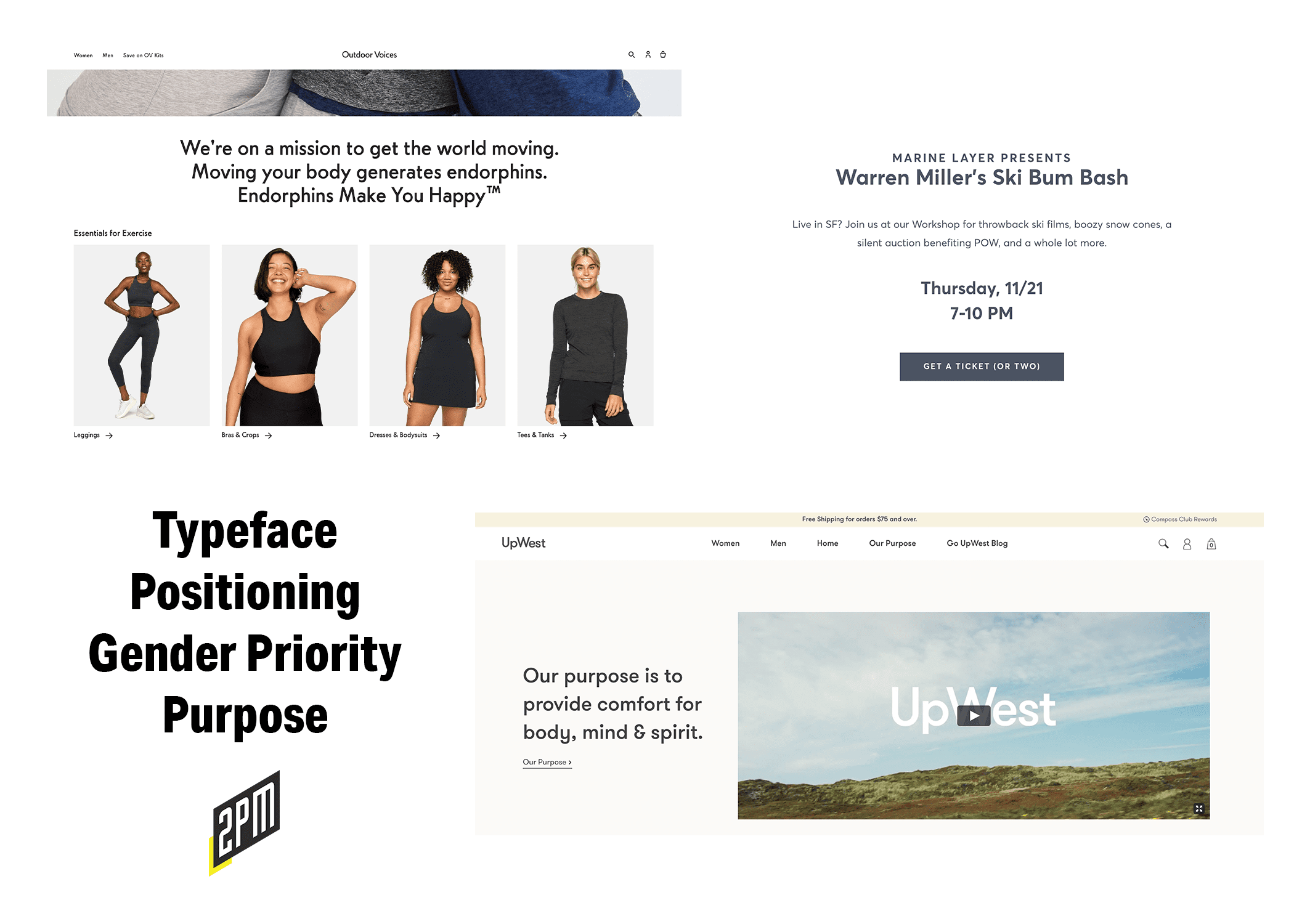
The site’s architecture communicates a desire to be mentioned in the DTC conversation, this includes UpWest’s partnership with Klaviyo and its new-age loyalty program. It would appear that UpWest chose to focus on the DTC psychographic for the sake of earned media and brand positioning. As far as the nuts and bolts are concerned, the site’s build communicates that the desired target demographic is millennial-aged women. On day zero, the brand has an explicit purpose: to provide comfort for body, mind, & spirit. The clothes, are priced similar in design and price to Marine Layer – its next closest competitor.

Identifying Waves: Importing Hygge to America

In the past year, this concept of Scandinavian coziness has made inroads with an international audience. [5]

Imagine a whiteboard in one of Express’ suburban Columbus boardrooms; the word “hygge” would have been at the center of it in big and bold lettering. You can picture the brand’s chief comfort officer (and Express’ SVP of Strategic Initiatives) standing in the corner of the room, jamming as Cody’s It’s Christmas plays on the room’s four Sonos speakers. The brand wants you to feel a feeling. Analysts agree. Emily Singer, founder of the DTC newsletter “Chips and Dip” had this to say:

There’s something very boring about it. Maybe that’s intentional. This line feels a little too on the nose: ‘Welcome to curated comfort. For those who are seeking peace and calm in a stressful world.’ Brands tap into emotional states, but it’s rarely laid out so explicitly.

It’s this perceived boredom that is viewed as an understated luxury in American culture. To the Danes, hygge is free of economic status. The culture’s entire focus is on practicality, movement, wellness, and mindfulness. It’s this underlying culture that Express hopes to import with the help of some obvious visual cues from well-known DTC retailers.

The UpWest typeface is nearly identical to the typeface of Outdoor Voices and Marine Layer’s. Ironically, both retailers have references to Scandinavian hygge throughout their brand messaging. But for UpWest, there’s no understatement. Every message is turned to maximum volume. Like the primary header of Express.com: UpWest’s primary menu is a throwback to “Limited Express”, a retailer for women-first and men-second. There are elements of luxury abound. Upwest’s blog features new-age terms like: nourish, mindfulness, tranquility, and sanctuary. The traveling pop-up is a “cabin.” These are all symbols of wealthier millennials with time and resources to spare. As is the concept of philanthropy and sustainability (though UpWest sells products that are made with synthetics).

It starts with our cozy apparel, home and wellness products. We want to surround you with calm and give you balance. But it’s not just the tangible things. It’s also about slowing down. Diving deeper. And giving back.

Not to be outdone, UpWest wants consumers to help them donate $1 million to the Mental Health Association. The Express-borne retailer plays the entire DTC hand of cards. This report began with a simple statement: middle-class retail is at an impasse. To the average consumer, this DTC play is akin to Structure being launched as Express Men. Like a sheep, the seventeen year old me bought from Express as soon as my adolescent wallet would allow. The mechanics are similar here. Express is attracting an existing audience (the DTC psychographic) and using it to invigorate a brand that is plateauing.

结论

The UpWest bet is that the retailer can earn the business of the upwardly mobile DTC audience by engineering a product-market fit. One with heavy branding, ideal-alignment, and market messaging. This is one of the first upmarket attempts that we’ve seen from a specialty retailer. It’s one that deserves praise. Their management team engineered a brand with contemporary pricing and luxury messaging – void of pricing promotions (for now). They’ve acknowledged that the data shows a middle-class at an impasse. They have the supply chain, the logistics, the distribution, and a snapshot of a brand. But do the executives at Express truly understand what makes the top DTC brands work? That remains the question that could move the market.

Time will tell if Express can duplicate the brand architecting of their L Brands era – a time defined by face-less brands, clever signage, billboards, and foot traffic. My guess is that Express will find an audience that is more sophisticated and critical than the young adults of the 80’s, 90’s, and 2000’s. Messaging, distribution, and customer acquisition methods will evolve with this realization. And if that’s the case, their hygge may be tested for quite some time.

Research and Report by Web Smith | About 2PM