Deep Dive: CPG Beef vs. DTC Beef

A funny thing happened while direct-to-consumer meat hit a ceiling: the humble beef stick escaped the snack aisle. In 2024, Circana estimated that U.S. dried meat snacks, excluding jerky, generated roughly $3.3 billion in 2024, up more than ten percent from the year before, and the “stick” format is driving most of that growth. Since 2020, the category has added more than a billion dollars in retail sales. It’s the kind of expansion curve DTC founders used to dream about before freight bills and cold-chain math woke them up.

The same period has been merciless to online beef. Herd sizes in the United States have fallen to their lowest level since the early 1950s, pushing cattle prices to record highs. The USDA’s boxed-beef reports confirm a stubborn elevation in cutout values, and parcel carriers keep tacking on surcharges for insulated packaging and dimensional weight. In other words, it doesn’t matter how refined your subscription interface is—every order leaves the warehouse heavier, costlier, and more fragile than the last.

The stick lives on the other side of that cost curve. It’s shelf-stable, light, and high-protein, and it no longer feels like a gas-station impulse buy. Circana’s latest data places total U.S. meat-snack sales at about $5.5 billion for the year ending October 6, 2024, with beef sticks as the fastest-growing segment that went into 2025. Where frozen beef boxes are bound by physics and packaging, sticks are bounded only by convenience-store shelf space.

Mapping the field

To understand why this subcategory feels limitless, it helps to map the field.

At the top is Link Snacks, the privately held company behind Jack Link’s. It remains the category leader by jerky dollars; roughly $889 million in the most recent 52-week reading—and its sticks portfolio benefits from the same scale. Link’s sourcing is largely domestic, supported by massive owned manufacturing infrastructure that few can match.

RankBrand / ParentEst. 2024 RevenuePrimary SourcingChannel FocusNotes
1Jack Link’s (Link Snacks)~$889M (jerky dollars)U.S. & globalMass retail, club, convenienceCategory leader; owns manufacturing
2Conagra (Slim Jim, Duke’s)~$3.2B snacks divisionU.S. blended proteinsMass retail, C-storeHeritage leader in sticks; expanding “Bites” format
5Country Archer$151–200M100% grass-fed U.S./LatAmGrocery, club, onlineRegenerative sourcing; 36% YoY growth
6Johnsonville (Vermont Smoke & Cure)n/aU.S.National groceryJohnsonville acquisition; scale expansion
7Tillamook / Old Wisconsin / Werner / ObertoRegional (~$50–100M each)U.S. + mixed importsGrocery, C-storeLong-tail players
8Western Smokehouse PartnersCo-mfg capacity target: 1.1B sticksU.S.Contract manufacturing$500M valuation
9Monogram Foodsn/aU.S.Private-label + licensingProduces for Butterball & others
4Old Trapper~$365MU.S. + AustraliaNational retailFamily-owned, fast growth
3Chomps~$500M (est.)90% Australia (Tasmania/Victoria)DTC + retail (180k doors)Clean-label insurgent; 525M sticks sold in 2024

Conagra follows as the institutional incumbent. Slim Jim, now more than a century old, still anchors Conagra’s $3.2 billion snacks division. The brand’s ingredient list blends beef, pork, and chicken, all made in the United States, and its growth has come through snack-size innovations like Slim Jim Bites, one of the fastest-moving formats in the aisle. Duke’s, the craft-positioned label under the same corporate roof, adds a touch of premium legitimacy.

Old Trapper, based in Oregon and still family-owned, has become the quiet second-largest jerky name in the country with an estimated $365 million in annual retail sales. Customs data show imports from Australia supplementing U.S. beef supply, an increasingly common hedge against domestic price volatility.

Country Archer sits at the next rung. The company, operating under S&E Gourmet Cuts, reported $126.8 million in jerky dollars in 2024, up thirty-six percent year over year. Press estimates place total revenue somewhere between $150 million and $200 million. Every bag and stick touts “100 percent grass-fed and finished” beef and a commitment to regenerative agriculture partnerships.

Then comes the insurgent: Chomps.

By founder accounts and trade-press tallies, Chomps sold more than half a billion sticks in 2024, approaching $500 million in gross revenue. Distribution now spans roughly 180,000 retail doors. About ninety percent of its beef comes from Australia—specifically Tasmania and Victoria’s Cape Grim region—while turkey is sourced domestically and venison from New Zealand. The products are manufactured and distributed in the United States. In less than a decade, the brand turned clean-label protein into a mainstream habit.

Johnsonville, through its Vermont Smoke & Cure subsidiary, is pushing national after an acquisition that gave the sausage giant a foothold in premium sticks. Tillamook Country Smoker, Old Wisconsin (owned by Buddig), Werner, and Oberto under Premium Brands each maintain regional or national positions with mixed sourcing and co-manufacturing. Behind the scenes, contract manufacturers are scaling at astonishing rates. Western Smokehouse Partners, for example, was valued near $500 million and plans to produce 1.1 billion sticks annually by 2026. Monogram Foods, another private-label powerhouse, runs licensed lines for names like Butterball.

If you rank them by available public signals, the hierarchy looks something like this: Jack Link’s first by a wide margin; Conagra’s Slim Jim and Duke’s next; Old Trapper third; Chomps close behind as the pure-play growth engine; Country Archer as the rising premium competitor; and Johnsonville’s Vermont Smoke & Cure rounding out the national tier before a long tail of regional makers. Each depends on a mix of U.S. and Australian supply, but the sourcing story—who buys from where—has become a brand differentiator in itself.

Their initial concept was different from what Chomps became. Originally, they considered selling frozen, grass-fed beef directly to consumers, but the challenges of shipping frozen meat quickly became apparent. To simplify logistics and make the product more accessible, they pivoted to shelf-stable, individually wrapped meat sticks which would define the future of Chomps and the meat snack category itself.

Introduction: The Snack that Outsmarted the Brand

In 1994, Slim Jim was untouchable. Jeff Slater, then VP of Marketing at GoodMark Foods, recalls the swagger of the era: billion-unit annual production, Macho Man Randy Savage screaming through television sets, and $250 million in sales that made the brand synonymous with shelf-stable protein. “We thought we owned portable protein,” Slater wrote years later. And for a time, they did.

When ConAgra acquired Slim Jim, it inherited a juggernaut that produced over a billion sticks a year across more than twenty varieties. Even today, industry observers estimate that Slim Jim’s annual revenue sits between $600 million and $800 million—a brand that never truly left the convenience store checkout. Yet beneath the familiar snap, the foundation was softening. By the mid-2010s, consumers were no longer entertained by preservatives they couldn’t pronounce or “mechanically separated chicken.” They were reading ingredient labels.

That’s when two outsiders, Pete Maldonado and Rashid Ali,  did what legacy CPG couldn’t. With a $6,500 investment and a paleo grocery list, they reverse-engineered the industry from the bottom up. Their company, Chomps, began as a mail-order service, pivoted into individually wrapped sticks, and became the fastest-growing brand in protein snacking—producing two million sticks a day and approaching half a billion dollars in annual sales.

Slater’s retrospective tells the story simply:

Chomps didn’t try to out–Slim Jim Slim Jim. They became the anti–Slim Jim.

It was less a rebellion than an evolution—the same format, reborn under new rules. Slim Jim had marketed attitude; Chomps marketed intention. One chased cost efficiency and mass-market appeal; the other built loyalty through clean labels, sustainable sourcing, and Whole30 certification. One doubled down on volume; the other scaled through trust.fwhy one

The irony is that both brands sell the same idea: convenient protein you can eat with one hand. But only one speaks the new consumer language of health, transparency, and performance. Slim Jim once promised fun; Chomps promises function.

That divergence, the old guard’s fixation on distribution and the upstart’s obsession with alignment, sets the stage for a larger story about American protein commerce. The direct-to-consumer beef industry, for all its innovation, is capped by physics: rising cattle prices, cold-chain costs, and shipping fees that erode contribution margin before the first bite. The beef-stick industry, by contrast, feels like it has no ceiling. It is cheap to move, easy to store, and endlessly expandable across retail, convenience, and on-the-go channels.

This is not merely a case of small defeating large. It’s an object lesson in how consumer priorities: health, portability, identity can reroute entire supply chains. In 2025, while DTC beef battles volatility, the stick has quietly become the most scalable protein format in America.

From here, the story unfolds beyond nostalgia. It’s a map of a category once defined by a single brand that now belongs to a movement.

Why one ceiling and one sky

Direct-to-consumer beef, by contrast, has been bound by logistics and commodity cycles. Upstream inflation starts with the animal. With U.S. cattle inventories at seventy-year lows, processors pay more for every carcass, and ranchers hesitate to expand herds in a drought-stressed climate. The wholesale cutout values, the prices packers receive for boxed beef, remain high. Add in freight: every twelve to twenty-pound frozen assortment shipped to a customer carries the weight of gel packs, insulation, and hazmat-compliant dry ice. Major carriers treat those boxes as oversized, and each “additional-handling” surcharge erodes contribution margin. Even with strong average order values, the unit economics tilt against the operator.

MetricDTC Beef Box (12–20 lbs)Beef Stick 12-Pack
Product Weight~18 lbs (incl. gel packs, insulation)<1 lb
Shipping TypeCold chain / dry iceAmbient parcel
Average Freight Cost$18–$26 per order<$4 per order
Retail Price / Order$140–$220$24–$36
Contribution Margin20–25% (volatile)45–55% (stable)
Spoilage / Returns3–5%<0.5%
ChannelsSubscription, DTC onlyRetail, C-store, Amazon, gym, travel
CAC Recovery3–4 ordersImmediate (impulse sale)
Shelf Life5–7 days in transit, frozen 6 mo.12+ months ambient
Repeat BehaviorSubscription churn riskOn-the-go repeat impulse

The business model that looked brilliant when fuel was cheap and cattle abundant becomes brittle under the weight of inflation. Consumers, meanwhile, are less loyal to meat subscriptions than to coffee or supplements; a single bad delivery or price swing can prompt a pause or cancellation. The ceiling for DTC beef is not theoretical, it’s practical. And it’s already visible.

Beef sticks flip that equation. Ambient shelf life removes the cold-chain constraint. A twelve-pack ships for the cost of a book, not a cooler. The same product can sit in convenience stores, gyms, airports, or Amazon warehouses. The channel optionality is enormous: convenience stores are, in a sense, the second internet—hundreds of thousands of points of distribution that reward fast velocity rather than high margins.

The format itself keeps evolving. Bite-size sticks, mini packs, and flavor assortments create repeat purchase behavior without discounting. Conagra credited those small-format innovations for Slim Jim’s sustained growth. Co-manufacturers are adding capacity by the hundreds of millions of units, anticipating that stick demand will double again within two years.

And the consumer psychology has changed. The pandemic normalized protein snacking, while the GLP-1 conversation made portion-controlled, sugar-free options fashionable. A beef stick now signals health and discipline rather than convenience and guilt. It is a tidy fit for high-protein, low-carb, or intermittent-fasting lifestyles—the kind of cross-category relevance that DTC beef boxes can’t replicate.

The economics of freedom

The comparison is blunt but instructive. Direct-to-consumer beef sits atop a pile of volatile inputs: cattle costs, feed costs, fuel, labor, packaging, and last-mile delivery. Each layer compounds the risk. Even brands that control their own processing facilities struggle to pass through price increases fast enough. The category rewards vertical integration and regional micro-fulfillment, but few can afford the infrastructure.

Beef sticks, on the other hand, operate in an environment of relative stability. The product’s logistics are ambient, the margins healthier, and the distribution mix diverse enough to weather inflation. When Circana reports that meat sticks grew more than ten percent in 2024 while the broader snacks market crept upward only modestly, it underscores the point: this is one of the few packaged-protein formats with genuine runway left.

For founders and investors, the lesson is not to abandon beef but to rethink the hierarchy of SKUs. Treat the cold-chain operation as the hero product, the showcase for brand integrity, but finance it with shelf-stable formats that can move everywhere. Of course, this requires a Chief Marketer with decision-making autonomy. This is difficult to find.

Every successful meat company in 2026 will be a hybrid—part fresh, part ambient, part omnichannel.

The co-manufacturing arms race reinforces that thesis. Western Smokehouse’s billion-stick target is not just capacity, it’s a vote of confidence in long-term demand. Monogram’s quiet dominance in private-label licensing hints that large food conglomerates view sticks as their next billion-dollar bolt-on. As Western and others scale, the barrier to entry falls for brands with strong identities but no plants of their own. The next generation of premium meat brands will likely be born from this outsourced ecosystem, not from ranchland.

A market without a ceiling

The American DTC beef industry has met its upper limit. Rising input costs and shipping economics ensure that its growth curve will flatten until a logistics breakthrough arrives. The beef-stick industry, meanwhile, is only now hitting its stride. With double-digit growth, billions in new capacity, and mainstream cultural acceptance, it’s becoming the rare protein business that feels uncapped.

Where one side of the market is weighed down by insulation and ice, the other fits in your pocket. And in commerce, weight still matters.

Research and Writing by Web Smith

Ежегодный отчет 2PM: Athleisure 2025

The all-day athleisure era is giving way to something more disciplined. Over the last 18 months or so, the everyday uniform has shifted from leggings and hoodies to polished work-leisure: stretchier chinos, knit blazers, temperature-regulating shirts, and trousers with a drape. That shift didn’t kill comfort; it put guardrails around it. Comfort now has to “pass” in more rooms—client coffees, school events, airport lounges, all without reading like a gym kit. At the same time, the culture has rediscovered real sport, especially tennis and running, as a stage for style and credibility.

As those two currents converge, athleisure has narrowed. It’s no longer the default “worn by all.” It’s increasingly worn most by people whose lives actually orbit sport: those who play, coach, race, or at least anchor their social life around studios, courts, clubs, or run crews.

Even a pawn can beat a king.

Adidas advertises the potential future of her sport. Look at it as a rookie QB deal; the best of them outperform their relatively meager pay as they graduate into the top ranks of their sport.

That’s visible in product (court/pickleball capsules, performance trousers replacing leggings as daywear), in distribution (destination retail near clubs and studios), and in marketing spend (athlete deals and federation partnerships instead of purely influencer grids). Adidas’ partnership with Texas Tech Women’s Soccer player Sam Courtwright appeared this week on the homepage, in what I gather is a leading indicator for what’s to come. The redshirt sophomore is a high value athlete, providing credibility to Adidas in the collegiate scene. With under 700 Twitter followers and ~4.200 Instagram followers (at the time of publishing), she’s not a bonafide “influencer” in the sense that her posts will drive instant business. Adidas is not playing checkers like the minions, they’re thinking further ahead. Even a pawn can beat a king.

Sportswear is returning home. And it needs athletes to provide the credibility and authority that once rested on the pliable shoulders of fitness influencers and barely-clothed yogis.

Lululemon, Vuori, and Alo: once shorthand for anytime/anywhere athleisure are also investing where the cultural heat is: real sport plus a club-coded lifestyle that reads appropriate off-court. Lululemon’s Team Canada outfitting and the brand’s women’s ultramarathon project (FURTHER) are emblematic of that pivot from “studio vibes” to “performance receipts.” Vuori’s jump onto the pro-tennis stage is another. Alo’s tennis/pickleball push and athlete seeding is the same play in LA tones. Just this week, it was announced that Adidas’ part

The net effect: the mass, anything-goes uniform is giving way to a split market. On one side, polished business-casual made with performance materials (the Mizzen+Main, Ministry of Supply, State & Liberty, Fair Harbor universe) satisfies daily wear. On the other, “sport-first lifestyle” led by tennis/run/golf claims permission to travel beyond the venue. The middle—undifferentiated leggings-and-hoodie looks for non-athletic pursuits, is what’s shrinking.

Who the top brands are signing (recent headline deals):

Below are notable, verifiable athlete partnerships and ambassador signings from 2023–2025 that illustrate the shift toward authentic sport. This is a curated snapshot of marquee names (not an exhaustive list of every ambassador).

Lululemon

  • Sir Lewis Hamilton: (need I say more?)
  • Frances Tiafoe (ATP): joined as a global tennis ambassador in January 2025
  • Leylah Fernandez (WTA): active campaign face for tennis collections in 2025
  • Team Canada (Olympic/Paralympic): official outfitter through the Los Angeles 2028 Games
  • Programmatic sport push: women’s six-day ultramarathon “FURTHER,” tied to a women-specific running capsule

Vuori

  • Jack Draper (ATP No. 5): multi-year apparel deal announced ahead of the 2025 US Open.
  • Jared Goff (NFL): named ambassador in September 2025 as Vuori expands athlete partnerships
  • Arch Manning (NCAA/NIL) and Colston Loveland (NFL): part of Vuori’s growing athlete slate
  • Rob Machado (surf): long-running ambassador/collaborator anchoring the brand’s coastal performance DNA
  • Olivia “Livvy” Dunne (NCAA gymnastics): collaborator and NIL face

Alo

  • Parris Todd (pro pickleball): official sponsorship; featured in Alo’s tennis coverage and athlete content
  • Julian “Juju” Lewis. He signed an NIL deal with Alo Yoga in February 2024 and later enrolled at Colorado; recent coverage of his new equity deal notes the prior Alo partnership
  • Caleb Williams (USC, then NFL) — NIL partnership with Alo Yoga
  • J.J. McCarthy (Michigan, now NFL) — cited as an Alo partner

Athleta

  • Simone Biles (gymnastics): long-term partnership; continued 2025 visibility (ESPYs red-carpet collaboration)
  • Lexie Hull (WNBA) and Kate Martin (WNBA): signed as brand ambassadors in 2025; Athleta also maintains a broad women’s roster across sports

Sweaty Betty

  • Denise Lewis (Olympic heptathlon): 2025 ambassador announcement.

Why this list matters: it maps the center of gravity for the category. The biggest storytelling budgets are flowing to real athletes and federation-level platforms, not just studio instructors or generic influencer seeding. For brands born in the athleisure boom, these deals buy credibility on court/track—then justify the off-duty product that customers want to wear to dinner.

The Analysis:

From “Gym-Anywhere” to “Polished Off-Duty.” Or why athleisure is ceding ground to casualwear and how Lululemon and others are leaning into sport and Sporty & Rich-adjacent aesthetics to win what’s next

After a decade of “wear-it-everywhere,” the cultural permission for overtly gym-coded outfits outside the studio, court, or track is narrowing. Consumers still want comfort, but the uniform is evolving toward polished casual (denim, trousers, cardigans) and club-coded sport (tennis/golf silhouettes that “pass” in more social settings).

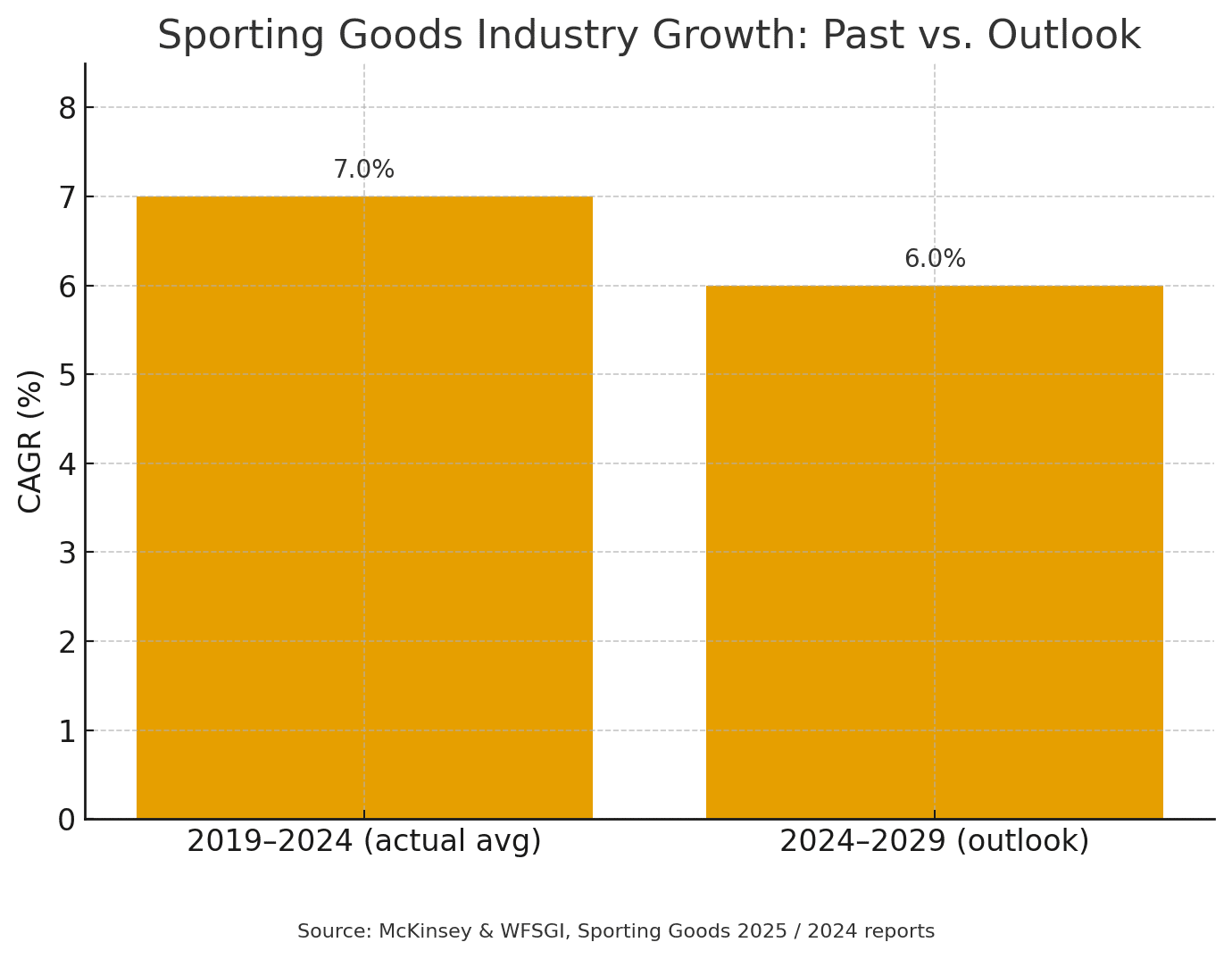
At the same time, performance sport is culturally hot again (tennis, running), nudging leaders to prove they’re serious about sport while selling a cleaned-up lifestyle aesthetic. Lululemon, Alo, and Vuori are each threading this needl: sport for credibility, Sporty-&-Rich-adjacent for lifestyle. as growth in the broader sporting-goods market softens from ~7% (2021–24) to ~6% (2024–29).

The demand shift: from “anywhere athleisure” to “polished comfort”

  • Macro growth is normalizing. McKinsey/WFSGI’s 2025 outlook pegs industry CAGR at ~6% from 2024–29, down from ~7% during 2021–24. The market isn’t collapsing, but it is moving from break-neck growth to a productivity game.
  • Comfort remains non-negotiable—just styled differently. As early as 2023, Circana tracked a steady pivot toward “polished comfort,” with dress pants, woven shirts, jackets/blazers and other “passable” items outperforming as shoppers seek versatility that reads appropriate across more venues.
  • Active bottoms are soft. Between April 2024 and April 2025, US active bottoms sales fell ~12%, per Circana cited by Business of Fashion, even as overall sportswear remains resilient. That helps explain the lens shift away from leggings-as-daywear toward trousers, wide-leg track pants, and tailored knits.
  • Category leadership is still attractive, but more contested. BoF and McKinsey State of Fashion 2025 notes sportswear continues to grow faster than the broader fashion market, but by slimmer margins and amid greater variance by region and company. Translation: out-execution matters more than tailwinds.

Why it matters: The “anywhere” athleisure look that felt novel in 2016 America can read underdressed at dinner, derivative on vacation, and flat at the office. The culture hasn’t abandoned comfort. However, it’s editing the costume toward refined, venue-appropriate pieces or sport-coded uniforms that carry social credibility.

Culture & sport: tennis goes mainstream, running gets mythic:

Tennis has become a fashion stage again (US Open capsules, pleated skirts, club sweats), and brands are investing accordingly. Meanwhile, running reclaimed mindshare as a proving ground for material innovation and women-specific design—spotlighted by Lululemon’s FURTHER ultra initiative and women-specific run capsule.

Lifestyle proof points:

  • Lululemon’s Varsity/tennis assortment (e.g., the Varsity High-Rise Pleated Tennis Skirt) squarely channels that Sporty-&-Rich-ish country-club aesthetic.
  • Alo pushes “Tennis Club” knits and dresses as street-passable athleisure.
  • Vuori’s Court to Resort blends tennis/golf silhouettes built to move, explicitly framed to travel beyond the court.

Category economics at a glance:

  • 2019–2024 actual/avg: ~7%
  • 2024–2029 outlook: ~6%

Implication: With softer topline, the winners must harvest efficiency while re-segmenting product: more polished casual for lifestyle, more real sport for credibility.

Brand narratives: how the leaders are repositioning:

Lululemon: leaning Varsity while doubling down on sport

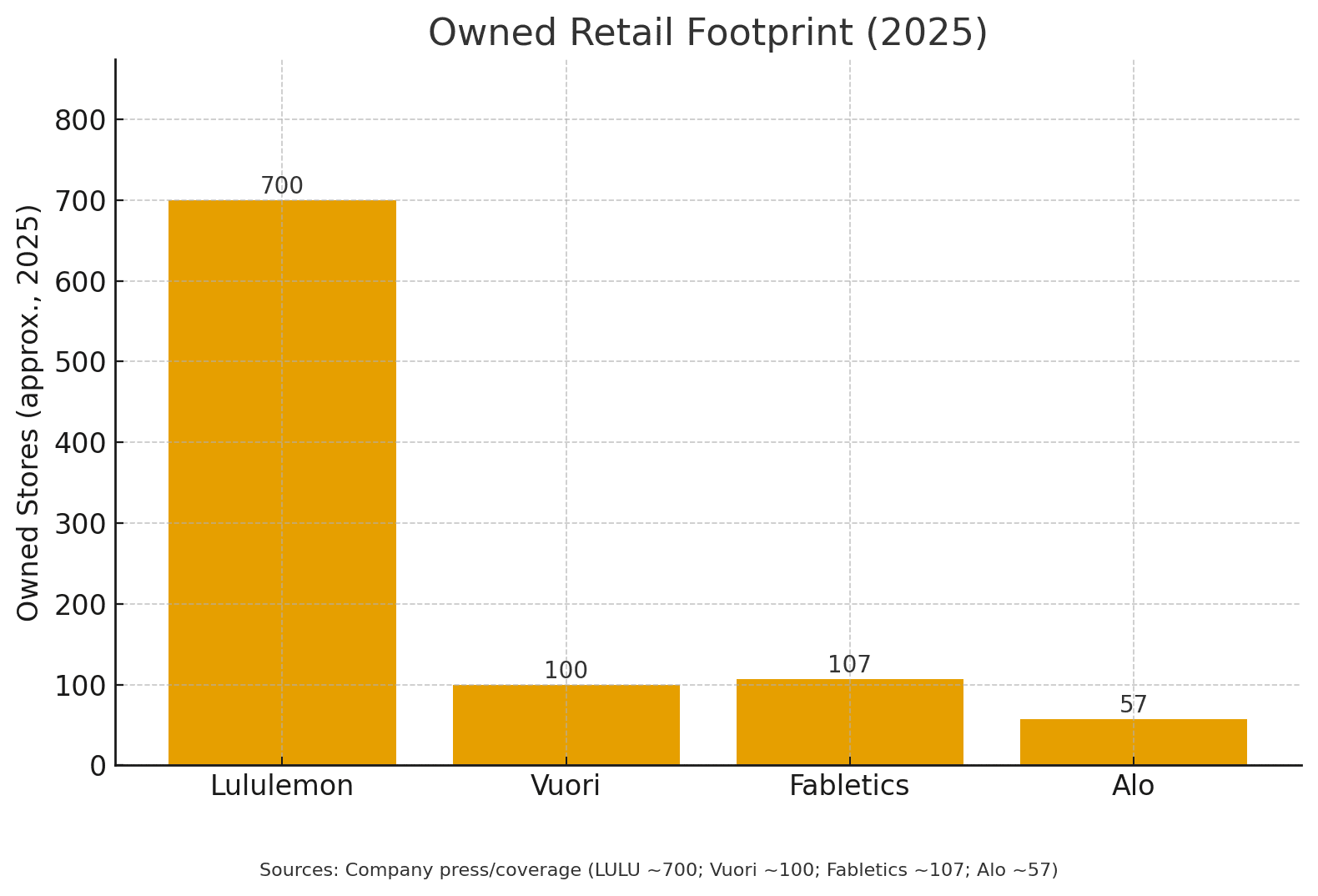
  • Where it wins: Scale (~700 stores in 2025), brand equity with both genders, and a powerful accessories/basics engine.
  • Where it’s vulnerable: North America momentum cooled into late 2024 as upstarts clawed share and style leadership; Reuters flagged the slowest quarterly growth in 4+ years amid stronger competition from Alo and Vuori.

The pivot in plain sight:

  • Aesthetic: A more polished, preppy varsity palette—pleated skirts, polos, cable knits—clearly sits in the Sporty & Rich slipstream. Lululemon’s “Varsity” and tennis pages show the merchandising logic.
  • Sport credibility: Lululemon attached itself to Team Canada (outfitter through the 2028 Games), and staged FURTHER, a six-day women’s ultra that anchored a women-specific running capsule (“Go Further”): a smart, ownable sport narrative that travels beyond the event. Not to mention, Lewis Hamilton, everyone.

Read: Lululemon is re-earning permission for lifestyle by proving it on-course/track—then selling the cleaned-up off-duty uniform.

Alo: luxury-wellness halo meets tennis-adjacent lifestyle

  • Distribution & scale: ~57 stores as of April 2025 with plans to add 50+ through 2025; European rollout (London, Paris) is live; DTC is the engine (Vogue Business cites ~98% DTC mix).
  • Aesthetic: “Tennis Club” knits/dresses and polished separates are built to pass at brunch or travel, not just the studio.
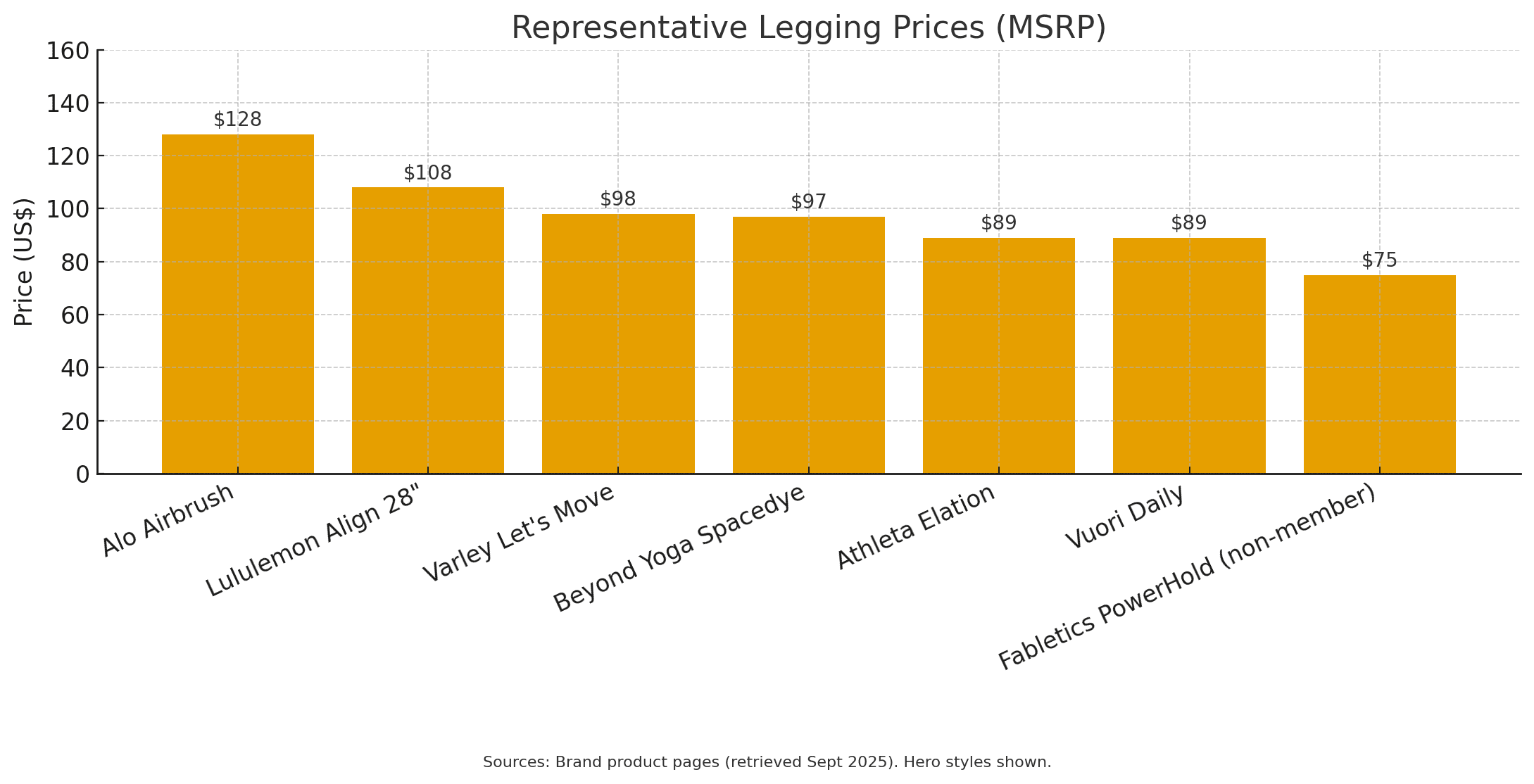
  • Price/positioning: Premium AURs (e.g., Airbrush leggings at ~$128) cement a “luxury-wellness” adjacency—price power requires distinctiveness.

Read: Alo scales through high-touch retail, creator marketing, and a wardrobe that implies sport yet reads refined in daily life.

Vuori: “Court to Resort” + real on-court receipts

  • Stores & expansion: Surpassed 100 owned locations globally (Aug 2025); accelerating international growth (UK, China, Korea).
  • Aesthetic: Clean SoCal minimalism, with Court to Resort as the bridge between performance and travel/lifestyle.
  • Sport credibility: A multi-year deal with Jack Draper (current world No. 5) gives Vuori hard on-court validation to push deeper into tennis product.

Read: Vuori pairs an easy lifestyle look with visible elite-sport proof, strengthening its “wear-it-everywhere” claim without the athleisure stigma.

The store race (because stores tell the strategy):

  • Lululemon ~700
  • Vuori 100
  • Fabletics 107
  • Alo 57

What the footprints signal:

  • Lululemon will keep adding doors but must refresh aesthetics faster.
  • Vuori is turning into a serious global retailer; tennis/golf doors make sense in travel/luxury corridors.
  • Alo is building a flagship-heavy network that sells the clubhouse lifestyle as much as product.
  • Fabletics is quietly becoming the value-plus omni player with >100 stores and membership economics.

Price ladders are hardening (and visible to the consumer):

Sources: brand product pages (retrieved Sept 2025).
Take: With active bottoms softening, premium brands need new reasons to pay up (fabric handfeel, fit innovations, and—crucially—styling that “passes” at the restaurant).

East Hampton × Erewhon: the five brands setting the uniform:

Alo: LA pilates energy with clubroom polish. Think tennis dresses, pleated skorts, cropped collared knits and sculpted leggings that pass from Reformer to lunch. It’s the default Erewhon look and shows up in Hamptons school-drop-off lines just as easily.

Varley: LA/London court-core made elegant. Soft neutrals, half-zip knits, tailored track pants, tennis skirts—the precise “polished comfort” moms wear from the club to Main Street. If you see a cable-stitch over a pleated skort in East Hampton, odds are it’s Varley.

Sporty & Rich: Off-court preppy as a worldview. Tennis club sweats, logo caps, retro polos and cream palettes that scream “country-club casual.” This is the reference aesthetic Lululemon and others are orbiting; the East Coast reads it as heritage without the fuss.

Why these five: they each deliver the new dress code, court-inspired, studio-capable, socially acceptable—without reading like gym gear. They’re the overlap in two style capitals (Montauk brunch and Beverly Hills produce runs), where comfort is table stakes but polish is the pass.

FP Movement: Fashion-forward active that still feels fun. One-shoulder sets, airy parachute pants, bold color capsules that move from pilates to beach errands. It’s the youthful, Instagram-native counterweight in carts that already have neutrals and knits.

Set Active: LA minimalist matching sets for the grocery-run-to-meetup window. Box-cut tees, compressive bras, monochrome leggings/shorts, all in seasonal tones. It’s the Erewhon aisle staple that also sneaks into Hamptons weekends when the brief is “clean, not try-hard.”

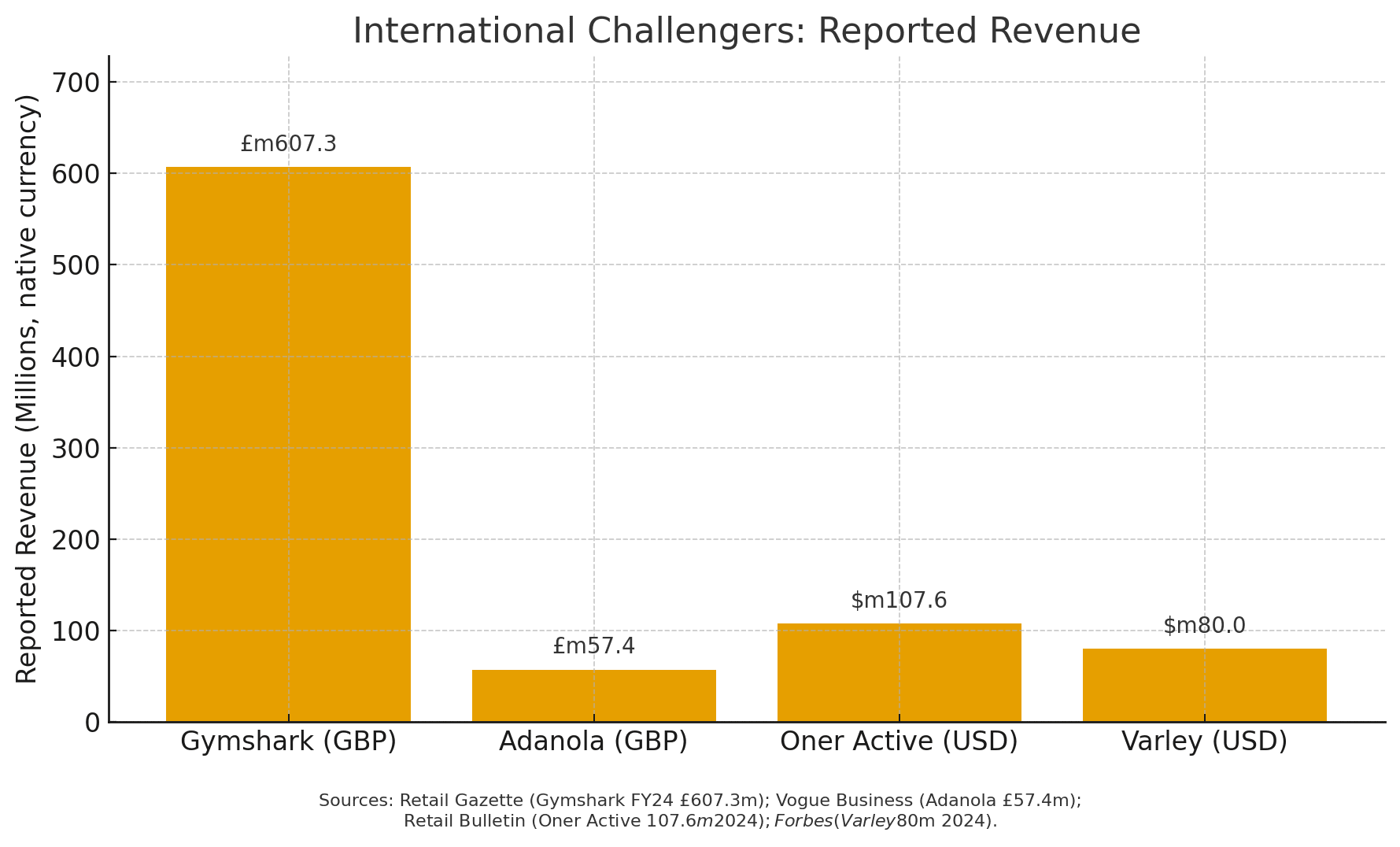
International challengers with real North American upside:

  • Gymshark (UK): flagship now on NYC’s Bond Street—credibility + DTC mastery + hybrid retail.
  • Adanola (UK): “clean girl” aesthetic aligned with polished athleisure; value-friendly sets with fast refresh.
  • Oner Active (UK→LA): creator-led distribution plus relentless newness; strength-first silhouette.
  • Varley (UK/US): tennis-adjacent lifestyle—already resonating stateside (Forbes coverage).
  • LIVE! Activewear (Brazil): single U.S. beachhead in Miami; yoga-first pilates/run/tennis closet with polished off-duty pieces; building U.S. awareness via events and eCommerce-led scale.

Also watch: Sweaty Betty (UK), back to U.S. stand-alone retail (Chicago & DC); and LSKD (AU), a scrappy, community-led playbook gaining ground in the U.S.

Outdoor Voices: a case study in the narrowing “anywhere” permission:

OV’s 2024 store closures signaled the end of a specific DTC era; the 2025 relaunch under returning founder Ty Haney aims to rebuild community and refine the aesthetic. It’s a reminder that generic “athleisure” storytelling is no longer enough—brands must own a credible sport lane or a distinctive polished lifestyle lane (ideally both).

Sporty-and-Rich-adjacent: the playbook in action:

A critical nuance: mimicry isn’t strategy. Sporty & Rich continues to elevate the off-court tennis narrative via fresh color/material capsules with Adidas—so incumbents must avoid derivative “country-club” clones and instead push their own fit/fabric signatures and authentic sport credentials.

  • Lululemon: attaches to national teams and women’s running R&D; merchandises pleats, polos, and varsity sweats without abandoning performance.
  • Alo: dresses the clubhouse with cashmere-adjacent knits and tennis-coded skirts; European flagships sell the lifestyle world as much as product.
  • Vuori: signs top-5 tennis talent (Jack Draper) to make on-court performance a central claim; then extends looks “from court to resort.”

What the numbers are telling me right now:

  1. The growth curve is bending, not breaking. A 6% CAGR outlook is still healthy, but it rewards clearer differentiation and sharper inventory discipline. (See Chart 1.)

  2. Lifestyle dollars are migrating to “passable” silhouettes. Circana’s polished-comfort data is consistent with what we see in merchandising across the leaders. Circana

  3. Active bottoms need a new story. With –12% category pressure, brands must either re-architect the legging (fit/feel/opacity) or sell alternative bottoms that still read active-adjacent.

  4. Retail footprint matters again. Vuori (100+), Fabletics (>100), and Alo (flagships) are proof that physical retail is a brand-experience moat—especially for a more refined, try-on-worthy wardrobe. (See Chart 2.)

Strategic implications (12–18 months):

For incumbents (Lululemon, Nike, Adidas, etc.):

  • Double down on credible sport moments that are ownable (e.g., women-specific R&D built on real athlete input). Lululemon’s FURTHER is the blueprint: a cultural event that justifies a product line.
  • Merchandise a “passes-anywhere” capsule in every delivery: pleated skirts, trousers with stretch/recovery, collared knits, and travel-ready layers that read elevated.
  • Refresh cadence matters. Upstarts are winning TikTok-speed trend windows. The response is faster color/material drops without SKU bloat.

For challengers (Alo, Vuori, FP Movement, Varley, Beyond, YPB)

  • Own a sport and an aesthetic. Vuori’s Draper deal gives permission to claim tennis performance; Alo owns the clubhouse. Keep both lanes distinct.
  • Price architecture: Protect premium AURs with fabric handfeel and tailored fits; consider value-adjacent capsules to defend share as promo pressure rises.
  • Retail where it counts. Flagship corridors + resort markets + club-adjacent neighborhoods monetize the new uniform better than generic high streets.

For wholesale/retail partners

  • Buy for outfits, not SKUs. Curate trousers + pleats + court knits as complete looks.
  • In-store services (stringing, run gait, pilates clubs) convert “sport credibility” into community and repeat visits—think Omni not just Units Per Transaction.

What could go wrong:

  • Aesthetic drift: Over-indexing on “country-club” sameness risks turning premium floors into a sea of cream cable-knits. Keep material innovation and brand signatures front-and-center.
  • Cost of legitimacy: Athlete deals and real on-court R&D are expensive. Vuori’s Draper bet raises expectations for performance across the line, not just a capsule.
  • It’s refinement, not a return to formality. Workwear casualization persists; the move is toward elevated comfort, not suits. Plan for nuance by market and occasion.

Brand scorecards (executive shorthand):

  • Lululemon: Scale incumbent managing NA softness by leaning harder into sport (Team Canada; FURTHER) and a varsity/tennis lifestyle. Execution risk is refresh cadence and not losing edge to faster-moving rivals.
  • Alo: Luxury-wellness halo + creator engine; ~57 stores and expanding in EU; DTC-heavy; sells the clubhouse closet at premium AURs.
  • Vuori: Now 100+ owned doors; clean SoCal aesthetic; Jack Draper deal to anchor a real tennis push; travel-and-resort hooks broaden usage occasions.
  • Athleta: Reset under Gap Inc.—sharpen assortments and rebuild brand heat (short-term comps pressure is the trade-off).
  • Fabletics: Membership economics + rapidly expanding retail (>100 stores) = a scaled value-plus foil if premium brands get too same-y.
  • FP Movement, Varley: Taste-making references for the “hot-mom” uniform—elevated, functional, and social-feed ready.
  • Outdoor Voices: Community nostalgia + founder return; must modernize supply and tighten the SKU plan to stick the comeback.

What to watch (next 6–12 months):

  1. US Open → Holiday tennis halo: Expect more tennis capsules (and brand/athlete moves) to ride the court-to-clubhouse wave.

  2. Active bottoms reset: Who tells the best non-legging bottoms story (tailored track pants, performance trousers) with true fabric innovation?

  3. Store productivity spreads: Vuori and Alo flagships vs. Lulu’s fleet—watch traffic quality, not just door counts.

  4. Value-active acceleration: As promo pressure rises, expect Abercrombie YPB, Fabletics and department-store private labels to take more oxygen.

I’ve written about this category for years, but I’ve never published an analysis like this. Consider it a line in the sand. The era of all-day athleisure is closing; the permission structure changed. Comfort didn’t lose—presentation won. The uniform is migrating to polished workleisure and court-coded pieces that pass at dinner, while generic leggings and hoodie looks recede to people whose lives actually orbit sport.

The winners will choose a lane and prove it: real performance receipts (athletes, federations, timed results) that legitimize off-venue wear, or business-casual silhouettes built from technical fabrics that survive the office, the flight, and the evening. Expect tighter clustering around clubs and studios, faster fabric refresh cycles, and stricter chemistry and sustainability standards that raise the cost of imitation. Watch the outside lane too. If I’m right, this framework will shape how brands merchandise, price, and expand for years.

This analysis began, “the all-day athleisure era is giving way to something more disciplined.” Better put: athleisure is dying, long live sportswear.

Research and Analysis by Web Smith (LinkedIn)

Смена сигнала: Первое издание

Полезный рейтинг не просто объявляет победителей, он объясняет , почему импульс сместился. На этой неделе SignalStack показывает летний рынок, который все еще движется, но движется более осторожно. За редким исключением, даже сильные операторы немного снизили свои позиции по сравнению с предыдущей неделей. Такова история: широко распространенные микроснижения, которые отделяют дисциплинированных операторов от удачливых.

Начните с выброса. Hydrow продемонстрировал положительную дельту (+0,004 до 10,000, 1 место). На неделе, когда большинство категорий дрейфовало вниз, способность Hydrow удержаться и продвинуться вперед - это сигнал: устойчивый спрос плюс эффективный летний мерчендайзинг.

Отслеживайте все данные в SignalStack

Ниже Hydrow, в таблице "ризеры", лидеры скорее отстаивают позиции, чем набирают обороты: Glossier (-0,018 до 9,953, 2 место), Oura Ring (-0,048 до 9,951, 4 место), AllTrails (-0,049 до 9,951, 3 место), Barstool Sports (-0,050 до 9,921, 5 место), Whoop (-0.050 до 9,921, 6 место), Diff Eyewear (-0,050 до 9,917, 9 место), Simple Modern (-0,050 до 9,912, 12 место) и Athletic Brewing Company (-0,050 до 9,908, 13 место). Это не обвалы, это контролируемые замедления в плоской ленте.

Это сглаживание проявилось и в отраслевом срезе. Спорт (Avg ΔSignal -0,069) и путешествия (-0,106) смягчились, что не должно никого удивлять: середина лета насыщает ранние сезонные покупки, и внимание переключается с открытий на впечатления. Здоровье и фитнес (-0,145) отражает предсказуемую усталость от программ; стиль и мода (-0,184) и еда и напитки (-0,299) указывают на управление маржой и эластичность скидок - хорошие операторы будут сопротивляться паническим акциям в июле, чтобы защитить август/сентябрь. Самое резкое снижение - "Технологиии компьютеры " (-0,431) и "Шопинг" (-0,377) - свидетельствует о давлении на эффективность рекламы и более спокойном PR-цикле. Короче говоря: широкая нерешительность, выборочная устойчивость.

В таблице "Падающие" представлена другая половина истории. Alallure Couture (-1,012 до -0,085, 864 место), Shop Royal Oak (-1,000 до -1,000, 866 место), GYMGUM (-0,965 до -0,335, 865 место) и Poplar (-0,785 до 3,131, 863 место) не просто охлаждаются, они сигнализируют о риске релевантности. В каждом случае диагноз, как правило, рифмуется: непоследовательный захват спроса, слабая система удержания (электронная почта/SMS/сообщество) и PR-каденция, которая не приводит к ощутимому импульсу. Решение редко бывает "больше рекламы"; это более четкое позиционирование, более чистая воронка и причина для возвращения, которая сильнее, чем последняя скидка.

Прорыв: Бандитские бега

Bandit Running зарегистрировал скромную отрицательную дельту (-0,012 до 9,694, 224 место). На неделе, когда наблюдалось мягкое сокращение, эти показатели лучше, чем кажется. Bandit работает в сегменте (бег), где покупки сгруппированы вокруг календарей событий, погодных окон и тренировочных блоков. Следствие: середина августа - это не апогей спроса, а период подготовки к осеннему всплеску.

Теперь важны три рычага:

  • Спрос, привязанный к календарю. Цикл специализации бега предсказуем: создание базы в июле, интенсивность в августе, пик в октябре (Берлин/Чикаго/Николай). В этом случае предпочтение отдается капельному поступлению продукции, контенту, предназначенному для тренировок, и рассказам о практичности (посадка, ткань, теплосбережение), а не широким сезонным лозунгам. Еженедельная череда небольших, заработанных поводов для повторного посещения превзойдет однократную кампанию.

  • Конверсия сообщества в коммерцию. Преимущество Bandit - культурный авторитет среди серьезных бегунов. Оно только усиливается, если точки соприкосновения с сообществом инструментализированы: Клубы Strava, привязанные к пулам целевых предложений, пользовательский контент групповых пробежек, привязанный к геолокализованным целевым страницам, и обучение под руководством спортсмена (как экипироваться для длительных влажных сессий). Сообщество - это не осведомленность; сообщество - это сегментация.

  • Дисциплина мерчандайзинга. В недели, когда погода зависит от погоды, победители делают продукт очевидным. Упакуйте капсулы для бега в жару (синглет + короткие раздельные штанишки + защита от пота) и привяжите их к случаям использования ("16-мильный забег при температуре 80°F+"). Ограничьте матрицу, возвысьте самое необходимое и устанавливайте цену на основе воспринимаемой эффективности, а не на основе самого дешевого конкурента.

Если Bandit все выполнит, то легкий спад в конце лета станет заделом для сентябрьского подъема. KPI, за которыми нужно следить, - это не только трафик, но и скорость повторных покупок среди известных пользователей, количество подписчиков в каналах сообществ и соотношение контентных сессий к общему количеству сессий. Именно эти показатели станут сигнальными изменениями в следующем месяце.

Правильно прочитайте таблицу, и эта неделя преподнесет простой урок: импульс дефицитен и поэтому ценен. Hydrow показала, как выглядит продвижение на плоском рынке. Лидеры сохранили высоту. Отстающие выявили структурные проблемы. Для операторов август не был периодом ожидания, он стал проверкой планирования. На спокойной неделе правильные мелкие шаги - календарно согласованные падения, инструментарий сообщества и четкость мерчендайзинга - создали основу для единственного числа, которое имеет значение на следующей неделе: положительного Δ.

Данные и анализ Веба Смита