No. 281: “V” is For Vertical

फेसबुक-विज्ञापन
Warby Parker’s factory.

If you read any post on digitally vertical native brands, you’ll be hard pressed to find one single paragraph on manufacturing. In Andy Dunn’s now famous essay on the rise of vertical brands, he doesn’t mention the process of production one time. In CB Insights much-loved analysis of the nine biggest DTC success stories, you won’t find one mention of the production process.  This, despite the entire industry being driven by a global manufacturing resurgence.

Screen Shot 2018-08-06 at 1.45.48 PM
eCommerce as a % of total manufacturing shipments.

You listen hard. Stick to the basics, stick to the basics, stick to the basics, so says the antagonist from one of my favorite films of my youth. But while crusty old Coach Kilmer was a villain in the movie, he made a great point. And it’s a point that many in the DNVB space are overlooking. As the battle to rise above the noise has reached a fever pitch, brands are overlooking the most important part of the value proposition: a great product.

Face it, not everyone has a factory. This means that manufacturing partnerships must be priority number one for product-founders. A partner has to serve your best interest; they are there for the long haul. They make concessions and provide you with help during the product discovery and refinement phases.

Founder Collective on Twitter

Yes! The first Casper Mattress that sold was the 50,001st sold by founder Philip Krim, who spent a decade dropshipping beds previously. The best D2C founders are more focused on industry dynamics and acquisition channels than twee launch videos and clever branding. Follow suit! https://t.co/r9oDO74x6b

A DNVB is a manufacturer first, marketer second. Either you’re building the product within your own walls or you’re spending countless hours overseeing the process with a trusted partner. But for every ShinolaRogue Fitness, Warby Parker, Harry’s or East Fork that own their factories, there are countless DNVB’s (see: Fashion Nova) that excel by optimizing partnerships with manufacturers. The operative word is “partnership.” If you’re the owner of a vertical brand, you’ll need more than a vendor to navigate the obstacles of today. A manufacturing vendor sends you a spreadsheet with pricing, a manufacturing partner tests ideas and sends you samples. They are an extension of you. They are as invested in you as you are in them.

4
American Giant Partners with Eagle Sportswear

Early on in my DNVB journey, I met a savvy product-driven entrepreneur named Adam Blitzer at Manhattan’s Javits Center during the very early days of Mizzen + Main. Those were the years that we spent (a) not paying ourselves and (b) being brushed off at trade shows. Blitzer’s situation was a little different than ours. His booth was always directly across and nearly always bustling. As one of the few young companies who closely-managed their own production, we built a kinship for each others brands. His product offering was refined and constantly evolving. In short, he simplified a very difficult aspect of the business.

Setting aside trade agreements, tariffs, and other political issues, things are booming. More goods, coming from more sources, going to more places.

One other thing that’s increasing: pressure. Every year there is greater pressure on producers to show regulators and customers that their goods are sourced ethically and sustainably. It’s as if the whole world is now from Missouri, saying, “Show me” when it comes to the integrity of products they purchase. Ingredients now matter as much as, if not more, than the end product. To many modern consumers, ingredients are the end product, whether it’s the wheat going into your cereal, or the cotton going into your jeans.

Trends in Global Supply Chain Management

Before becoming the CEO of his latest company, he was the founder of a successful duffel bag direct-to-consumer brand called Blue Claw Co. There, he maneuvered through the arduous obstacles faced by brands that manage the push and pull of global politics on their young companies. It was through this experience that inspired him to build Softline Brand Partners as the solution for vertical brands who are focused on insulating themselves from the industry and market fluctuations (from materials to production to shipments). Softline has become the go-to for DNVBs seeking the type of partnerships that scale from zero to one. A network of domestic and foreign manufacturing plants, the company heralds its partnerships: from startups like Bespoke Post and Leesa Mattress to retail titans like Timex, Woolrich, and Allen Edmonds.

In a recent discussion with Blitzer, here’s what he had to say about the industry:

We’ve grown accustomed to operations like Gin Lane and Red Antler successfully building product brands from sample to market. We’re the company that works with you before you complete the brand development phase. For us, the ultimate partnership would be inline with those legendary marketing agencies. Let us build a better product pipeline and make their jobs easier.

DNVB founders are in a tough position. Not only are the tech (online retail) and acquisition (paid advertising and social) vital components to achieve growth; managing the supply chain may be the most important of the three core competencies. As global trade increases in volatility, brands that are not managing their own product manufacturing (in house or through partnership) will be at a distinct disadvantage.  A brand is not truly vertical unless the founders have a stake in production. The end consumer can observe the difference. There are brands who are thriving thanks to successful partnerships.


From Member Brief No. 27

Fashion Nova is not a traditional DNVB. The fashion brand began as a very small group of retail stores in Los Angeles’ B-level malls. The brand relaunched in 2013 as a digitally native brand and achieved rare air. Instagram, influencers, and consumers-turned-evangelists amassed one of the most effective top funnel efforts in brand-side eCommerce. Needless to say, they’ve built a blueprint for legacy businesses that are looking to reinvent themselves for the digital commerce age. 

Fashion Nova’s manufacturing turn-around is reportedly best-in-industry. CEO Richard Saghian can move from idea to sample to production in under 72 hours by working with close to 1,000 factories. As a result, the five-year-old website releases new designs faster than most fast fashion houses. This means that typical consumers can look like their celebrity and social media icons within a few days of their red carpet appearances. 


The founders who possess the sophistication to navigate trade and supply chain superiority will become the leaders of their product categories. While technical prowess and customer acquisition successes receive the majority of the press buzz, it’s supply chain excellence that empowers brands to maintain the agility and growth potential that characterized DNVBs from the start.

इस मुद्दे पर अधिक जानकारी यहां पढ़ें।

By Web Smith | Edited by Meghan Terwilliger |About 2PM

Editor’s note: If you would like an introduction to Softline Brand Partners, feel free to reach out. 

No. 280: Media Companies Are Brands Too

फेसबुक-विज्ञापन
Barstool CEO Erika Nardini | Game recognizes game.

The digital landscape is changing beneath our feet. For publishers to continue building organic readership, they must become brands. Operating as a source of content is no longer enough. To do that, efforts can no longer be siloed, the traditional factions of legacy-styled newsrooms must fall.

The factions in every legacy newsroom. The (1) affiliate marketing team is paid bonuses on their revenue growth. Every ounce of content that they publish is devoted to Amazon and Skimlinks. The (2) advertising team is the highest paid group in the company, with salaries ranging from $80,000 – $250,000. They are often adversarial with the affiliate and commerce groups. The (3) native advertising (brand studio) team is newer, so the advertising team leans on them to add value to existing bigger deals. This means bigger bonuses. The (4) editorial / creative team is both underpaid and the most important. For this reason, they want nothing to do with teams 1-3. And if the media company has one, the (5) direct-to-consumer team may as well be on an island. This team sees very little support and collaboration. Hey, it’s an experiment.

A lifestyle newsroom shouldn’t have factions at all. And increasingly, this is becoming the mark of the ones that are well-managed. For those newsrooms, they share a few common beliefs. The most important of those beliefs which they share: media companies are brands, too. And the second of those beliefs: depending on Amazon for a sizable portion of eCommerce revenue is a fatal error in judgment. Let’s revisit a brief from April 2017.


Issue No 209: Amazon Wants to Dress You

Amazon’s growth as an eCommerce company is tied to its growth as a publisher. As such, Amazon’s advertising business will eventually thrive as Bezos has invested in streaming, digital magazines, and owning most of our consumer lives. The intent to buy is a powerful indicator of success and stateside, it’s harder to find a place with more consumers willing to spend money than Amazon.

Their advertising platform will eventually disrupt Google’s Adwords and Facebook’s Newsfeed for this very reason. Whereas “eyeballs” determined the last 25 years of tech growth, cart conversions will determine the next 25 years. The great digital businesses understand that this is the foundation. Amazon and Alibaba are building commerce-driven ecosystems where eyeballs and clicks aren’t enough. Retailers have no choice but to reward publishers for sales efficacy with higher margins, increased leverage, and more ad spend.


Affiliate-only commerce operations will be the next to stumble. Amazon controls affiliate percentages, all while ramping up the company’s ability to generate consumer demand on its own. We’ve seen this before.

In a recent report by Digiday+, Mark Weiss writes: 

In the long run, it might be advantageous for publishers to steer clear of Amazon. Selling products on Amazon or referring traffic to Amazon only helps strengthen the direct connections between Amazon and consumers, not between consumers and publishers. As shoppers become accustomed to shopping on Amazon and fast delivery speeds, the chances that consumers will shop directly with publishers could decrease. It will also be interesting to see whether publishers, after being burned by Facebook, let themselves become dependent on another major platform.

Building a brand is essential for publishers. This cannot be done without a strong direct-to-consumer presence. And DTC success cannot happen without a collapse of departmental silos. Editorial teams believe their priority is journalism-alone; other areas of the business suffer because of it. When advertising teams see eCommerce as competition and creative teams as their horses, other areas of the business tend to suffer.

Facts and figures

  • Of publishers surveyed, 40% relied on eCommerce as a revenue source.
  • An astounding 83% of publishers sell products for Amazon.
  • Nearly 43% report sizable revenues from commerce operations
  • Less than 30% believe that editorial content should be siloed from commerce operations.
  • Recent research shows that only 16 percent of publishers allocate 25%+ of their marketing spend to promote their own commerce projects.
  •  A worthwhile 61% of those surveyed use audience data to inform content direction.
  • Just 29% of publishing executives think that editorial content should be independent of advertising.
  • And 47% spend nothing on promoting their commerce efforts, according to a survey of publishing executives.
  • In 2017, Amazon generated $21B in revenue on affiliate commerce.

It’s been my experience that direct to consumer commerce operations face unparalleled opposition within publishing houses. Often times, this is simply because it takes the most effort.  The advertising machine is in motion, branded content (native advertising) is up-front money, affiliate marketing v1.0 is just writing a hyperbolic blog on whatever it is you’re trying to sell for Amazon or your Skimlinks partner. But direct to consumer commerce takes holistic, interdepartmental development. It takes buy-in from the top down.

In issue No. 252, 2PM covered the successes of publishers excelling in the eCommerce space. Of those publishers: Barstool Sports, Uncrate, Goop, and Buzzfeed stand out as operations who understand the importance of brand, loyalty, and repeat business.

Buzzfeed is a great example. There was such a collaborative effort between departments, that the company relaunched BuzzFeed News as a separate entity responsible for covering serious matters of national import. It’s likely that this arm of BuzzFeed will move to a subscription-based model, like NYT, WAPO, The Information, and other outlets who aim to cover matters objectively.

Just a few weeks later, they launched BuzzFeed Reviews to appeal more to consumers looking for objectivity in their purchases. In Wirecutter fashion, this approach takes research and time. It is an alternative to repetitive lists of travel gadgets to buy.

Screen Shot 2018-07-30 at 2.17.39 PM
BuzzFeedNews.com

For media companies that cover non-essential matters like products, sports, entertainment, and culture, there isn’t a valid reason to pretend that journalism isn’t reliant upon the revenue driven by ad dollars and commerce spend. For media companies who do cover essential matters, a subscription model is the most favorable system. Even so, this takes an awareness of brand equity. Building a cohesive message around a publishing mission goes a long way in developing meaningful funnels for affiliate and DTC revenue. The key to understanding this philosophy is simple: publishers must be, both, intellectual property and loyalty-driven companies.

Barstool CEO Erika Nardini on intellectual property and commerce:

We have tripled down on our merchandise business with new lines of clothing, and premium clothing and apparel. Rough N Rowdy was our first foray into pay-per-view. It enables us to create things where our audience is able to buy something to wear, to listen to for 12 hours or an event to go to on a Friday night with friends.

Nardini goes on to say:

Our advertising business has grown 700 percent since I joined. […] Advertisers are also having a harder time breaking through and getting their product to resonate. Barstool does a really good job of that.

Despite perpetual controversy, they’ve figured out a model that few executives in publishing have. They report news, but the majority of their resources are spent generating intellectual property that can be monetized. Barstool has a valuation of $100M+, according to reports.

Bleacher Report, Barstool’s antithesis in many ways, has begun to do the same. Their recent eCommerce efforts have accelerated growth across all departments. According to Ed Romaine, chief brand officer for the publisher,” eCommerce is not the endgame for Bleacher Report, but rather a targeted means with which to grow its brand.”

इस मुद्दे पर अधिक जानकारी यहां पढ़ें।

वेब स्मिथ द्वारा | मेघन टेरविलिगर द्वारा संपादित | लगभग 2 बजे


No. 279: The Appeal of Independents

फेसबुक-विज्ञापन

While overall advertising revenues for print magazines continue to decrease, the real story is the increasing number of well-received independents. You know these magazines when you see them. They are wider and heavier than most, the paper is of higher quality, and the photography has a common theme throughout. In these publications, the magazines’ creative teams determines the artistic direction; it’s not the brands’ direction. This means a more natural feel with a greater connection to the reader.

These publications feel more like books than magazines and the price reflects that: they range between $10-25 per issue.

The savviest of these publishers are sidestepping the mistakes of previous era of print publishing. This new generation of print magazines aren’t merely media vehicles that are built to support a bloated advertising payroll. These magazines are brand statements and loyalty builders. But most importantly, they are the break from the digital economy that we all seem to be craving.

The Data

Screen Shot 2018-07-23 at 9.24.34 AM
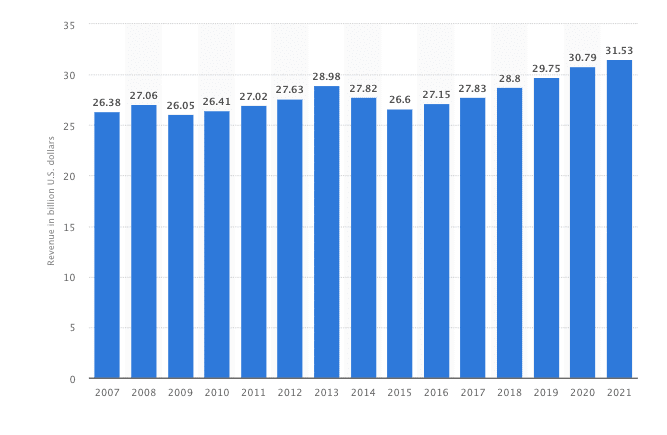
Magazine advertising will continue dropping (2018-2020).
Screen Shot 2018-07-23 at 9.26.24 AM
Major media estimates for 2018: magazines ranked third from bottom.
Screen Shot 2018-07-23 at 9.26.46 AM
Magazine advertising revenue is set to fall over the next two years.

Conventional publishing houses like Hearst and Conde Nast are increasing investments into digital properties as traditional print advertising falters. But independent publishers are taking a counter cultural approach to business. The Guardian just recently published a timely article on the independent publishing craze here:

Magazines espousing the counter-cultural idea of “slow journalism”, such as Ernest or Delayed Gratification (which was founded in 2011 to review news events “after the dust has settled”, has 5,000 subscribers and a print readership of 24,000), are funded by fairly expensive subscription charges. Ernest starts at £21.50 for two issues a year, while Delayed Gratification costs £36 for an annual subscription of four issues.

Whether they prioritise elegant looks or go for a samizdat-like underground style, they all share the appeal of the tactile experience of printed paper. “It is hard to say why people buy them. But the magazines are usually run and read by people who are enjoying the fact they have a voice and a place to go,” said Catterall. Read more.


IMG_2815
Issue No. 6: Gear Patrol.

Independent magazines have taken on a new role as home to more than a readership. These publications are cultivating consumer-driven communities away from the world wide web. Here are ten of the notables:

Monocle. $14. Winnipeg, Canada. The magazine launched on in 2007, By 2014, Tyler Brûlé sold a sizable minority stake in Monocle magazine to Nikkei Inc. It is reported that the company was valued at $115M at the time of the investment. Read more.

Darling. $20. Los Angeles, California. In 2009, the magazine’s Founder and Editor-in-Chief Sarah Dubbeldam and her husband Steve Dubbeldam created Darling. After starting off as a blog, the first print issue arrived in fall 2012. The magazine proudly embraces women of different ethnicities and body types. Read more.

Gear Patrol. $20. New York, New York. In 2014, founders Ben Bowers and Eric Yang launched the first magazine. GP is an award-winning digital, social and print publication that reaches nearly two million young, affluent men. The creative direction by Andrew Haynes has elevated the Gear Patrol brand to new levels. Read more.

Highsnobiety. $10. New York, New York. A publication covering forthcoming trends and news in fashion, art, music, and culture, all on one platform. Highsnobiety has steadily built a strong brand in the online fashion and lifestyle world. Today the blog and print magazine sit among the most visited global sources for inspiration in the areas of fashion, sneakers, music, art and lifestyle culture. Read more.

Uncrate. $15. Columbus, Ohio. A publisher for men, the bi-annual magazine features what to buy and how much it costs. Read more.

Cherry Bombe. $20. The magazine celebrates women and food through a biannual magazine. The book shares the stories of everyone from industry icons to notable newcomers, encouraging creativity in the kitchen. Read more.

Suitcase. $25. London, England. The magazine exists to change the way you travel: from where to go to how to pack. It’s for travel insiders, not tourists. Read more.

Raquet. $15. New York, New York. Racquet is a quarterly magazine that celebrates the art, ideas, style and culture that surround tennis. Read more.

Franchise. $20. New York, New York. A premium print publication dedicated to global basketball culture. The team consists of a group of players, artists and writers. The magazine documents the stories, characters and ideas that shape the game we love. Read more.

Here. $10. New York, New York. Away is a company on a mission and their latest project falls within this category. A well-produced, independent magazine that leans more on brand equity than advertising revenue. Steph Korey and Jen Rubio are the latest brand executives to turn their product into an escape for their readers. Read more.

Traditional publishing has been plagued by pay-for-play influence and an excessive approach to advertising sales and placements. Does anyone else ignore the first 20 pages of advertising? For brands that are looking to grow along with impassioned, independent audiences, this is the class of publishers that are truly making an impact for retailers.

Legacy magazine publishers focused on building a readership that advertisers would pay for. Independent publishers focus on building a product that consumers will pay for. Brand partnerships with independent publishers can reveal a smaller-yet-primed audience that can supplement performance marketing efforts. In the last two years, we’ve seen similar efforts launched by eCommerce brands: Airbnb, Hodinkee, and GOOP.

As traditional advertising and product placement continues to attract DNVB brands, you can expect to see more partnerships in this space. And more brand-funded magazines that mirror the quality of independent publishing.

इस मुद्दे पर अधिक जानकारी यहां पढ़ें।

वेब स्मिथ द्वारा | लगभग 2 बजे