

第 342 期:对立的埃利奥特先生

Elliot

In the closing scene of AMC’s final episode of Mad Men, the viewers are left to believe that our seven season survey of Don Draper ends in his personal enlightenment. In this particular moment: Draper is seen sitting on the grass, cross-legged and with no shoes. He’s meditating on a hilltop with a dozen or so other students. For what seems like just a moment, the audience is led to believe that the embattled protagonist is finally at peace with himself. And then he smiles. It’s the kind of smile that communicates “I’m still the best at what I do.” The audience is left guessing. The scenery, the moment, and Draper’s skill set suggest that Draper was responsible for conjuring one of the most impactful and audacious brand advertisements of the 20th century. It was a rare moment in brand history: an incumbent brand operated like an insurgent. The result? An ad that reshaped Coca-Cola’s narrative for nearly a decade.

The Mad Men scene of the origin story was fictitious, of course. The story of the advertisement’s impact was not, however. Like Ford and General Motors in the 1960s or Nike and Reebok in the 1980s, Coca-Cola and PepsiCo’s rivalry gave rise to the idea of insurgent brands. Insurgents are brands that arise out of the rivalries of incumbents.

In early 1886 an Atlanta chemist (and morphine addict) introduced Coca-Cola to the world. He called it a “potion for mental and physical disorders.” For him, it was a solve. The product’s main ingredient was cocaine, a narcotic that was – perhaps – less detrimental than his addiction. Pepsi-Cola followed just seven years later. It would be decades before the two companies became legitimate rivals. The arc of the two brands has become a case study in corporate brand competition. One that remains relevant to this day.

Pepsi-Cola had made hay during the Depression. Like Coke, the drink cost a nickel, but it came in a 12-ounce bottle nearly twice the size of Coke’s dainty, wasp-waisted one. But by the 1950s, Pepsi was still a distant No. 2. It nabbed Alfred Steele, a former Coke adman, who arrived embittered and ambitious. His motto: “Beat Coke.” Coca-Cola refused to call Pepsi by name — the drink was “the Imitator,” “the Enemy,” or, generously, “the Competition” — but it began tinkering with its business (and imitating Pepsi) to stay ahead. [1]

When John S. Pemberton secured the recipe for Coca-Cola in 1886, he couldn’t have foreseen a feud that would span three centuries. But for many consumers, the Pepsi vs. Coke feud is about as American as baseball. In 1899, Caleb Bradham decided to compete head on. Also a chemist, Brad’s Drink was later incorporated as Pepsi-Cola. And so began a roller coaster of a century that crescendoed in the 1970’s with the Pepsi Challenge – a marketing push that aimed to convince younger consumers that rival Coca-Cola had inferior taste and less cool. It worked. And so continued the back and forth. The two companies were well-established when the 1970s’ Cola Wars broke captivated American consumers (and international ones, alike).

The cola competition study [HBS Case Summary: 2] is a prologue to a greater point. What happens when incumbents ignore insurgents? The inertia of dominance often becomes an incumbent’s nemesis. At the peak of the cola wars, a future founder was employed by Unilever and then Procter & Gamble. There, he led marketing for German toothpaste manufacturer Blendax. By working for these conglomerates, Dietrich Mateschitz had an early education in the gifts and curses of incumbency. And one chance meeting in Thailand provided his platform for insurgency.

In 1982 he met an Austrian toothpaste salesman called Dietrich Mateschitz, who had started drinking Krathing Daeng (founded in 1976) during visits to Bangkok and found it cured his jet lag. Mateschitz became convinced that the drink had wider commercial potential, and in 1984 the two men became business partners. [3]

The emergence of Red Bull serves a case study in insurgency-driven marketing and branding. Over the next three decades, Red Bull would go on to master alternative marketing, clawing domestic and international market share from incumbents that should have been equipped to stifle the Austrian beverage manufacturer’s advances.
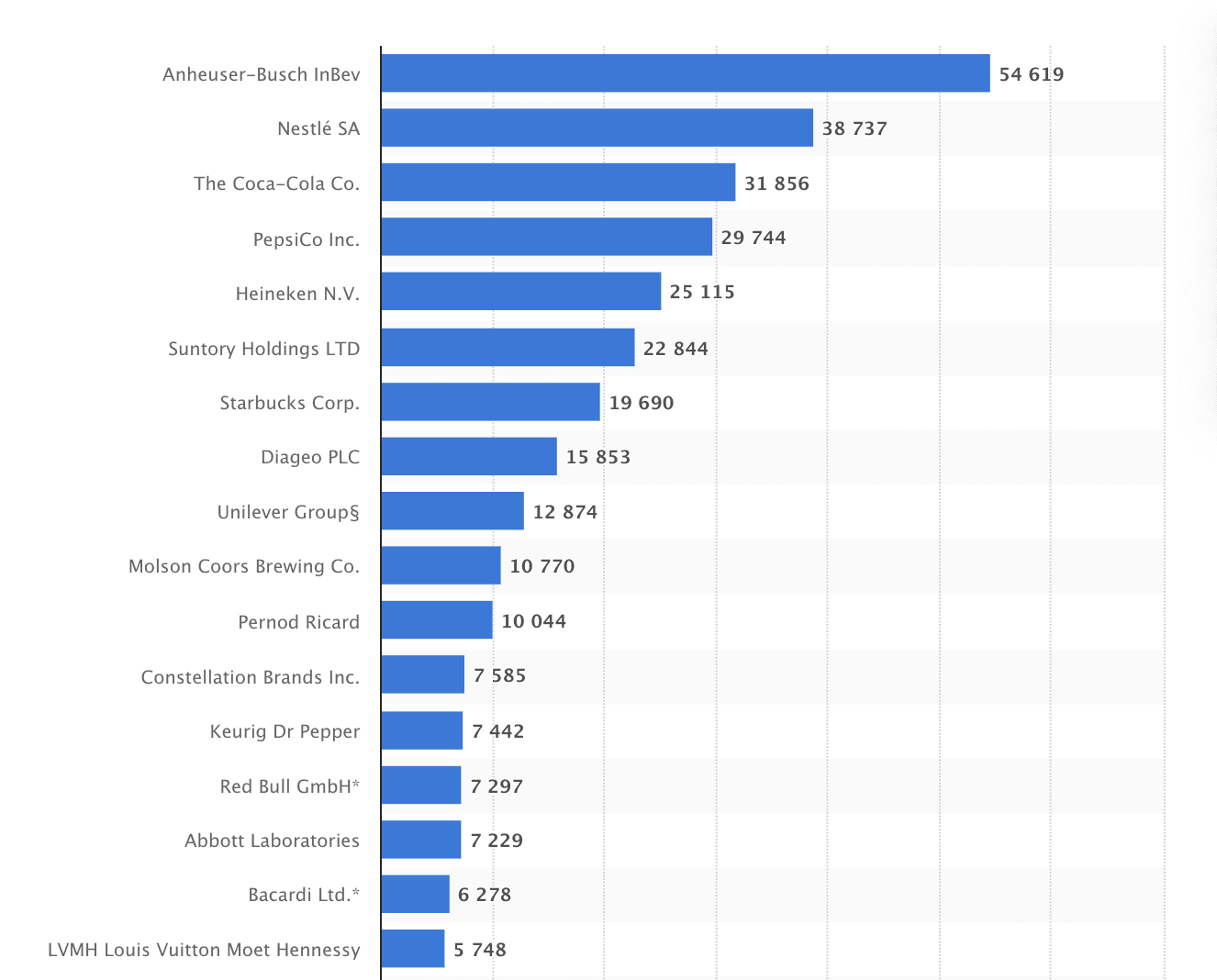
Screen Shot 2019-12-17 at 8.58.27 AM
Global beverage market: leading companies 2018, based on sales | Source: Beverage Industry Magazine

But as with anything, it can be difficult for incumbents to obsess over potential competitors when existing threats exist. By 1979, Pepsi overtook Coca-Cola in sales after a clever “taste test” marketing push that outwitted the Atlanta-based manufacturer. This victory was relatively short-lived. By 1996, Fortune magazine declared the cola wars to be finished. And since, Pepsi shifted its focus altogether.

IMG_7163-1024x682
Concepting a new form of brand marketing.

Retail has been witness to a history of these brand battles. And if the future of retail is eCommerce, it’s likely that today’s next surprise is brewing. Insurgents take markets by surprise by operating in ways unanticipated by established corporations. They move differently and they rarely play by traditional rules. Incumbents are incentivized to preserve the status quo, retaining market share. It’s often the case that product-wise, all things are equal. It’s the subtle differences in messaging and community that tends to shift the conversation from old and stable to new and dynamic. Shopify is the Coca-Cola of this conversation. Shopify wasn’t first to democratize eCommerce but no platform has a better understanding of marketing and branding than the Ottawa-based SaaS company. In a recent 2PM report, I explained:

The growth of the DTC era can be attributed to SaaS companies like Shopify, BigCommerce, Magento [Adobe], and Demandware [Salesforce]. But in an industry where innovations are finite development cycles away, community and brand equity has become the key differentiator. [4]

Shopify’s innovations are numerous. Two of their top competitors (Salesforce and Adobe) are now cogs in corporate wheels. In this way, BigCommerce is the Pepsi to Shopify’s Coca-Cola. Of all of Shopify’s innovations, branding and sociology are ones that BigCommerce cannot seem to contend with. Led by Brent Brellm, the Austin-based SaaS company competes on the merits of its product. “We taste better” may as well be on his CEO’s whiteboard. But Shopify is more than the merits of its product, it’s a lifestyle brand. This perplexes BigCommerce’s leadership. In the platform wars, taste will matter as technologies shift toward no-code architecture. But brand will be equally important. Enter Elliot, a platform that seems to possess the tools that Shopify’s other competitors do not. And an emphasis on substance and brand.

On Insurgency and No-Code Development
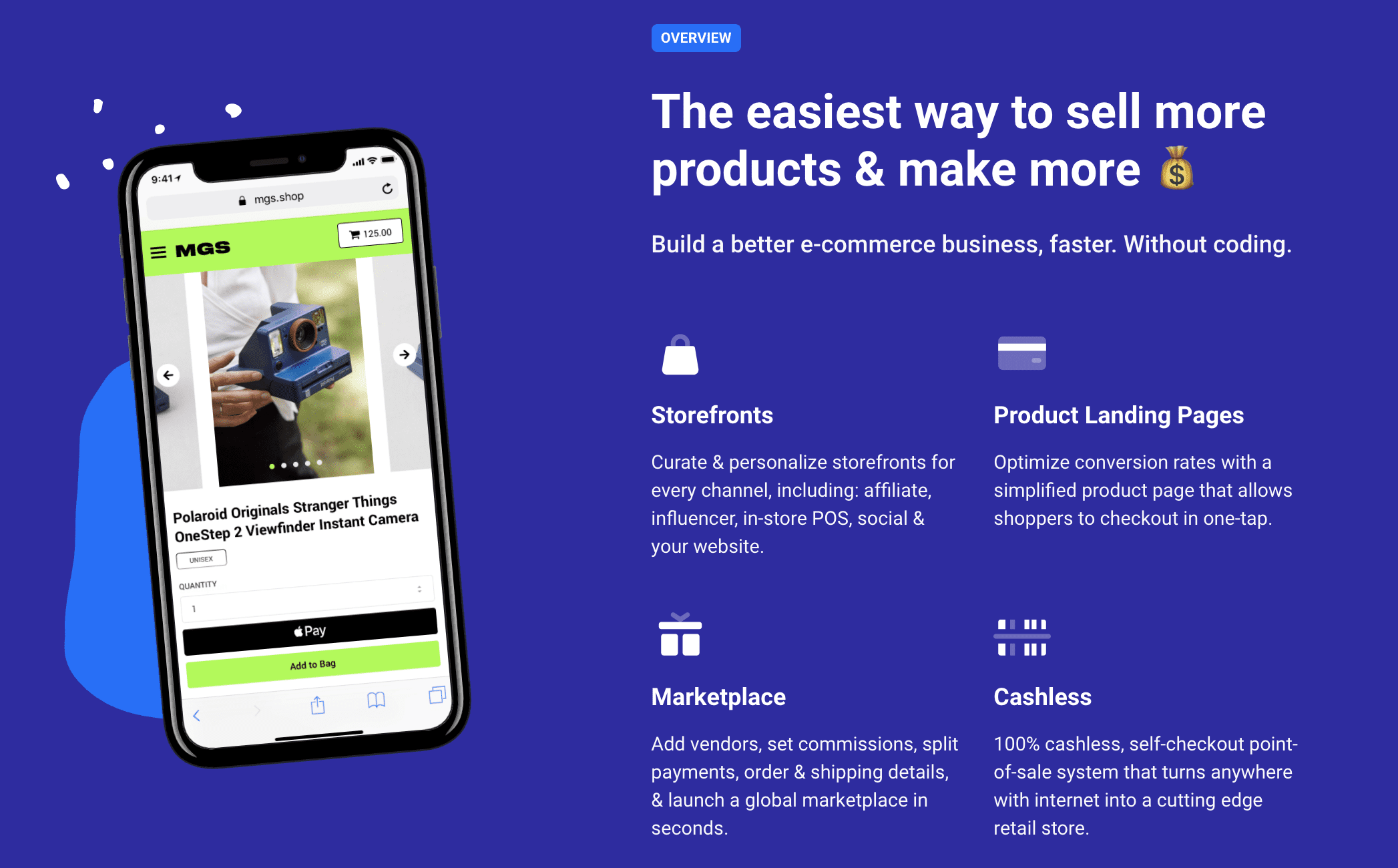
Screen Shot 2019-12-17 at 11.10.58 AM
The rise of the no-code economy

Founded in July 2017 by Sergio Villasenor, Elliot announced a $3 million round in January of 2018. And like many venture announcements in that first quarter, the news came and went. Beyond a PR wire, the company’s announcement made no headlines. There was no grand entrance and even less buzz. This, despite a list of admirable investors and advisors.

We have orchestrated a blue-chip syndicate of seed stage investors including Bowery Capital, a national seed stage fund with offices in SF and NY leading the round, and Susa Ventures as the co-lead. Others participating include Acceleprise, Bam Ventures, Flexport, and SV Angel. [5]

Early on, Elliot’s founder built the company’s value proposition on the common premise: “We taste better.”  In SaaS, this is akin to iterating fast and architecting software superiority. For product developers, this product-first concept is the default.

On the merits of its product alone, Elliot has a number of clones. A casual observer will find them in the brand’s Twitter mentions questioning how the company has begun to consume mindshare with its unique approach to antagonizing incumbent brands. The company, itself, has little protected intellectual property. And until recently, it had no marketing flywheel. But over time, I’ve observed the company’s playbook evolve into one reminiscent of an insurgent of old: Red Bull. The brand has become uncomfortably antagonistic. But you can’t behave insurgently without some level of discomfort.

Elliot on Twitter

@tobi Emojis must be a Plus feature 😉

Elliot contends that Shopify’s products aren’t for everyone. And that its no code approach is early but it will be of increasing relevance as vendors begin to shift away from development agencies to launch new merchandising operations. A Shopify Partner, who asked for his identity to be withheld, commented on this trend. He noted: “As no-code becomes more common, agencies like mine will need to find new ways to add value for our clients. Who is paying $100,000 to do what can be done for free?” In the Lean Luxe slack channel, former Shopify Editor-in-Chief Aaron Orendorff and notable copywriter contended with Elliot’s brand voice:

There’s a 100% chance I’m not your target audience. So that’s probably part of it. For me, it’s the mixed feelings of: (a) that’s clever and attention grabbing vs (b) I’d be uncomfortable to retweet it.

The founding team is rounded out by Clayton Chambers (formerly of Yotpo) who serves as the Head of Growth. Additionally, Villasenor was successful in hiring Marco Marandiz (formerly of Capital One, VRBO]) as his Head of Marketing. The team has made an early impact, though it remains to be seen as to whether it has had a material effect on penetrating one of Shopify’s top advantages: its partnership ecosystem. What is evident is that the DNA of the team is different than the rest. And that, more than anything else, makes them something to watch. They’ve begun to build Elliot into a lifestyle brand, merchandising and all. They are out-Shopifying Shopify.

Sergio Villaseñor on Twitter

est. 2019

The technology and promotional DNA that the company possesses aside, a few questions remain. Can Villasenor convince Shopify’s target consumer that no-code architecture is an acceptable path forward? And can he convince development agencies to shift their offerings to account for a no-code economy? Frequent justifications for merchants considering no-code platforms include: speed, cost reduction, and ease of launch. No-code architecture allows early stage brands to sidestep developer shortages and agency fees, potentially decreasing startup costs and early investment needs.

Although no one is saying that coding is dead or that programmers are going to be out of a job soon, there is no denying that the current demand for software far exceeds the supply of coders and that many traditional ways of building applications are complex and time-consuming. [6]

According to my research, less than 8% of Shopify Plus merchants have a GMV that exceeds $10 million annually. Although, this number can improve. Shopify brands like Supply can grow from $2.5 million annual run rates to $10+ million run rates in just a year.

Shopify’s gift is that its brand partners mature over time, a process that has been aided by the company’s support systems and suite of technical services. Some analysts would argue that BigCommerce (or Salesforce or Adobe) would be positioned to benefit if Shopify ever lost community support. However, it’s likely that Shopify’s incumbent competitors are ill-equipped to facilitate such a shift. And besides, all proverbial cola tastes the same. But no-code is a different value proposition altogether. One that may become relevant as the economy tightens and venture capital becomes less available to early stage eCommerce brands and retailers.

Like Coca-Cola, Ford, and Nike before it – Shopify’s name represents more than its product. In May 2020, Shopify hosts its next Unite conference in Toronto. It’s the annual event that hosts thousands of loyalists that converge to praise Shopify’s continued growth. In the process, the event fortifies the phalanx of protection that the SaaS company has surrounding it. More than software, Shopify is the people, brands, and agencies that evangelize it. These are the company’s strategic advantages. If Villasenor and team have it their way, they’ll be in Toronto as well. But they won’t be in the event’s venue handing out cards with software specs, that’s what an incumbent like BigCommerce would do. They’ll be down the street from Unite, hosting their own party. And perhaps, a few Shopify clients will trickle in to see what the fuss is about. Some will scoff at the lack of decorum and some will nod at the audacity of it.

报告人:Web Smith |大约 2PM

第 340 期:机动性碰撞课程

Steve Jobs believed that one of the few things that separated humans from high primates was our ability to build tools. In some cases, these tools mitigated the crippling inferiority of human mobility. Compared to some animals, humans possess lesser top end speed, endurance, and efficiency of movement. It’s our ability to engineer solutions that ultimately improves our collective mobility. Jobs assessed these shortcomings in a 1995 interview:

I read a study that measured the efficiency of locomotion for various species on the planet. The condor used the least energy to move a kilometer. And, humans came in with a rather unimpressive showing, about a third of the way down the list. It was not too proud a showing for the crown of creation.

Over the course of Jobs’ career, he predicted the future quite a few times. He foresaw what the inter connectivity of internet would do for humanity. He predicted the efficacy of the computer’s mouse, and the dawn of cloud computing, and the professional preference of the laptop computer. Jobs even understood that the diffusion of this technology would be so profound that ten year olds would own computers that are orders more powerful than the ones used by 1960’s-era NASA engineers. But it was perhaps his two distinct thoughts on figurative and literal mobility that may go on to define the next ten years of disruption.

Jobs indirectly recognized the inverse relationship between online retail and shopping centers:

People are going to stop going to a lot of stores. And they’re going to buy stuff over the web.

The second thought expounded on his obsession with human physical efficiency:

Somebody at Scientific American had the insight to test the efficiency of locomotion for a man on a bicycle. And, a man on a bicycle, a human on a bicycle, blew the condor away, completely off the top of the charts.

This line of thinking is the origin of Jobs’ commentary on the personal computer serving as a proverbial bicycle for the mind. According to Jobs, “What a computer is to me, is it’s the most remarkable tool we’ve ever come up with. It’s the equivalent of a bicycle for our minds. Walking is relatively slow and inefficient.” This remarkable thought may end up meaning something more than what Jobs meant at the time.

The advancement of mobile payment technology and the evolution of physical mobility are on a collision course. The diffusion of one technology may lead to the diminishing of the other. There is no greater example of the potential disruption than China’s stark contrast to the nature of American retail. Cashless consumer economies will have a profound effect on mobility. Paul Haswell of Pinsent Masons notes:

Many Chinese cities are now the closest we have to cashless consumer economies.

According to eMarketer’s Shelleen Shum: 79.3% of smartphone users in China will operate within a completely cashless economy. By comparison, the United States will see just 23% of smartphone users doing so by 2021. And Germany will have just 15%. Why is this significant? The move towards a cashless economy corresponds with a shift in mobility preferences. “The use of digital technologies—from smartphones and wearables to artificial intelligence and driverless cars—is rapidly transforming how city dwellers shop, travel, and live.Without a firm foundation in electronic payments, cities will not be able to fully capture their digital future, according to our analysis,” said Lou Celi, Head of  the Roubini ThoughtLab.

无标题

Mobile payments are influencing a collision course. No. 1 market for mCommerce (payments) is China. Here is a quick comparison. Mobility:1a/ US cars per 1000: 8381b/ China’s cars per 1000: 179Retail locations:2a/ US sq. ft. / person: 23.5 2b/ China sq. ft. / person: 2.8

And here is the key question. If the United States is moving towards a cashless society driven by mobile wallets and smartphone-driven payments systems, will the shape of our economy begin to change with it? The data affirms. The shuttering of American retailers outpaced all of 2018 by April of 2019 according to data from Coresight Research. As of now, the correlation does not rely upon mobile payment tech. Rather, it’s driven by the growing adoption of online retail. However, online retail adoption in China is driven by mobile payment technologies. American adoption of such technologies will accelerate overall growth. The percentage of retail in the form of eCommerce will hockey stick when it does.

Smart Cities and Urban Mobility

9db5098f3d10fea0f7d35b394714b6ae9518277c_2_1380x840
From Polymathic: The market opened to red, post Black Friday 2019.

There may not be a greater example of the potential clash between online retail and mobility than the city that is quietly known for its specialty retailers. In retail circles, Columbus is known as HQ City; the Central Ohio region is host to Abercrombie & Fitch (and Hollister), L Brands (Victoria’s Secret, Bath & Body Works, etc.), Express, Ascena Retail Group (Limited, Justice), DSW, Value City Furniture, and ties to American Eagle Outfitters. There isn’t a mall in the United States that isn’t influenced by this region’s businesses.

For Columbus, it’s a double-edged sword. The city’s working population is heavily influenced by this small group of very large employers. And these large employers have a symbiotic relationship with America’s inflated 23.5 square feet of retail real estate / person. In comparison, China has just 2.8 square feet of retail / person. Despite this lacking physical infrastructure, China passed the United States as the number one retail market in 2019. [1]

In 2015, Columbus, Ohio applied for a national grant for the Smart City Challenge, a national competition between a collective of technologically progressive cities.

Smart Columbus will help shift travel patterns. Even more, we want to shift people’s thought patterns and behavior. This means inspiring policy makers and influencing people’s preferences. We will partner with others to create programs, introduce new solutions and promote adoption. Once our city understands what’s possible, everybody should be able to get on board. This will be a gradual process over the coming decade. As a region with urban sprawl, we are committing to a new, improved ecosystem of solutions to move people and goods. [2]

A smart city is tasked with testing technological solutions and progressive policies to innovate mobility practices. As the winner of the first-ever Smart City Challenge, the city agreed to embrace the “reinvention of transportation to accelerate human progress.” The city would then serve as a standard bearer to other cities as they continue to evolve. In 2017, the city outwitted dozens of other top cities to include: Pittsburgh, San Francisco, Portland, Kansas City, Austin, and Denver. The result was an award of a combined $50 million grant from the US Department of Transportation and the Paul Allen Foundation.  This award would then be amplified by hundreds of millions in public-private partnership, generated by the cities own businesses and political partnerships.

Through the Smart City Challenge, the Department committed up to $40 million to one winning city. In response, cities leveraged an additional $500 million in private and public funding to help make their Smart City visions real. [3]

Screen Shot 2019-12-02 at 1.44.24 PM
United States: eCommerce as a share of retail

The data suggests that the advancement of eCommerce adoption would influence mass transit and ride sharing as primary means of urban travel. This same data would suggest that eCommerce would also spur economic development in harder to reach areas of the region. But it would have to get much worse before conditions improve. Some 92% of the citizens in China’s largest cities use Alipay or Wechat as their mobile wallets and sole means of transacting. In rural China, that number is 47%. In both cases, the primary means of retail is through eCommerce channels. In contrast, America will see just 12.4% of retail by eCommerce in 2020. For rural citizens and underbanked Americans, that number is significantly lower. The majority of eCommerce transactions are located in or near major metropolitan areas. This is relevant and will be explained shortly.

Black Friday 2019

In September of 2017, the proverbial floodgates opened. Amazon’s patent for one-click purchasing expired. With this, any and every online retailer could build or integrate payments solutions to promote better consumer experiences on desktop and mobile platforms. The improved experiences were especially noticeable on mobile operating systems, where dropped carts were commonly 60+%.

The end of Amazon’s hold on one-click ordering gives opportunities to large and small retailers to reap benefits they haven’t had before. Perhaps the most widespread benefit will come in the world of mobile commerce where there are high rates of cart and purchasing abandonment. […] The patent expiration will allow for widespread adoption of one-click purchasing, which will challenge the market to adapt quickly. There is an opportunity for major reconfiguration of social networks to challenge major e-commerce giants such as Amazon.  [4]

This coincided with the integration of tools like Apple Pay, Android Pay, and Shopify Pay, three solutions that would fuel mobile commerce in ways that were only previously seen in Chinese markets. Apple Pay recently crossed Paypal in volume of transactions. Amazon’s YoY growth was closely tied to the stickiness of similar technologies. An unnamed Shopify analyst suggested that with Shopify Pay, conversion rates were nearly identical to Amazon’s – an extraordinary improvement in performance between 2016 and 2019.

Screen Shot 2019-12-02 at 1.42.59 PM
United States: Projected revenue from mobile commerce ($B)

Over this most recent retail holiday, there was a contrast to observe. In 2PM’s most recent Executive Member Report, I explain the context behind the title “The Blackest Friday.” According to data pulled from Alibaba, Amazon, and Shopify – Black Friday was a success for the burgeoning eCommerce ecosystem and a disappointment to traditional retailers like Kohl’s, JCP, and Nordstrom. The holiday shed light on the growing divide between mobile adoption and the dependence on traditional retailers.

无标题

It wasn’t deals that drove the BF, it was ease of purchase. Via Adobe Analytics: 1/ 39% of eCom: mobile2/ 61% of traffic: mobileAnd Shopify added 400k stores in 2019. The avg. BF $ / merchant dropped just 1.8%. Payments ease mitigated the lack of trust or perceived value.

Adobe, which now owns Magento, revealed data that communicates a permanent shift toward mobile traffic (61% mobile). Shopify’s data (69% mobile) reflected the same. Physical retail continued to slip.

The drop in Black Friday physical shopping mirrors a year-long share pullback in departments stores including Macy’s, Kohl’s and Foot Locker, all of which are down more than 25% this year. Meanwhile, Amazon, the dominant U.S. e-commerce retailer, has gained about 20% this year. [5]

For Shopify, the result was especially positive. On the heels of Apple Pay adoption and the growth of Shopify Pay,  the company added 400,000 new stores in 2019 while dropping just 1.8% in average store revenue on Black Friday. This tells a story. Despite the relative infancy of nearly 40% of the stores on the platform, new merchants were able to generate nearly enough in sales volume to match the per capita avg sales figure of the previous year’s merchants. This would indicate that the shift away from desktop and towards mobile payments mitigated issues of trust or early-stage brand equity concerns by lifting conversion rates. As mobile payment adoption increases, the divide between DTC-minded brands and traditional retailers will continue to grow. So where does this get us?

Conclusion: On Primates and Politics

If you’ve ever frequented Amazon Prime Now, you understand the value of two hours saved. In a matter of 90 seconds, you can click through on recently purchased grocery items to replenish your pantries. Then, in a matter of 60-90 minutes, those selections manifest. There are four packages at your door. When Steve Jobs suggested that software engineering would impact our mobility, it’s unlikely that he imagined the effect that mobile commerce would have on developed cities. Mobility isn’t just the efficiency, speed, or distance traveled. It’s what we can do with our time. Mobility is freedom.

When Columbus, Ohio was awarded $50 million to build the blueprint for a smart city, it’s unlikely that the city’s leaders understood the ties between commerce technology and physical mobility. If so, the heaviest investments would have been earmarked for commerce infrastructure:

  • improving shipping lanes by designating key routes for delivery vehicles and couriers
  • retrofitting struggling malls and shopping centers as fulfillment hubs
  • investing in the numerous local businesses by equipping them with the same types of technologies that enable the DTC mobile revolution
  • repurposing successful malls as meeting grounds, deemphasizing the emphasis on shopping
  • and laying the groundwork for a city with 60-80% fewer cars and 70-90% fewer shopping centers

America is over-retailed. And unfortunately, innovation in online retail will exacerbate this. For Columbus (and many other forward-thinking cities), this is a conflict of interest. As regions shift toward mobile commerce-forward models, old ways of retailing will subside. And given early data  – the numerous retailers that are headquartered in and around the city would be placed at existential risk.

It’s for this reason that Columbus serves a microcosm of traditional retail as a whole. The industry will have to choose between its past and its future, both of which are tied to shifts in mobility innovation.  Like Jobs said in 1995: “People are going to stop going to a lot of stores. And they’re going to buy stuff over the web.” This is beginning to reflect in public and private markets. What happens when we stop driving to stores? What happens when shopping centers no longer have sufficient demand? What happens when advancements in last-mile delivery becomes carbon negative? This is happening now.

The largest retail economy in the world is no longer the United States. But this will potentially change, as the United States closes the gap in mobile computing and payments adoption. China has 10% of the retail square footage and 79% fewer cars. This should give us pause. These numbers provide a bit of foresight into how this country must adapt to modern retail. Computers did become the bicycles for our minds. And now, advancements in mobile computing and payments are influencing physical mobility. The smartest cities will correct for these advancements before the markets correct it for them.

Research and Report by Web Smith | About 2PM 

Member Brief: NASA, The Moon, and Jeffree Star

Member Brief - 2PM

There’s a scene in Damien Chazelle’s First Man that depicts a moment that I had never considered. A tune by Leon Bridges blares for the short duration of the scene. On screen, a group of young African-Americans stand viewing the Apollo 11 launch from a nearby field. Kennedy Space Center is in view but the military installation may as well have been 10,000 miles away. They were purely spectators, nowhere near the real action. And they knew they never would be.

本会员简报专为以下人士设计 执行委员为了方便加入,您可以点击下面的链接,获取数百份报告、我们的 DTC 权力清单和其他工具,帮助您做出高水平的决策。

在此加入