NATSEC Roundtable No. 10: The Forges Went Dark

Years ago, when Mizzen+Main was still a young brand trying to prove that performance fabric had a place in the dress shirt category, I made an argument that nobody wanted to hear: keep the manufacturing in America. Not because of patriotism in the greeting-card sense, but because of what domestic production would have enabled over time. Mizzen+Main had something unusual for a direct-to-consumer brand at that stage of its life. The product had coastal cues, the kind of clean technical construction that reads well on a dock and equally well in a briefing room. It had military adjacency in its aesthetic DNA without ever having claimed it explicitly. The fabrics performed under stress. The fit was disciplined. There was a customer profile hiding inside that brand that went well beyond the weekend golfer and the startup founder who wanted to look put-together on a Zoom call.

The argument I was making, even if I wasn’t articulating it in these terms at the time, was that Mizzen+Main had the early profile of a dual-use textile company. Not a contractor; not a uniform supplier. Something more interesting than either of those things: a civilian brand with the product credibility to serve both markets without compromising the identity that made it matter to consumers in the first place. The manufacturing stayed offshore. The brand grew, was acquired, and became a solid mid-market performance apparel business. The other version of the story, the one where domestic production and defense-adjacent positioning compound over a decade into something that looks more like a platform than a brand, never happened. I don’t think anyone regrets the decision they made. I do think the window they missed is worth understanding.

What the Chart Actually Shows

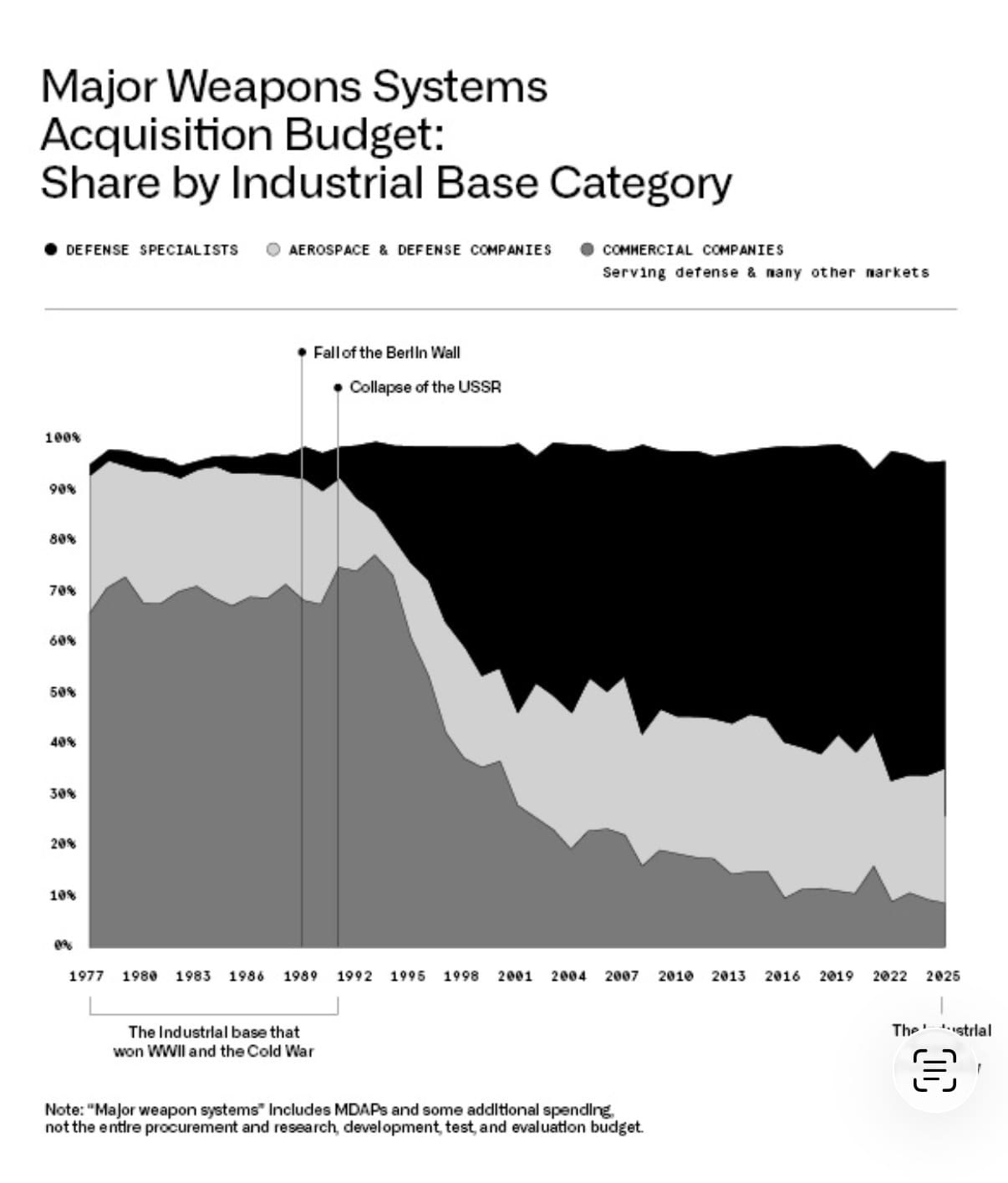
Shyam Sankar and Madeline Hart published Mobilize this month, and the Palantir CTO’s argument is not subtle. The book is a call to resurrect the American industrial base before the structural consequences of its decay become irreversible. The chart that anchors the book’s diagnosis shows the Major Weapons Systems Acquisition Budget broken down by industrial base category from 1977 to 2025, and what it reveals is one of the most consequential and least discussed shifts in American economic history.
An early nominee for the most important book of the year.

In 1977, commercial companies, companies serving defense and many other markets simultaneously, represented the largest single category of weapons systems acquisition spending. These were companies like Chrysler, which built tanks. General Mills, which built naval fire control systems. Ford, which built aircraft engines. The industrial base that won World War II and the Cold War was not a specialized defense economy. It was the American commercial economy, partially redirected. The capacity that defeated the Axis powers was the same capacity that built automobiles and refrigerators and breakfast cereal. The defense budget flowed through companies that also competed in consumer markets, which meant their manufacturing processes, their supply chains, and their engineering talent were being continuously sharpened by commercial competition.

Then the Berlin Wall fell and the USSR collapsed, and the procurement world made a decision that seemed rational in the moment and has proven disastrous in hindsight. Defense spending consolidated into a smaller number of specialized contractors; I lived that too. As the Cold War came to a halt with the fall of the USSR, my father left Texas Instruments’ missile defense practice for greener pastures at Time Warner Communications. TI sold its practice to Raytheon, four years later, for $2.9 billion in cash. For an ex-military officer turned defense contractor, he segued pretty well for the time. Commercial companies exited the defense market because the margins didn’t justify the compliance costs and the procurement timelines didn’t suit commercial operating rhythms. By the 2000s, the commercial company share of the acquisition budget had fallen to a fraction of what it had been, replaced almost entirely by defense specialists and aerospace and defense companies whose entire business model was organized around government contracting. The industrial base that had once been synonymous with American economic vitality became a separate and increasingly fragile ecosystem.

Sankar and Hart’s argument is that this separation is the source of nearly every current American defense capability problem. The Pentagon now buys from companies that have no commercial discipline, no competitive pressure, and no incentive to innovate faster than the contract requires. The companies that might bring speed and manufacturing competence to defense problems have largely opted out because the procurement system was designed to exclude them. The result is the chart: a graph whose shape tells the story of American industrial decline more clearly than any policy paper or congressional hearing.

The Dual-Use Premise

The concept that Sankar and Hart are trying to recover is not new. It is, in fact, the original operating model of American industrial power. What made the United States capable of outproducing every adversary in the twentieth century was not a defense industry in the modern sense of that term. It was a manufacturing economy that could be mobilized because its capabilities were genuinely general-purpose. A factory that makes automobiles can, with the right conversion effort, make tanks. A company that supplies textile mills can, with the right contracts and specifications, supply the military. A logistics network built to move consumer goods can, under pressure, move war materiel. The dual-use company is not a strategic novelty. It is what American industry looked like when America was winning.

What has changed is that the procurement system spent thirty years actively discouraging commercial companies from participating in defense markets, through compliance requirements, contracting structures, and classification barriers that made the cost of entry prohibitive for any company that had a viable alternative. The companies that might have stayed in the market left. The companies that entered the market after that period were purpose-built for government contracting, which meant they were optimized for compliance rather than performance and for contract retention rather than innovation. The defense industrial base became a walled garden, and the plants went quiet, and China spent those thirty years building the manufacturing capacity that the United States was methodically dismantling.

Anatar and What Domestic Manufacturing Looks Like Now

Anatar is an American apparel manufacturing company building automated domestic production capacity through its Loom OS platform, an AI-orchestrated system that manages production planning, dynamic line routing, and downstream demand sensing from a single integrated software layer. The company’s Georgia manufacturing facility will be among the first domestic apparel plants built around autonomous production at commercial scale.

What makes Anatar worth discussing in the context of Mobilize is not the eCommerce angle. It is the defense relationship that has been there from the beginning without being the headline. Anatar is an approved member of the Advanced Robotics for Manufacturing Institute, a Manufacturing Innovation Institute funded directly by the Office of the Secretary of Defense. It is also a member of the Revolutionary Fibers and Textiles Consortium, another Department of Defense Manufacturing Innovation Institute. These are not marketing relationships. They are structural integrations into the defense manufacturing innovation ecosystem, which means Anatar’s technology is being developed in the same environment, against the same standards, and in conversation with the same institutional stakeholders as the military textile supply chain.

This is what a dual-use company looks like in 2026. It is not a defense contractor that makes civilian products on the side. It is a commercial manufacturing company that has built its technical infrastructure inside the defense innovation ecosystem from the beginning, which means that when the procurement system eventually opens up to the kind of agile domestic manufacturers that Sankar and Hart are arguing for, Anatar will already be there. The capability is commercial. The relationships are governmental. The manufacturing platform serves both markets without being compromised by either.

The version of Mizzen+Main I was imagining in those early conversations was something along these lines, even if the path from performance dress shirts to a defense textile supplier requires a longer argument than most brand founders are willing to make. The aesthetic profile was right. The product performance was right. The only missing element was the domestic manufacturing decision that would have created the infrastructure for the rest of it to follow.

Ten Already Building the Dual-Use Industrial Base

The list I want to make is not about brand aesthetics or defense-adjacent positioning. It is about companies sitting inside the Ohio-Indiana-Michigan-Pennsylvania manufacturing corridor that are already producing the kind of output, or already developing the kind of platform, that a reformed procurement system should be routing contracts through. These are not aspirational candidates. Most of them are already there in some form. What they need is not encouragement. They need the procurement barrier removed.

Rogue Fitness consumed 26 million pounds of steel in a single year at its 800,000-square-foot factory on East Fifth Avenue in Columbus, along with 14 million feet of welding wire. The company already sells equipment to military units, collegiate programs, and the professional sports teams whose athletes feed into the services. The manufacturing process that produces a barbell to tolerance is the same process that produces precision steel components for any program that needs them. Rogue is not a defense company. It is an Ohio steel fabricator with a consumer brand attached, and that distinction is the entire point.

Path Robotics is a Columbus startup that has trained its Obsidian AI model on tens of millions of welded inches and deployed autonomous welding cells into fabrication shops across the country. In February 2026, Path signed an MOU with HII, the nation’s largest military shipbuilder, to bring autonomous welding to naval shipyards, and separately announced a deployment with Saronic, the autonomous vessel builder, in Louisiana. The intelligence behind those systems, the vision models, the machine learning architecture, the software stack, is an Ohio product built in Columbus. Path is not aspiring to defense relevance. It is already there, and the procurement system has barely noticed.

Vertiv, headquartered in Westerville and manufacturing in Delaware and Ironton, Ohio, announced in late March 2026 a $50 million expansion of its Ohio facilities adding up to 730 new jobs through 2029. The company builds the power management, thermal management, and critical digital infrastructure that keeps data centers running without interruption. That is also what keeps a command and control facility operational under pressure, what keeps a forward operating base’s communications infrastructure alive, what keeps any mission-critical computing environment running when the grid is contested. Vertiv became a Fortune 500 company in 2026 and its technology is already embedded in defense-adjacent infrastructure worldwide. The formal relationship to the procurement system is the only thing missing.

French Oil Mill Machinery has been building hydraulic presses in Piqua, Ohio, since 1900. The company already lists aerospace, military, and defense as a primary market on its website. Its custom hydraulic presses are used in composite manufacturing, rubber molding, and lamination processes that appear throughout the defense supply chain, from aircraft components to armor systems. French Oil is the company on this list that most clearly illustrates what the chart is measuring: a commercial manufacturer with over a century of domestic production that has always served both markets, quietly, without the procurement system building the kind of formal relationship that would make that capability visible and scalable.

Lincoln Electric, headquartered in Cleveland, is the world’s largest manufacturer of welding products and a company whose equipment is already in every serious fabrication shop in the country, including the ones building defense hardware. The dual-use argument for Lincoln Electric is straightforward: the company that makes the machines that weld the components is upstream of every manufacturing program in the defense supply chain. Lincoln Electric’s commercial relationships with fabricators and its technology development roadmap, including automation and AI-assisted welding, position it as a platform company for the industrial mobilization that Sankar and Hart are describing.

Cummins, based in Columbus, Indiana, manufactures diesel and alternative fuel engines that power commercial vehicles, construction equipment, and generators worldwide. They also power military vehicles, generators in forward operating bases, and the logistics infrastructure that keeps any sustained operation functional. Cummins already has defense relationships through its commercial engine business. The question the procurement reform agenda should be asking is not whether Cummins can serve defense programs. It is why those relationships are not more formal, more durable, and more strategically structured.

Parker Hannifin, headquartered in Cleveland, makes the motion and control technologies that appear in aircraft, satellites, defense systems, and the industrial equipment that builds all of the above. Parker’s commercial business is already deeply integrated with aerospace and defense through its product portfolio, and the company has formal defense programs. It belongs on this list not as an aspirational candidate but as a demonstration of what a mature dual-use industrial company looks like, and as a standard against which the others here should be measured.

Kennametal, based outside Pittsburgh, makes cutting tools, tooling systems, and engineered components from tungsten carbide and other advanced materials. Its products are used in machining operations that produce defense hardware, aerospace components, and precision manufactured parts across the industrial base. Kennametal is the kind of company that the chart is mourning the loss of: a materials science company with deep manufacturing expertise whose commercial and defense customers require the same underlying capability.

Dana Incorporated, headquartered in Maumee, Ohio, makes drivetrain and sealing products for commercial vehicles, off-highway equipment, and industrial applications. The same components that Dana engineers for heavy commercial trucks also appear in military vehicle programs, because the underlying engineering problem is identical: transmitting power reliably under load, in harsh conditions, without failure. Dana already has defense programs. The barrier to deeper integration is not capability. It is the procurement structure that treats commercial and defense supply chains as separate systems when the twentieth century proved they function best as one.

Whirlpool, based in Benton Harbor, Michigan, is the largest appliance manufacturer in the country, with domestic production and a supply chain built for volume. The dual-use case for Whirlpool is not about appliances. It is about the fact that a company capable of producing millions of precision-engineered units per year from domestic factories has the manufacturing management systems, the quality control infrastructure, and the workforce scale that a mobilization scenario requires. General Mills did not win World War II by making cereal for the Army. It won by demonstrating that its production capacity and manufacturing discipline could be redirected. Whirlpool is the closest contemporary equivalent in the consumer goods space.

A Direct Address

I have been covering the intersection of consumer commerce and defense technology at 2PM long enough to watch the conversation move from the margins to the center. I see which centers consume the data and insights, from the Pentagon to the main lands of our adversaries. I often write with this in mind. Both the good guys and the bad guys have access to the same analyses and opinions in the modern day, and the ideas in this essay will travel accordingly.

For those in positions to act on the reform agenda that Mobilize describes, the commercial brand world is a more capable and more willing partner than the current procurement structure has allowed it to be. The brands on the list above are not waiting for a government relationship to validate their product quality. They have already proven it in commercial markets that are harder to fool than government procurement, because commercial customers can leave and defense customers historically have not been able to. What these brands need is not subsidy or preference. They need procurement barriers removed, compliance costs reduced to something proportionate to a commercial company’s operating model, and contracting timelines that do not require a company to wait three years to find out whether the relationship was worth pursuing.

Sankar and Hart end Mobilize with a call for people and ideas before hardware, which is the correct sequencing. The people building dual-use companies today, the Kaia Rhodes building Anatar inside DoD manufacturing institutes, the founders choosing domestic production when offshore would be cheaper, the brand operators applying military-grade performance standards to civilian products, are the industrial base that the reform agenda needs. The question is whether the procurement system can move fast enough to meet them before they conclude that the commercial market alone is a sufficient reason to exist.

The forges went dark because the system made it rational to let them. The system is being reformed. What happens next depends on whether the reform is fast enough to matter and ambitious enough to actually reintegrate the commercial and defense economies that the twentieth century proved were stronger together. The brands are ready. The manufacturing talent is available. The technical infrastructure is being built, in Georgia, in Oregon, in Maine and Massachusetts, by people who did not wait for a procurement officer to tell them it was worth doing.

韦伯-史密斯的研究与写作

Web Smith is an outside consultant, the founder of 2PM, and the Chief Revenue Officer at MTN Haus, a Shopify Premier Partner agency specializing in complex commerce systems. The 2PM NATSEC briefing series covers the intersection of defense technology and commercial brand strategy.

NATSEC Roundtable No. 9: Capital, Cloud, and Commerce

This is the new defense stack, and the best venture capital firms in the country (re: world) enable it. 

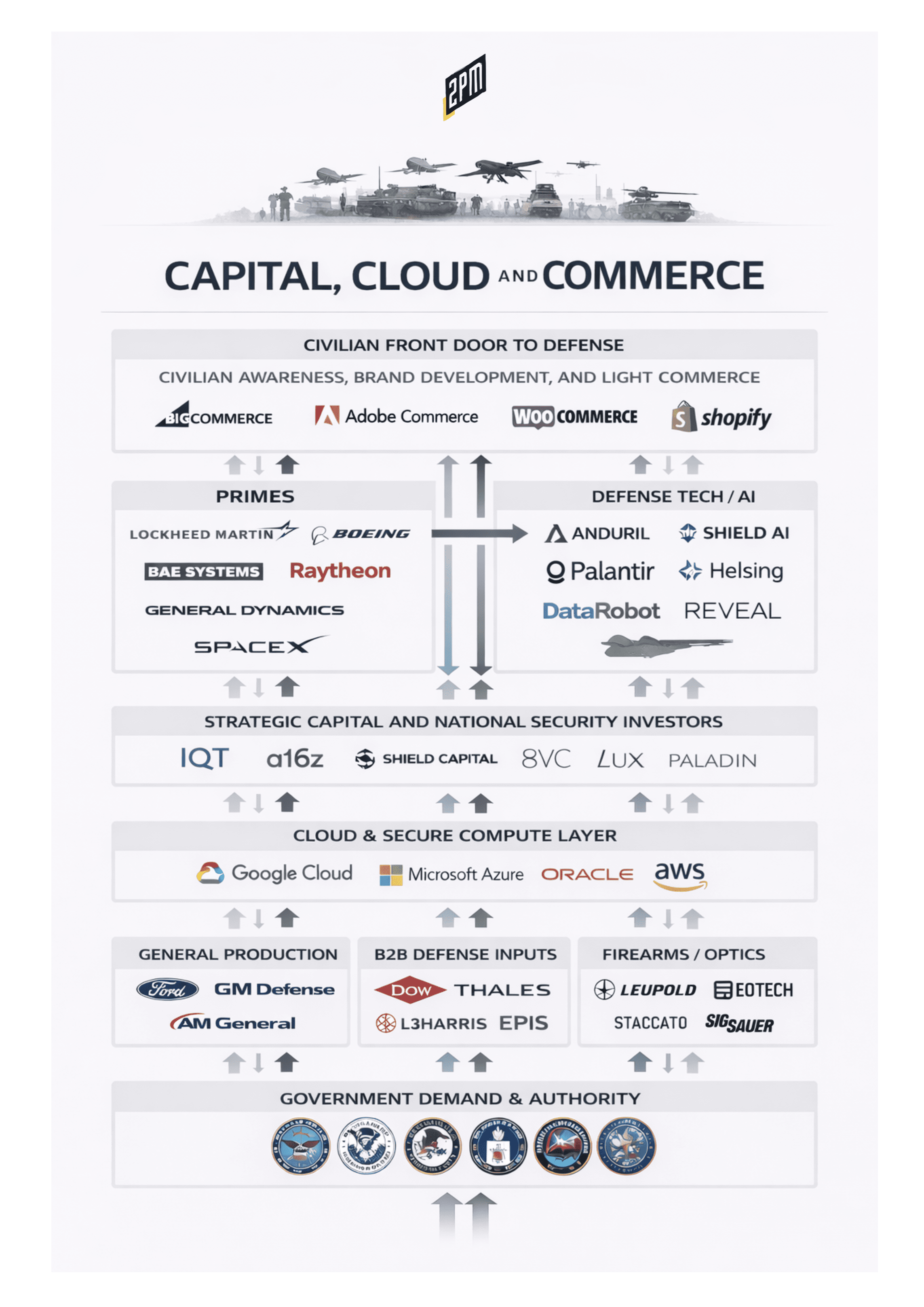
American military and intelligence capabilities no longer originate solely in the Pentagon or within the legacy defense primes. It is increasingly assembled across three layers that sit outside traditional procurement: venture capital, cloud infrastructure, and modern commerce platforms (B2B-primarily). Each layer operates commercially, and each layer is indispensable to national power. Each layer is quietly shaping how modern national defense is built, coordinated, and sustained.

The emerging defense ecosystem is best understood not as a weapons system, but as a technology stack: capital funds it, cloud computes it, commerce distributes it. Together, they form the invisible scaffolding beneath the visible battlefield.

To see this clearly, it helps to begin with the investors who explicitly finance national security innovation. These firms are not opportunistic participants. They are mandate-driven actors who have chosen to organize themselves around American security as a core thesis.

Mandate-explicit capital for national security

The table below captures the U.S. venture investors that publicly state a defense, national security, or dual-use mission. This is not a generalist list. It excludes firms that occasionally invest in defense. It includes only those whose identity, fund structure, or published thesis explicitly centers on national security.

FirmCategoryHow the mandate is stated:Primary domains they name
In-Q-Tel (IQT)Strategic / government-adjacentExists specifically to identify and scale commercial technology for the U.S. national security community and allied agenciesAI, data, cyber, sensors, space, advanced analytics
a16z – American DynamismLarge platform with dedicated practiceRuns a named practice and fund explicitly focused on “the national interest,” including defense and aerospaceAerospace, defense systems, industrial tech, frontier science
Shield CapitalDefense specialist VCPositions itself at the intersection of commercial tech and national securityAI, autonomy, cyber, space, robotics
Razor’s Edge VenturesDefense specialist VCStates its core mission is backing companies that solve major national-security challengesCyber, space, data, sensing, dual-use infrastructure
Decisive PointDefense / critical tech VCPublicly frames itself as investing in technologies critical to defense, energy, and national resilienceDefense tech, energy, infrastructure, advanced hardware
Scout VenturesDual-use frontier VCExplicitly focuses on founders from the military, intelligence community, and national labs building dual-use techAI/ML, robotics, space, security, advanced materials
8VC (Government & Defense focus)Large platform with explicit defense thesisMaintains a distinct government/defense investing effort and teamDefense systems, autonomy, logistics, industrial tech
Point72 Ventures (defense positioning)Growth/late-stage VCPublicly describes itself as a dedicated partner to next-generation defense-tech companiesAI, autonomy, sensors, secure software
DataTribeCyber-security foundryDescribes itself as bridging Silicon Valley and the Intelligence Community to strengthen U.S. cyber capabilityCybersecurity, secure infrastructure, national labs spinouts
Paladin Capital (Cyber Fund)Security VCExplicitly focuses on “Digital Infrastructure Resilience” and protection of critical systemsCyber, critical infrastructure, secure networks
NightDragonSecureTech VCStates that it invests in SecureTech including defense, national security, and advanced cyberCyber, AI security, quantum, defense software
Lux CapitalFrontier science VCPublicly frames recent funds as operating at the intersection of frontier science and national securitySpace, AI, advanced manufacturing, energy
DCVC (Data Collective)Deep-tech VCPublishes theses explicitly linking its investments to strengthening U.S. defense innovationAI, robotics, space, autonomy, industrial tech
Riot VenturesIndustrial modernization VCPublic materials and reputable coverage consistently describe a focus on modernizing sectors including defense/aerospaceIndustrial automation, robotics, aerospace supply chain
J2 VenturesDual-use VCWidely described in top-tier reporting as a specialist in dual-use (civilian + government) technologySpace, sensing, autonomy, secure hardware

This capital layer explains why so many new defense companies look like software startups rather than defense contractors. They raise venture rounds, hire engineers from Big Tech, and think in terms of platforms rather than programs. They build products that scale beyond a single government customer. They compete for talent with Silicon Valley instead of only with traditional primes.

What this table also shows is something more structural. National security is no longer financed solely through appropriations. Rather, it is financed through private markets that expect growth, returns, and global impact. The defense ecosystem is now a hybrid of public mission and private capital logic.

Where commerce enters the defense stack

Capital creates companies. Commerce determines how those companies present themselves to the world. When defense and national-security firms like Anduril or Palantir use Shopify, they are rarely selling weapons. They are building culture, community, and lightweight industrial distribution.

The table below captures verified defense and national-security companies that operate Shopify-based stores restricted to merchandise or non-weapon catalogs. These are official or clearly authorized storefronts, not third-party novelty sites.

CompanyStore domainStore typeWhat it sells (high level)Shopify verification
Palantir Technologiesstore.palantir.comPublic merchBranded merch storeCookie banner references Shopify as a partner
Anduril Industriesandurilgear.comPublic merchBranded “Anduril Gear” store (apparel/accessories/relics)Anduril job listing explicitly cites gear-store tech stack including Shopify
General Dynamics – Bath Iron Works (BIW)gdbiwstore.comPublic/employee merchBIW-branded merchandise with employee discountsOfficial BIW communications reference the Shopify store
Raytheon Technologies (program store instance, operated by vendor)garmentgraphics.net/pages/raytheon-technologies-pmxAuthorized program storeBranded program merchandise fulfillmentFooter explicitly shows “Powered by Shopify”
L3Harris (OceanServer)oceanserver-store.myshopify.comOfficial catalog store (non-weapon items)Compasses, Li-ion battery systems, related equipmentFooter states “Powered by Shopify”
Leidos (Australia)leidosstore.comBranded merch (regional)Leidos Australia branded apparelFooter notes Shopify operation on behalf of Leidos Australia

These stores reveal a consistent pattern. Defense companies use Shopify to build identity and simplify commerce, not to move regulated hardware. The opportunity for development agencies, here, is therefore not about compliance policing, but about elevating brand, experience, and operational design.

Four layers of lethality-adjacent commerce

It is useful to conceptualize this ecosystem as four nested layers rather than one undifferentiated market.

Layer 1 is the brand layer.

These are traditional defense primes and new defense-tech challengers whose core business is national security. Their online usage centers on apparel, patches, posters, collectibles, recruiting gear, and limited drops. Their stores function as cultural artifacts rather than distribution channels for critical hardware.

For eCommerce development agencies, this is fundamentally a brand and community play. These companies expect premium design, sophisticated storytelling, and frictionless UX. Their audiences are employees, alumni, recruits, and a small but influential public following. Success here is measured in cultural resonance, not units shipped.

Layer 2 is the industrial layer.

These are subsystem suppliers that build components for larger defense architectures. They produce sensors, batteries, navigation tools, robotics, and marine hardware. Via eCommerce: they follow two patterns. Some are merch-first, mirroring the primes. Others operate non-weapon B2B catalogs that look more like industrial storefronts than consumer brands.

These catalogs tend to prioritize functionality over aesthetics. They feature technical specifications, tiered pricing, and basic checkout flows. The strategic opportunity is operational. Agencies can add value through better B2B UX, custom pricing logic, ERP integration, and wholesale workflows that reduce friction for engineering customers.

Layer 3 is the regulated-adjacent layer.

This includes optics, night vision, lasers, and mounts. Most commerce in this category is not centered on Shopify today; frankly BigCommerce and Adobe have an outsized share. Companies rely on specialized distributors, government channels, law enforcement relationships, military procurement routes, legacy eCommerce stacks, and custom builds.

When companies like Shopify appears in this layer, it is usually supplementary. Some may maintain merch-only Shopify storefronts while keeping core product sales elsewhere. The strategic implication is straightforward; Shopify is under-penetrated in this segment. There is room for growth if platforms and agencies can serve this sector responsibly while modernizing experience and back-end architecture. EOTech has recently migrated to Shopify Plus’ Leupold Optics is in the process of doing the same, with the help of Colorado and Ohio’s MTN Haus.

Layer 4 is the highest-risk layer.

This includes firearms, ammunition, and serialized parts. Payment restrictions, shipping constraints, age verification, FFL requirements, state-by-state complexity, and ITAR rules make this category least compatible with mainstream commerce platforms. Where Shopify exists, it is typically not primary. Most transactions live on other systems designed for these regulatory realities to include WooCommerce, Magento, and BigCommerce. I believe that this needs to change. 

How large is this universe?

The scale of defense-adjacent development is bounded rather than infinite. Below, order-of-magnitude estimates provide a clear sense of scope.

For defense primes and defense-tech challengers operating merch stores, the realistic global range is roughly 20 to 40 corporations. Most are U.S.-based, low-volume, and high-visibility. These are the cleanest Shopify use cases.

For subsystem suppliers that mix merch and industrial catalogs, the range is roughly 30 to 70 corporations. This includes 10 to 20 brand-first stores, 10 to 25 B2B component catalogs, and 5 to 15 hybrid industrial setups. This category is growing, especially among startups backed by the capital firms listed earlier.

For optics, night vision, lasers, and mounts, meaningful Shopify storefronts likely number between 5 and 10. The total company universe is far larger but Shopify’s penetration remains limited.

For firearms, ammunition, and serialized parts, primary Shopify storefronts probably fall between zero and 5. Regulatory friction and reputation keeps most commerce off the platform.

Add these layers together and the total defense-adjacent Shopify universe likely sits between 60 and 90 stores. This is a manageable landscape; it is not an ocean of thousands but this number should be in the 100s. 

Cloud as the invisible backbone of lethality

Commerce and capital do not operate in isolation; they run atop cloud infrastructure controlled by companies like Google, Microsoft, Amazon, and Oracle. These firms are not weapons manufacturers but they are nonetheless deeply embedded in national defense.

Microsoft provides secure cloud environments that power logistics, AI modeling, and battlefield coordination. Google supplies geospatial tools, machine learning capabilities, and data analytics that enhance situational awareness. Oracle underpins databases used in government operations, procurement systems, and defense logistics.

These companies function as infrastructure suppliers for modern defense. They make it possible to process massive data streams, coordinate autonomous systems, and integrate global supply chains. The battlefield increasingly runs on software. That software runs on commercial cloud.

This reality collapses the old distinction between civilian tech and military capability. The same platforms that power consumer apps also support national defense; the line between commercial innovation and strategic advantage grows thinner every year.

What this means for Shopify and Its Partners

Shopify should not promote weapons procurement. That is neither its brand nor its purpose. At the same time, Shopify should equip defense and dual-use companies with modern commerce infrastructure suited to a new era of industrial and digital operations.

That includes world-class brand stores for defense-tech firms, sophisticated B2B catalogs for subsystem suppliers, secure and compliant checkout for regulated-adjacent categories, and scalable architecture for complex product ecosystems. Commerce is becoming a critical layer of the defense stack, not an afterthought.

For well-positioned agencies, this creates a clear strategic position. There are several equipped to own the intersection of defense, industry, and modern commerce. It can design premium brand experiences for companies adjacent to the likes of Anduril and Palantir. It can build operationally intelligent B2B systems for component suppliers. It can help bridge legacy industrial culture with Shopify-native best practices.

The future of American industrial power is being constructed across venture funds, cloud platforms, and digital storefronts. Lethality is no longer built only in factories; it is assembled through capital allocation, software infrastructure, and commerce architecture.

Understanding that stack is essential for anyone operating at the frontier of defense and technology: capital funds innovation, cloud enables intelligence, commerce distributes identity and capability. And together these define the new defense economy.

By Web Smith | Linkedin | More: NATSEC @ 2PM

NATSEC Roundtable No. 8: Dragon-Guarded Mountain of Treasure

Build site: Anduril’s Arsenal-1 (Ohio)

Why Financial Infrastructure Is Now National Infrastructure

Over the past several years, my writing under the NATSEC banner at 2PM has explored how American commerce has quietly become inseparable from national security. From artificial general intelligence and biometric identity systems to re-identifiable consumer data, weaponized supply chains, and the industrial resurgence triggered by companies like Anduril, the through line has remained consistent. The battlefield is no longer confined to geography. Rather, it has expanded into markets, logistics networks, data ecosystems, and capital structures. The modern conflict is being waged inside the machinery of the economy itself. Finance is another layer of this machinery, one best explained by quantum mechanics:

A ‘superposition’ is a particle that can exist in multiple states or locations at the same time until it is measured. Mathematically, a particle’s wavefunction spans many positions at once. Frontier companies in defense, energy, AI, aerospace, and industrial tech exist today in a similar state of economic superposition. They are simultaneously:

  • Engineering organizations
  • National security assets
  • Commercial entities
  • Policy instruments
  • Sovereignty projects

But they cannot fully realize all of those states at once because capital is the measurement device. The deeper I have gone into this convergence, the more one conclusion has crystallized. America does not have a technology problem. It does not have a talent problem. It does not even have a will problem. What it has is a capital architecture problem. The financial systems that are supposed to fund, scale, and stabilize the next generation of American industry are misaligned with the reality of the world they now serve. Until that changes, everything else remains downstream.

If those primitives are financed on venture timelines, the United States inherits venture risk at the level of national infrastructure.

We are entering a period where the United States is being asked to rebuild industrial capacity and defense capability at scale under conditions of permanent geopolitical instability; this is not a cyclical adjustment. It is a structural transition. The systems that govern capital allocation were built for a world of short wars, long peace, and slow moving technological change. That world no longer exists; what replaces it is an environment where risk never resets to zero, where supply chains are weaponized, where data flows are strategic terrain, and where industrial production itself becomes a form of deterrence.

In that environment, the greatest constraint on American power is no longer innovation or engineering. It is finance.

The weakness of the current defense and industrial financing model is subtle but devastating. Defense technologies and industrial platforms require long timelines, heavy capital investment, regulatory endurance, political fluency, and sustained workforce development. Yet the dominant sources of private capital remain optimized for fast iteration, short duration risk, rapid exits, and financial optionality. Venture capital expects hypergrowth and liquidity events; not every venture firm thinks like In-Q-Tel, for instance. Public markets impose quarterly discipline and private equity extracts cash flow and compresses operating horizons while government procurement remains bureaucratic and slow. Each of these systems evolved in rational isolation. Together, they form an ecosystem that is structurally incompatible with the demands of modern national security.

This mismatch produces cascading consequences. Companies are forced into artificial business models that optimize for investor optics rather than strategic durability. Engineers and operators are pulled toward projects that satisfy capital timelines rather than national needs. Startups burn precious years waiting on government contracts while government waits for startups to de risk themselves. The entire system stalls inside its own incentives.

In my recent essay on existential risk and growth at 2PM, I argued that once systemic danger exists, time itself becomes the most dangerous variable in the system. Slowing down does not stabilize risk. It compounds it, as I explain below.

Risk is not eliminated by waiting. It is outrun. The brands that survive disruption do the opposite. They accelerate through it. They ship faster or they learn faster. They adapt faster and they reach stable ground first. Specific industries have internalized this logic completely. Defense technology never pauses. When the threat increases, acceleration becomes the strategy. Data infrastructure behaves the same way: rising complexity demands faster buildout, not slower. Entertainment follows the same pattern. Fragmented attention requires aggressive output, not restraint.

The longer a society remains exposed to structural vulnerabilities, the greater the cumulative probability of failure becomes. That logic applies directly to American industrial and defense finance. The world is not becoming safer; the hazards are already embedded. The correct response is not to pause or retreat. It is to build faster, scale faster, and reach the next equilibrium before exposure compounds.

The problem is that our financial institutions punish exactly that behavior.

Venture capital in particular is the wrong tool for a significant portion of frontier technology. Venture was built to fund software, networks, and platforms that scale with minimal capital intensity and deliver liquidity within a decade. It is extraordinarily effective at that task. It is deeply unsuited for sovereign-scale infrastructure, advanced manufacturing, defense systems, energy grids, space platforms, and industrial AI. These domains demand patience, stability, and commitment. Venture demands velocity, optionality, and exit.

When those incentives collide, the nation pays the price. Dual-use companies contort themselves into enterprise abstractions. Hardware firms chase SaaS narratives. Defense startups chase recurring revenue optics while delaying the hard work of physical scale. The financial structure, not the mission, becomes the primary constraint.

This is not an abstract concern. In the NATSEC essays at 2PM, I have shown how surveillance technologies, identity systems, consumer data markets, and global supply chains have already become national security primitives. If those primitives are financed on venture timelines, the United States inherits venture risk at the level of national infrastructure. That is not merely inefficient. It is strategically dangerous.

The appropriate financial architecture empowers a quantum-like economic superposition that enables industry, intelligence, and people across key geographic regions in the United States.

A handful of companies have already broken this model. Palantir, SpaceX, and Anduril did not succeed simply because of superior technology. They succeeded because they rejected the existing financial architecture and forced capital to adapt to the mission rather than the reverse.

Financial infrastructure is no longer a neutral service layer of the economy.

Palantir embedded itself inside the government long before it ever approached public markets. SpaceX refused short-term economics and compelled investors to accept decade-scale risk. Anduril rewrote the defense contracting playbook entirely, building manufacturing with the speed of software and anchoring production inland as a sovereignty play, a transformation I explored in depth in the Anduril essay at 2PM.

What these companies created was not simply a new category of firm. They created a new category of capital relationship. Not venture, not government, and not defense prime. Something hybrid, long-term, and sovereign-aligned. A financial structure capable of sustaining national objectives at industrial scale.

Once you see this pattern, it becomes impossible to ignore its implications. Financial infrastructure is no longer a neutral service layer of the economy. It is now a national infrastructure. The architecture of capital determines which technologies survive, which regions grow, which industries remain resilient, and which supply chains harden under pressure. It determines how quickly a nation can adapt under stress and how deeply it can absorb shocks without cascading failure.

In modern conflict, wars are often decided before the first weapon fires. They are decided in capital markets, data markets, manufacturing pipelines, energy financing, and talent flows. Whoever designs the financial infrastructure controls the true battlefield.

This is where a new class of institutions begins to emerge. Entities that do not merely lend, invest, or underwrite, but that engineer capital as strategic infrastructure. Institutions that understand that sovereign intent and financial architecture must be fused if American power is to remain durable.

The next phase of American industrial resurgence will not be led solely by engineers, policymakers, or military leaders. Financial architects will lead it.

The work of commercial operators becomes central in this transition: engineers build systems, policymakers define objectives, but the world breaks or holds in the space between them. It breaks in supply chains, hiring pipelines, revenue models, capital stacks, and institutional trust. Commercial operators live inside those fault lines. They understand how incentives distort behavior, how systems fail under stress, and how narratives shape capital flows. They operate at the intersection where mission meets market and where theory becomes execution.

Commerce, as I have argued repeatedly in the NATSEC series, is no longer neutral. It is strategic terrain.

America’s next century of power will be built inside this convergence of finance, industry, and national security. The country does not lack ambition. It lacks the financial systems capable of carrying that ambition to scale without collapse. Fix the capital architecture and the rest accelerates. As Trammel and Aschenbrenner recently quantified in Existential Risk and Growth, “risk is not eliminated by waiting. It is outrun.”

This work will be addressed, at least partly, by a dragon-guarded mountain of treasure and the people or companies enabled by it.

Written by Web Smith | LinkedIn Profile