
NATSEC Roundtable No. 17: Nashville and Peter Thiel

Peter Thiel closed his four-part Nashville lectures on October 19th with three tests for the empire that holds back the end of the world. He called the second test scripture. It is a payments thesis, and the operators reading this are already standing on the rails.

The lecture was titled “The New Rome,” the fourth of four closed-door sessions hosted by The Pamphleteer and Meriwether Academy at $100 a seat, with devices prohibited and the room asked to keep what it heard inside the building. Nathan Worcester reported from the room anyway, and his account, relayed in full within a day, is the most precise record of the night that exists. What follows leans on it, on the recordings of the first two nights that Politico obtained, and on an attendee’s account of the third.

The series ran September 28 through October 19, opening at the Grand Masonid Lodge of Tennessee on Broadway, and the first three nights built the frame the fourth one needed. Thiel cast AI regulation as the on-ramp to a one world government and accused Obama and Pope Leo of leveraging the technology’s unpopularity to boost their own, he spent a stretch of one night on effective altruism, which he said had brainwashed a share of the people building the models, and on night three he named the katechon of 2 Thessalonians 2, the restrainer that holds back the man of lawlessness, and suggested the great fortunes had a role in being it. The force to be restrained, in that telling, was globalism, with the ICC, USAID, and the SWIFT system named outright.

This is the seventeenth dispatch in the NATSEC series and the first one built on a sermon. It earns the slot because the sermon was about infrastructure.

BLUF

  • The military test is not close. The FY2027 request puts national defense at $1.5 trillion, 4.6 percent of GDP and the highest single-year level since World War II, and the Iran war that emptied the magazine we wrote about in August is the reason the number is that large.
  • The financial test is where the margin is thinnest and still decisive. The dollar is 56.7 percent of allocated reserves as of the second quarter, against a 20 percent euro and a 2 percent renminbi, and it still carries half of all SWIFT payment value while CIPS and mBridge grow from a small base.
  • The ideological test has no clean number, and Thiel answered it with geography. He named Nashville the center of a religion without a center and told the room to act like it.
  • The position of this brief: Thiel put Revelation 13:17 beside SWIFT and the reserve dollar and did not flinch, and the reading holds. The rails that restrain are the rails that would license, which makes payments infrastructure the national security question that commerce operators already sit on.

What Thiel said in the room

He opened with cities, which he treats as something nearer to the principalities and powers of Ephesians 6:12 than to any human institution, because they outlast the companies and the people inside them. He watched Mark Zuckerberg accept, from the Facebook board, that the company would one day die, and he called it a mistake to assume San Francisco will collapse under its own weight on any schedule at all; cleaning its streets, in his telling, is closer to negotiating with a demon. The city is the empire in miniature, and Spengler’s rootless city dweller, clever and practical and sterile, is its citizen.

From there the lecture traced the imperial line. Rome sits in a moral gray zone, neither Babylon nor the New Jerusalem, and its inheritance passed to Byzantium and then to the Holy Roman Empire, which Napoleon dissolved while his contemporaries compared him to the Antichrist. The War of the Spanish Succession was the last real attempt at a Catholic superpower, illustrated with Southey’s “The Battle of Blenheim,” and once the Bourbon and Habsburg question was settled, Catholic universalism never again organized Europe. Britain took the mantle, adopting Hobbes’s Leviathan as a sea power while keeping the philosopher at arm’s length, and Tennyson’s “Locksley Hall” imagined a federation of the world that bound the British to their American successors. Truman carried that poem in his pocket.

America, in Thiel’s reading, copied Rome on purpose. The Federalist Papers authors wrote under Latin names, Washington sits on the currency the way Augustus once did, and the United States may be the only truly sovereign country left, with a president who functions as the mayor of the United States and the dictator of everyone else by way of the Five Eyes alliance, Echelon, SWIFT, and the reserve dollar.

Then came the three tests. A New Rome must be the military superpower, the iron kingdom of Daniel 2:40. It must be the financial superpower that controls the rails on which the world buys and sells, which is Revelation 13:17 read as infrastructure. And it must be the ideological or religious superpower that wins hearts and minds at global scale, the territory Matthew 24:24 warns about. Russia fails the test in his view; Moscow is not Constantinople’s heir, the Bolshevik break makes the line hard to trace, and he could not say whether Putin is more a Christian or more a former KGB man.

The last movement was about violence, and then about the room he spoke in.

The United States keeps the death penalty, stands apart from the developed world for it, and polices itself as hard as it polices everyone else, which Thiel read as proof that Americans have not been gelded and have not handed off their katechonic duties. He landed the old line that America is the only country where a revolution is impossible because it is the only country without an American embassy. Then he turned to Nashville, called it the global capital of Protestantism, a religion with no center, and told the people in the seats to take responsibility at the level of ideas and institutions rather than wait for someone else to do the restraining. He kept his own caveat in place. The katechon restrains the man of lawlessness and carries, in the same body, the risk of becoming him.

The rails that restrain are the rails that would license, and the difference is the law under which the switch gets thrown.

Three tests, scored

Run the three tests against the world as it stands and the United States passes all of them, which is the uninteresting conclusion. The interesting one is where the margins differ, because the margins tell you which test is still being contested.

Element Anchor The test Where the United States stands Read
Military superpower Daniel 2:40, the kingdom strong as iron Can it break every rival by force FY2027 request of $1.5 trillion for national defense, $1.15 trillion discretionary plus $350 billion through reconciliation, 4.6 percent of GDP, the highest single-year level since World War II Passes, and it is not close
Financial superpower Revelation 13:17, no buying or selling without the mark Does it control the rails of buying and selling Dollar at 56.7 percent of allocated reserves (Q2 2026), 50.1 percent of SWIFT payment value and 81.2 percent of trade finance (June 2026), 89 percent of global FX turnover (BIS, 2025) Passes; thinnest on reserves, widest on trade finance
Ideological or religious superpower Matthew 24:24, false messiahs and false prophets Can it win hearts and minds at global scale No clean number exists; Thiel answered with geography and named Nashville the capital of a religion without a center Passes on Thiel’s assertion, which this brief cannot score

The reserve figure is the one that has moved. The dollar held roughly 71 percent of allocated reserves around 2000 and holds 56.7 percent now, and the slide has been gradual enough that New York Fed researchers spend their time explaining how much of any quarter’s change is exchange-rate arithmetic rather than central banks selling. Over the same stretch the dollar’s share of payment messaging, trade finance, and FX turnover has held or risen. Central banks have diversified what they hold. The world has not diversified how it pays, and Thiel’s second test is a test of how the world pays.

The rail that moved, and the rails that did not

The challenger rail has a trajectory, and it runs the wrong way for the challenger.

Month Renminbi share of SWIFT payment value Note
August 2024 4.7 percent (approximate) Peak, built on Russia-related flows after the 2022 reserve freeze
February 2025 4.33 percent Fourth most used currency
September 2025 3.17 percent Fifth
November 2025 2.88 percent Sixth
December 2025 2.73 percent Sixth
January 2026 3.13 percent Fifth
February 2026 2.74 percent Sixth
June 2026 3.10 percent Fifth; the dollar carried 50.10 percent the same month

Sources: SWIFT’s monthly RMB Tracker and Global Currency Tracker releases, compiled via Boundary Advisors and Trade Treasury Payments. The August 2024 peak is approximate.

The renminbi’s climb was built on Russian trade rerouted after the February 2022 reserve freeze, and the share has given back a third of its peak while the infrastructure underneath it keeps growing. CIPS cleared roughly ¥180 trillion in 2025, about $25 trillion, across 176 direct and 1,514 indirect participants, and China-Russia trade now settles mostly outside the dollar. Volume is moving onto Chinese rails inside specific corridors. The global share of payment messaging is not following it, which is the distinction that matters for anyone whose supply chain touches those corridors, a problem we worked through in Weaponized Supply Chains two years ago.

Rail Where it stands Challenger Read
Reserve holdings Dollar 56.7 percent of allocated reserves, euro about 20 percent, renminbi about 2 percent (Q2 2026) Gold and euro diversification Eroding slowly; valuation effects explain much of each quarter’s move
Trade finance Dollar 81.2 percent of SWIFT trade finance value, renminbi 8.0 percent, euro 5.6 percent (June 2026) Renminbi letters of credit in China-linked trade Dominant
FX turnover Dollar on one side of 89 percent of global trades (BIS 2025), renminbi 8.5 percent None at scale Dominant and rising
Clearing and messaging CIPS at about ¥180 trillion in 2025 across 176 direct and 1,514 indirect participants; China-Russia trade settles about 87 percent outside the dollar CIPS, Russia’s SPFS Challenger growing fast inside specific corridors
Wholesale CBDC settlement mBridge at $55.5 billion cumulative by January 2026, about 95 percent e-CNY, run by the PBoC, HKMA, UAE, Thailand, and Saudi central banks mBridge Pilot scale
Dollar stablecoins About $270 billion outstanding (June 2026), USDT about $180 billion and USDC about $72 billion; GENIUS Act signed July 18, 2025, effective January 18, 2027 at the latest e-CNY, euro stablecoins under MiCA The dollar rail extending into software

Revelation 13:17, compiled

The stablecoin row is where the second element is being rebuilt in code. The GENIUS Act, signed July 18, 2025, requires one-for-one reserves in Treasury bills and cash, and Nellie Liang and Brent Neiman estimate at Brookings that first-round net demand for bills lands between $400 billion and $2.3 trillion by 2030, depending on whether the growth comes from abroad or from money funds that would sell the same bills to buy the coins. Either way, private digital dollars become a funding channel for the sovereign, which is the stated intent.

Tennessee’s junior senator, Bill Hagerty, wrote the law and said in August that he drafted it in part to guarantee dollar dominance over digital currencies and create structural demand for Treasuries.

The same paper names the tradeoff without flinching. If stablecoins route around correspondent banking, the leverage behind sanctions weakens unless issuers and wallets can block a transaction on a lawful order, so the authors recommend requiring exactly that. That is Revelation 13:17 stated as a compliance rule. Section 3(b)(2) of the Act takes effect January 18, 2027, platforms listing Tether need a documented basis to believe the issuer can freeze funds on a US order by then, and no foreign jurisdiction had received a Treasury comparability determination as of Monday, which happened to be the day the Treasury’s own comment window closed and the day Thiel took the stage.

The banking layer underneath it is being built by Thiel’s own circle.

Erebor, the Columbus bank that Palmer Luckey and Joe Lonsdale founded with Founders Fund behind it, and which 2PM covered in January as the dragon-guarded mountain, told the OCC it intends to be the most regulated entity conducting stablecoin transactions and won its national charter in February. The restrainer is extending its rail into software, the extension carries the license switch with it, and the capital behind the extension shares a cap table with the lecturer.

Why Nashville

Thiel’s third test has no scoreboard, so he answered with a city, and he didn’t choose it at random.

Nashville has been called the buckle of the Bible Belt for generations: the Southern Baptist Convention’s executive committee and Lifeway sit in the metro, Thomas Nelson has published Bibles from the city for decades, the Gospel Music Association and the Christian music industry are headquartered there, and The Daily Wire moved its operation to Nashville in 2020.

A religion with no center still has a supply chain, and most of the American Protestant supply chain runs through one metro area.

The venue carried the same message. The Pamphleteer positions itself against corporate and progressive media, Meriwether Academy exists to build fraternal networks and boys’ schools, and the opening night was held in a Masonic lodge that opened the evening by distancing itself from the content. Thiel’s charge to the room was that the people who already own the ideas and institutions should act like the restrainer rather than wait for one.

The financial rail runs through the same state, and that is the part of the final lecture that was not theology. Hagerty wrote the law that extends the dollar into software, and two of Thiel’s three elements, the religious infrastructure and the authorship of the dollar’s next rail, already have a Tennessee address. A man who tells a room to take responsibility for ideas and institutions is usually describing a room that has already started.

Restrainer or catalyst

The tools that make the United States the katechon are the tools Revelation assigns to the beast, and Thiel alluded to this. The 2022 freeze of Russia’s reserves and the removal of Russian banks from SWIFT were the restrainer deciding who may buy and sell, and the GENIUS requirement that issuers and wallets block transactions on a lawful order is the same decision compiled into software. What separates the restrainer from the thing it restrains is not the instrument. It is the law under which the instrument is used and the breadth of the hand that holds it.

His critics make the inverse case from the same facts. The Vatican-adjacent press in March called his vision a superplutocracy that would monitor humanity in the name of guarding it, and the standing objection to the series is that the man warning about surveillance co-founded Palantir, a company whose commercial logic we laid out in The Drop Economy. Both sides are describing one machine from different ends, and the argument is over who holds the keys.

Three conditions would turn the restrainer into the catalyst, and each one can be watched. The license switch moves from a sovereign exception to a programmable default inside wallets and checkouts. The three elements migrate from a national government to a supranational one, which is Thiel’s one world government drawn as an org chart. The rails get turned inward on domestic commerce rather than outward on adversaries, which is what the mayor of the United States looks like on the day the mayor decides he is also the dictator.

What operators should do?

The second element is the one commerce operators sit on, and the third is the one they actually own. Six moves follow from that.

  1. Settlement is a choice, not a utility. Shopify, Coinbase, and Stripe put USDC on Base into Shopify Payments and Shop Pay in June 2025, with merchants paid out in local currency by default. A merchant that turns that on has joined the dollar rail’s software extension, and should know which rail it is on and under whose law it runs.
  2. Sanctions screening is now a product feature. The lawful-order obligations in GENIUS reach wallets and platforms on January 18, 2027, and OFAC exposure already sits at checkout for any brand selling across a border. Build the screening into the order flow rather than the finance team’s inbox.
  3. Corridor risk is rail risk. Hong Kong clears 76 percent of offshore renminbi payments, and China-Russia trade settles mostly outside the dollar. A supply chain that touches those corridors is settling on a challenger rail whether or not the invoice says so.
  4. Brands are the hearts-and-minds rail. Thiel’s third element is the ideological contest at global scale, and the storefront is the surface where that contest reaches a consumer every day. A publication that sells and a store that publishes are the same operation, both of them carry a flag, and we argued in December that defense itself is becoming a brand for the same reason.
  5. The restrainer funds itself through your float. Every dollar a merchant holds in a GENIUS-compliant stablecoin is backed by a Treasury bill or cash in the issuer’s reserve, which means the operator’s working capital has become part of the sovereign’s balance sheet. Price that into treasury decisions rather than treating stablecoin balances as cash with a yield.
  6. Nashville is a commerce market with a theology attached. The audience Thiel addressed owns churches, schools, publishers, and music catalogs, and it buys like a market with its own supply chain. Operators building in faith-adjacent categories should read the final lecture as a demand signal rather than a sermon.

What to watch

Seven things decide whether the second element holds through 2027, and each has a date or a trigger attached.

Indicator Date or trigger What it would signal Confidence
IMF COFER Q3 2026 release Late December 2026 A print below 56 percent sets a new three-decade low; a print above 57 percent is valuation, not buying High that it prints; moderate on direction
OCC final GENIUS rule Expected November 2026, per the Comptroller Starts the 120-day clock and sets the effective date near March 2027; a miss leaves the January 18, 2027 backstop as the operative date High
Treasury comparability determination for Tether’s home jurisdiction None scheduled as of October 19 Decides whether USDT, at about $180 billion, stays listed on US platforms after January 18, 2027 Moderate on timing, low on outcome
FY2027 defense appropriations and the $350 billion reconciliation Fiscal year began October 1 without enacted funding; Iran war supplemental reported at $80 billion to $100 billion Whether the military element is funded at the requested $1.5 trillion or settles near FY2026’s $1.01 trillion Moderate
SWIFT Global Currency Tracker Monthly A renminbi share back above 4 percent means a new corridor shock on the scale of Russia 2022 Moderate
mBridge membership and CIPS participant count Any expansion beyond the five founding central banks The challenger rail moving from pilot scale to a settlement bloc Low
Stablecoin supply against Bessent’s $4 trillion estimate Quarterly The market has sat near $270 billion to $300 billion for a year; growth from abroad is the scenario that creates net Treasury demand, growth from money funds is not Moderate

Confidence describes how reliably the indicator produces a reading on schedule, not the direction it will take. The broader monitoring posture from Monitoring the Situation still applies.

The verdict

The lecture will be read as theology, and the coverage will sort itself into the usual two piles: the billionaire with the Antichrist obsession, or the philosopher the press refuses to understand. Both readings miss the operative claim.

Thiel described the restrainer as a government that fields the strongest army, controls the rails of exchange, and wins the argument for hearts and minds, and then he looked at the room and told it that the third job was theirs.

On the numbers, the restrainer is intact. The army has been requested at a level the country has not funded since 1945, the rails carry half the world’s payment value and four-fifths of its trade finance, and the challenger rail has been losing share for two years. What has changed is where they’re building the rail. It is being built in software, under a Tennessee senator’s statute, on charters issued to banks from the lecturer’s own cap table, with a license switch written into the code because the Treasury’s economists asked for one.

The Katechon Economy is the business of holding the rails. Commerce operators do not get to choose whether they are on them. They do get to choose whether they know it, and the last Nashville lecture, read as infrastructure rather than prophecy, is the clearest account anyone has given of what being on them now means.

Peter Thiel has held a New Zealand passport since 2011, and for the better part of two years he has been tied, by the press and by his own itinerary, to Argentina. On its face that is a strange posture for a man who spent four Monday nights telling Nashville that America is the New Rome, the katechon that holds back the man of lawlessness, and that the people in the seats should take responsibility for its ideas and institutions. It is less strange once the lecture is read as a thesis about rails rather than a sermon about a country. The katechon in Thiel’s telling is not a static good. It is the empire best positioned to become the thing it restrains, and a man who believes that keeps a second passport the way an operator keeps a second rail.

His geography is what it looks like to hedge the restrainer failing, and he has been hedging since before he had a name for it. He told Nashville to stay and build. But just in case, he has the exits.

Research and Analysis by Web Smith

Sources

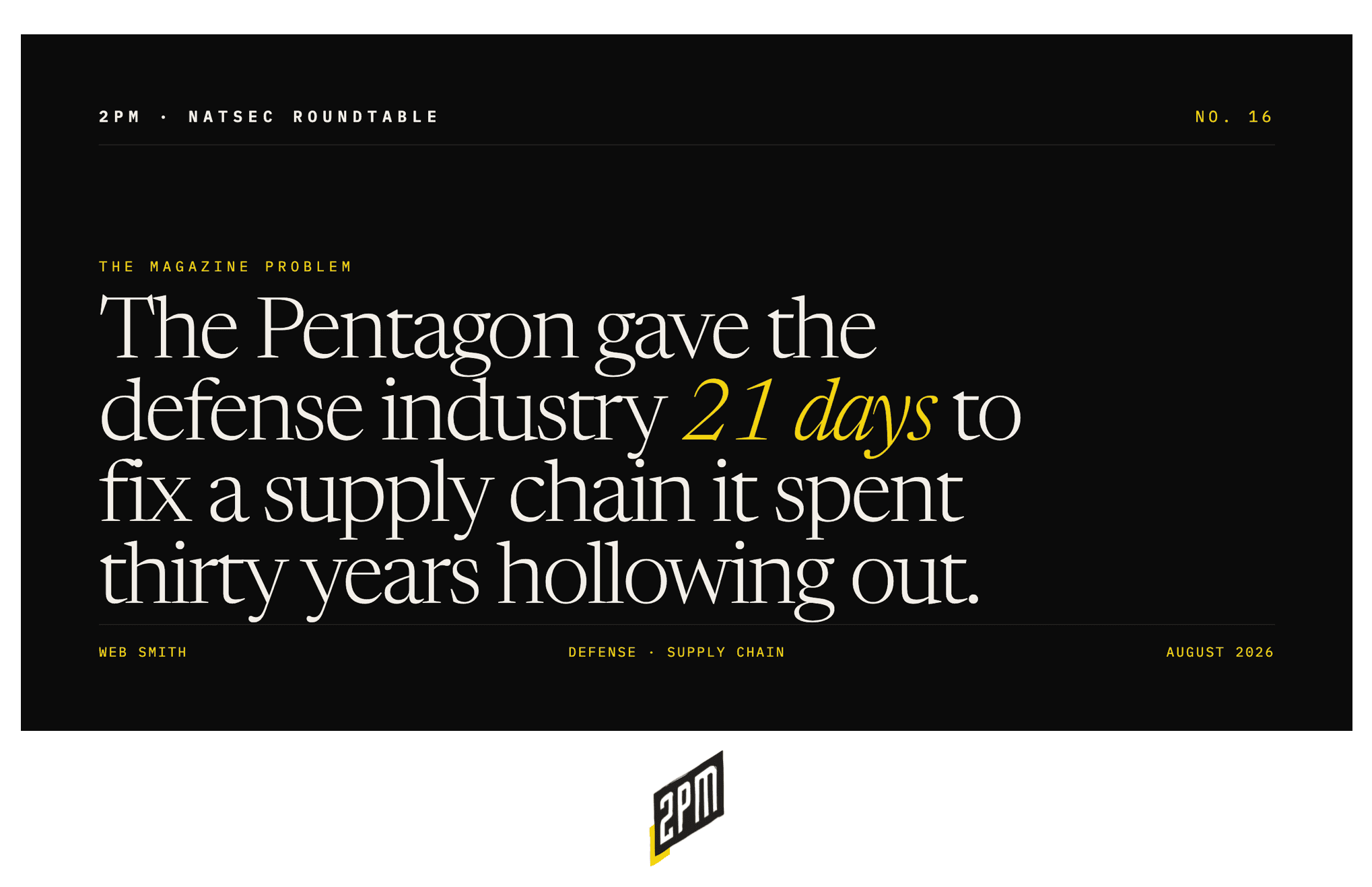
NATSEC Roundtable No. 16: The Magazine Problem

The Pentagon gave the defense industry 21 days to fix a supply chain it spent thirty years hollowing out. The memo calls it a production problem. It is a demand problem, and commerce solved that one a decade ago.

On August 5, Deputy Defense Secretary Steve Feinberg sent the primes a letter with a clock attached. Twenty one days to submit plans for faster delivery and expanded production across sixteen critical programs. Years-long development cycles, he wrote, are not acceptable. The Pentagon confirmed the memo is real and said it will shape the FY2028 budget.

The memo asks for more than schedules, it asks the primes to name the capital investments they are prepared to make themselves, the facilities they would expand, the risk they would carry before Congress guarantees a dollar of funding. The Pentagon’s phrase for this is skin in the game. Hold that thought; it matters later.

It reads like a production directive: make more, make it faster. That framing mistakes the symptom for the disease, and the difference is the entire story.

Start with the arithmetic that produced the memo. In the first month of the Iran war, the United States expended more than 850 Tomahawks, more than 1,000 Patriot and THAAD interceptors, and over 1,300 Army tactical ballistic missiles. CSIS estimates the Patriot inventory fell from roughly 2,330 before the war to somewhere between 759 and 827. That is a decline of at least 65 percent. THAAD dropped by nearly 40. The magazine emptied in weeks, and it will take years to refill, because the binding constraint was never the assembly line. It is solid rocket motor capacity, concentrated in two suppliers, sitting on an energetics base that is thinner still.

Retail buried a generation of companies between 2010 and 2020, and the autopsy was the same every time

That is the crisis everyone is describing. It is not the crisis that matters.

The failure is in the feedback loop

Retail buried a generation of companies between 2010 and 2020, and the autopsy was the same every time. The companies that died were not the ones with bad products. They were the ones whose demand signal and whose production had come unbolted from each other.

SEARS reordered on seasonal guesses against a customer that had already moved. Department stores bought two quarters ahead of a demand curve they could no longer see. Meanwhile retailers like Zara compressed the loop from concept to shelf to roughly two weeks, and Shein compressed it to a mere number of days, cutting micro-batches against live sell-through and reordering only what the signal confirmed. The winners did not have better warehouses; they had shorter, more predictive loops. When demand moved, their systems saw it move. When demand moved on the losers, the shelf was either empty or buried in markdowns, and the P&L found out a year later. The traditional defense industrial base is a version of the losing company.

For thirty years, the interceptor model optimized for one comfortable assumption. A small number of exquisite, expensive rounds. Drawn down slowly against a small number of high-value threats. Replenished on a peacetime cadence measured in fiscal years. Every incentive pointed toward fewer, better, and costlier. Margin lived at the top of the stack. Capacity was sized to the reorder rate, and the reorder rate assumed the magazine would never actually empty.

Then the demand signal changed shape, and the architecture could not see it.

The exchange ratio is the demand signal

The signal is a number, and the number is a ratio. A Patriot interceptor costs on the order of four million dollars. The threats now saturating the airspace, the FPV quadcopters of Ukraine and the Shahed-class loitering munitions of the Middle East, cost between a few thousand and a few tens of thousands each. Carbon fiber, injection-molded plastic, commercial motors, off-the-shelf guidance. Sourced from the same supply chain that ships consumer electronics, and producible at effectively unlimited scale because nothing in them is exotic.

Every time a four million dollar interceptor kills a fifty thousand dollar drone, the defender wins the engagement and loses the war, because the attacker builds a hundred more before the defender refills a single tube. That is not a marginal inefficiency. It is a structural cost inversion, and it is the actual content of the Feinberg memo whether the memo knows it or not. The magazine did not empty because production was slow; it emptied because the defender answered cheap, distributed mass with expensive, centralized scarcity. That is an architecture decision, not a manufacturing one.

Commerce has a name for a business that answers distributed demand with centralized inventory. It calls it bankrupt.

The reorder loop, in public

Look at how the department has tried to replenish so far, because it proves the diagnosis better than any memo could.

The Pentagon has spent months announcing framework agreements with primes and startups to expand supplies of interceptors and low-cost munitions. These are nonbinding. They signal intent to buy, pending congressional funding. Tom Karako at CSIS put it plainly: they are agreements to agree. Almost nothing has been contracted.

Translate that into commerce terms. The buyer is issuing letters of intent instead of purchase orders, against inventory that is already gone, on a funding cycle that resolves in years. There is no reorder signal in that system because there is no order in it. And the skin-in-the-game ask completes the picture: the channel is asking its suppliers to build capacity and carry the risk ahead of committed demand. Retail ran this exact play on its vendor base in the 2010s. The vendors who complied on faith got crushed. The vendors who answered by going direct, owning their own demand signal, and sizing production to real sell-through became the DTC generation.

A 21-day memo is what it looks like when an organization discovers in public that its reorder logic is three budget cycles behind its own sell-through.

Cheap, many, attritable

The answer commerce arrived at was not to build the central warehouse faster, it was to distribute the magazine. Push cheap, replaceable, demand-responsive capacity to the edge. Tolerate loss at the unit level and win at the level of the system. The Pentagon has a word for this already: attritable.

And watch what the department is actually funding underneath the memo’s production panic.

Replicator 2, the counter-small-UAS line of effort, made its first acquisition on January 11, 2026. AI-driven interceptor drones using radar and tethered nets to detect and capture small UAS, fielded through a joint interagency task force built specifically to move counter-drone capability from a community of interest to a community of action.

Drone Dominance, a roughly one billion dollar program, plans to run production through four competitive gauntlets beginning in early 2026. The first phase alone puts twelve vendors on contract to deliver 30,000 one-way attack drones at a unit cost of 5,000 dollars.

Thirty thousand units at five thousand dollars. Set that against a magazine of 827 Patriots at four million. The department is quietly, under a different budget line, building the distributed magazine. It is doing offensively what the interceptor base cannot do defensively. Match cheap mass with cheap mass, and make the exchange ratio run the other way.

So the memo and the gauntlet are the same organization holding two contradictory theories of its own supply chain, one in each hand. One says refill the expensive magazine faster; the other says the expensive magazine was the wrong architecture.

Only one of them is right, and the interceptor math already delivered the verdict.

Demand-driven design, applied to the arsenal

This is where a commerce operator sees something the acquisition system structurally cannot, because the acquisition system was built to optimize the exact thing that is now the problem.

The bottleneck everyone names, solid rocket motor capacity, is real and it is also downstream. The upstream failure is that the system has no live loop between what gets expended and what gets built. It reorders on the fiscal-year cadence of a peacetime demand curve, against a wartime demand curve that moves in weeks.

The fix is the thing distributed commerce spent a decade building. A production architecture whose default is cheap, plentiful, and close to the signal. Capacity sized to real expenditure instead of to a comfortable assumption. A feedback loop tight enough that when the magazine starts to empty, the line already knows. Attritable systems are not just cheaper interceptors. They are a supply chain that can see its own demand, because the units are cheap enough to build at the rate they are spent.

That is demand-driven design. It rebuilt retail. It is now the unspoken logic of the Pentagon’s most-funded drone programs. And it redraws the map of who matters. The twelve vendors on the Drone Dominance gauntlet are running the DTC playbook against the primes: short loops, cheap units, capacity sized to expenditure, demand signal in hand. The primes are the department stores in this story. Some of them will figure out that the shelf has moved. The ones that internalize distributed production, that stop defending the exquisite magazine and start owning the distributed one, are the ones that still matter in 2030. The rest will keep signing agreements to agree.

The verdict

The memo will be read as a production story. The arsenal ran low, the department cracked the whip, and the primes will surge. That reading is comfortable but it is wrong. The arsenal ran low because it was the wrong arsenal. A centralized, expensive, slow-feedback magazine answering a distributed, cheap, fast-moving threat. Twenty one days of accelerated production refills the wrong magazine faster.

The war did not expose a manufacturing gap. It exposed an architecture that lost the plot the way legacy retail lost it, by optimizing for the demand curve it wished it had instead of the one it got. The signal has already spoken. It is a ratio, it is inverted, and no volume of surge production turns a four million dollar answer to a fifty thousand dollar problem into a trade worth making.

The magazine problem is a demand problem. Commerce solved it a decade ago by innovating out of it. The arsenal is about to learn the same lesson, on a 21-day clock, in front of Congress.

Research and Analysis by Web Smith

NATSEC Roundtable No. 14: Civilian Drone Defense

You could say that we are incredibly privileged. We are consumers consumed by all of what makes America, America. Sports, short-form media, reality television, politics, sensational news, social division, gambling, and all of the rest. We are generally safe from the atrocities that are now common in other countries, both first world and global south.

Every industrialized nation in a position to be exposed to modern unmanned warfare has been exposed but most Americans have not. The gap between what the rest of the world’s operator class understands about drones and what the American consumer understands about drones is the largest single asymmetry in the protective equipment market today, and it is the entire opportunity.

The American consumer cannot do any of this. The American consumer has not been asked to.

At roughly 5:30 in the morning on the 28th of January in 2024, a one-way attack drone of Iranian provenance, built around Chinese commercial components and routed through the supply networks of an Iraqi Shia militia umbrella called the Islamic Resistance in Iraq, approached a logistics outpost in northeastern Jordan called Tower 22. The drone arrived at the base at almost the same minute that an American MQ-9 (drone) was returning from a routine patrol. The operators on duty could not tell the two aircraft apart; Tower 22 had air defenses but hey did not engage. The Iranian drone slipped through the layer, descended toward the container housing units where the night shift was sleeping, and detonated against the side of a connex box.

The names of the three soldiers who died that morning were Sergeant William Jerome Rivers, Specialist Kennedy Ladon Sanders, and Specialist Breonna Alexsondria Moffett. Rivers was 46 and lived in Carrollton, Georgia. Sanders was 24 and lived in Waycross. Moffett was 23 and lived in Savannah. All three were reservists assigned to the 718th Engineer Company at Fort Moore. Forty-seven other Americans were wounded; eight were casevaced. The collective public memory of the attack peaked on a Monday and was substantially gone by Friday.

The system could not distinguish between a friendly aircraft and a hostile aircraft because both of them looked roughly the same to the sensors they presented to. That is the entire problem set of modern unmanned warfare condensed to a single morning. It is also the operating condition the American consumer is about to inherit, and the American consumer is the least prepared population in the industrialized world to inherit it.

The asymmetry, stated plainly

A Ukrainian artillery officer in 2026 has more practical drone-defense literacy than the average American Fortune 500 chief executive. A Sudanese journalist on the road between El Fasher and Khartoum has more functional multispectral signature awareness than a Silicon Valley founder who pays for a private security detail. A rancher in the cartel corridors of Sonora or Sinaloa can identify the engine note of an inbound quadcopter at three hundred meters and tell you, from the pitch, whether the drone is carrying ordnance. The American consumer cannot do any of this. The American consumer has not been asked to.

This isn’t as much of a moral observation as it is a market observation. Every other large population in the world that has been exposed to drone presence at scale has produced a downstream consumer awareness, a vernacular, and a thin protective equipment market underneath it.

The Ukrainians have consumer-grade RF jammers sold openly in Kyiv electronics stores. The Israelis have IDF-surplus signature management material in regular civilian rotation. The Russians moved a third of their conscripted population through drone-defense familiarization in 2024 and 2025. The Mexicans and Colombians who live in cartel-contested territory have built informal countermeasure economies that include thermal-defeating tarps, RF detection, and trained dogs that signal on engine pitches above a certain frequency. None of this exists at scale in the United States because the United States has not, until very recently, been touched in any way – here or abroad.

The events that should have changed that have been treated as foreign news, novelty news, or UAP news.

The events we have not internalized

On the evening of the 6th of December in 2023, a fleet of drones approximately twenty feet in length and operating at speeds north of one hundred miles per hour began transiting Langley Air Force Base in Hampton, Virginia. The drones continued for seventeen straight nights. They flew south across Chesapeake Bay, across the airspace of Naval Station Norfolk (which is the largest naval base in the world), across the home base of Naval Special Warfare Development Group (Little Creek, Virginia), and back. The F-22 squadron at Langley could not engage them under existing rules of force. The incursions stopped on the 23rd of December, 2023, as cleanly as they had begun. The Pentagon has never publicly attributed them.

Roughly one year later, beginning on the 13th of November in 2024, a similar but larger pattern emerged over New Jersey. It began at Picatinny Arsenal in Morris County. It spread to New York, Pennsylvania, Ohio (including airspace closures at Wright-Patterson), Utah (Hill Air Force Base), California (Plant 42 and Camp Pendleton), and Texas (Naval Air Station Joint Reserve Base Fort Worth). By mid-December the FAA had imposed temporary flight restrictions over parts of nine New Jersey towns and the Nuclear Regulatory Commission was reporting a surge in sightings over US nuclear facilities. The Department of Homeland Security, the FBI, the Department of Defense, and the FAA collectively told the public that what they were seeing was a combination of authorized commercial drones, hobbyists, and misidentified manned aircraft. NORAD simultaneously confirmed that there had been more than six hundred unidentified drone incursions over US military installations since 2022.

The most likely explanation for the New Jersey wave, given what is now public, is that some portion of it was rehearsal by adversary services and some portion of it was tolerated commercial overflight that the existing regulatory framework had no language to describe. The actual answer matters less than the public response.

The public response was a national news cycle, followed by a Twitter cycle, followed by silence.

There was no consumer behavior change. There was no protective equipment purchase wave. There was no demand on Congress to update the statutes that prevent counter-UAS engagement over civilian airspace. The signal moved through the discourse without leaving a residue.

This is the population that is going to be exposed at scale in the next thirty-six to eighty-four months. We are extraordinarily soft.

How the sensor stack got here

The history of armed drone warfare in the post-Cold War period is, fundamentally, a history of capability migration from state monopoly to commercial availability, compressed across roughly twenty-five years.

The Central Intelligence Agency armed its first MQ-1 Predator with Hellfire missiles in late 2001. The first targeted killing using that system occurred in Marib Governorate, Yemen, on the 3rd of November in 2002. The capability was, at that time, a sovereign capability of one nation. It cost in the high tens of millions of dollars per system, required a satellite link and a CONUS-based pilot to operate, and was sustained by an industrial base that the United States and a small number of close partners exclusively held.

Twenty-two years later, on the 1st of June in 2025, the Ukrainian Security Service ran Operation Spiderweb, in which a swarm of small commercial-component drones launched from concealment positions inside Russia destroyed a substantial fraction of Russia’s strategic bomber fleet, including Tu-95 and Tu-22M3 airframes that the Russian state cannot replace at scale. The drones were assembled in a garage. The total cost of the operation was a rounding error against the value of what it destroyed. The capability that twenty years earlier had required a sovereign intelligence service had migrated to a determined non-state actor or sub-state intelligence cell with a parts list and a parking lot.

In between those two endpoints, the milestones are dense and consistent. The Houthis crippled five percent of global oil production with a Saudi Aramco drone strike in September 2019. The Venezuelan opposition attempted to assassinate Nicolas Maduro with two DJI Matrice 600s carrying C-4 at a military parade in Caracas in August 2018. Azerbaijani Bayraktar TB2s decimated Armenian armor in the forty-four day war over Nagorno-Karabakh in late 2020, which was the moment that any serious military observer understood the doctrinal shift had arrived. The Israeli operation against Iran in June 2025 included drone components prepositioned in Iranian territory for months before activation. The cartel use of armed quadcopters in Michoacán and Tamaulipas is now constant enough that the Mexican military has its own drone-defeat schools. The Sudanese RSF runs a drone-buy program through Wagner-adjacent supply lines that puts dozens of strike-capable platforms a month into a non-state actor’s hands.

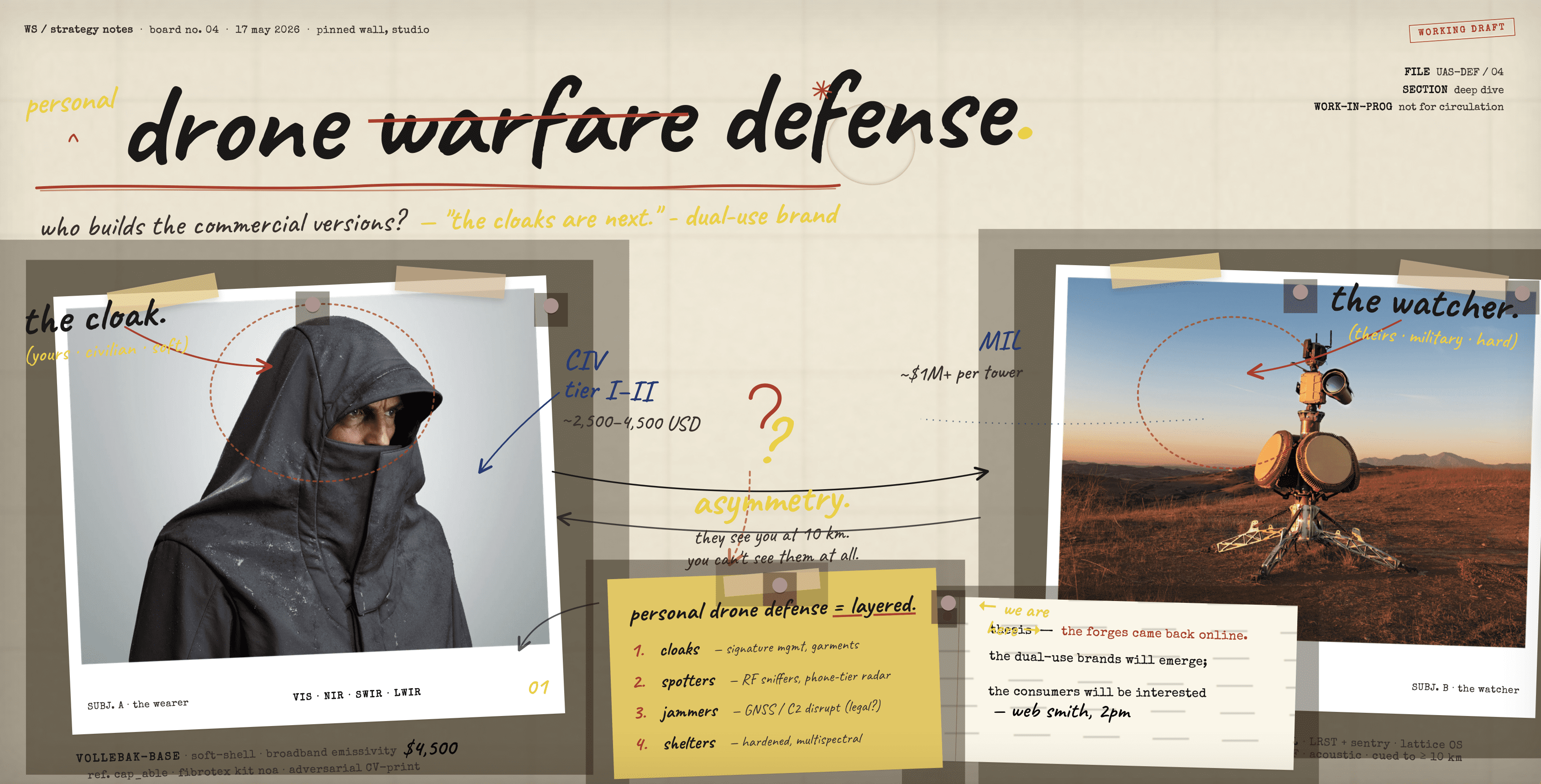
None of this is exotic.Actually, most of this technology stack is consumer-grade. The CV models doing the targeting are YOLO derivatives, the same person-detector that runs on a Raspberry Pi for backyard security cameras. The thermal cores are FLIR Lepton modules, sold openly. The flight controllers are Pixhawk. The mesh networks are off-the-shelf 2.4 and 5.8 GHz. The military-grade version of any of this leads the commercial version by roughly two to three years. That is the timeline a consumer defense category needs to be ready for, and it is the timeline that the existing tactical apparel and surveillance avoidance markets are not built for.

What the sensor stack actually does, and what it does not do

The threat surface that a personal protective system has to be built against is not “drones.” It is the sensor stack that drones present.

Commercial and prosumer platforms, which is the realistic personal threat through 2028 or 2029, target via electro-optical first, longwave thermal second, and navigate by GPS with visual-inertial backup. The CV layer is doing person-detection at the model level. The control link is on 2.4 or 5.8 GHz. The platform leaks RF in characteristic ways that are documented and detectable. Military-grade systems extend this with SAR, RF emission targeting, and multispectral fusion across the near-infrared, short-wave infrared, mid-wave infrared, and long-wave infrared bands, but the dominant near-term threat is the commercial layer.

The defensive doctrine that emerges from working backward from this stack is, in order: detection, concealment, deception, disruption, and hard kill.

Most personal anti-drone thinking jumps directly to disruption, which is the layer that is least available to a civilian buyer and least useful even when it is available. The eighty percent of survivability sits in the first three layers, which is the part of the doctrine that no consumer brand currently sells coherently.

Detection is RF awareness. A passive spectrum scanner tuned for the ISM bands picks up DJI, Autel, and most prosumer control links at ranges of several hundred meters. The hardware is software-defined radio at this point. The consumer-grade unit costs less than a decent pair of running shoes. The institutional-grade unit (the DroneShield RfPatrol Mk2, currently sold into military and executive protection channels) does this at higher fidelity with a maintained signature database. Knowing that a drone is in your area before it has imagery of you is the single highest-leverage capability in the entire stack.

Concealment is multispectral signature management. The standard wool blanket and Mylar bivy approach that defines the consumer survival market is binary and self-defeating. A reflective bivy blocks thermal entirely, which creates a cold anomaly against ambient that is, in some conditions, more identifiable than the human body it was supposed to be hiding. What modern signature management does is broadband emissivity matching to background. The defense industry product is the Fibrotex ULCANS netting that is now the US Army’s standard concealment kit, and its personal-scale analogs (Kit Noa, Saab’s Special Operations Tactical Suit).

The consumer version of this category does not exist yet at any kind of brand scale. Building it is the opportunity. I want to.

Deception is adversarial computer vision. The Italian fashion-engineering firm Cap_able has been shipping knitwear since 2023 with adversarial patches woven directly into the textile that misidentify the wearer to YOLO at approximately sixty percent rates under published testing. A frontier paper from November 2025 demonstrated thermally-activated dual-modal adversarial clothing that maintains above-eighty-percent attack success across both the visible and infrared bands simultaneously. The research is twelve to twenty-four months from a productized form factor.

Whoever ships the first dual-modal adversarial garment that does not look like a research artifact will define the consumer category aesthetic for a decade.

Disruption is where the public imagination collides with the legal and physical limits of the civilian channel. DIY EMP devices at man-portable scale are ineffective, dangerous to the operator, or illegal under FCC Part 15 and 18 U.S.C. § 1362, often all three simultaneously. The commercial counter-UAS systems that defeat drones at meaningful range (Epirus Leonidas, the Anduril Anvil, BAE Bofors) are crew-served, vehicle-mounted, and tightly export-controlled for entirely sensible reasons. Active RF jamming hardware is restricted to government and critical infrastructure customers in the United States and most of NATO. The civilian disruption layer is, honestly, passive RF detection plus operational discipline. Any brand that pretends otherwise is a liability rather than a category leader.

Hard kill at personal engagement range is a shotgun, the specialty loads exist. Effective range is thirty to forty meters against prosumer quadcopters with the right shot column. Net guns and SkyWall-class systems extend the range with no kinetic risk to bystanders but are slow, single-shot, and priced for facility security rather than personal use. Against a swarm of any meaningful size, hard kill is a last-resort interrupt for the one or two units that defeated the upstream layers. It is not a primary defense and should not be marketed as one.

The current consumer market is theater

What exists today for civilian buyers in the United States who are awake to this threat surface is a fragmented catalog of products positioned for the wrong customer. The tactical apparel brands selling “stealth hoodies” against thermal are selling cotton with a marketing budget. The Faraday-pouch market is mostly legitimate but positioned for crypto-paranoia and Faraday-as-EMP-protection rather than as one layer of a coherent personal signature management system. The YouTube ecosystem selling DIY capacitor-bank EMP devices is selling personal injury claims. The military surplus channel has the actual physics-validated material (Fibrotex panels, Saab MCS components, IDF-surplus thermal-disruptive material) but no consumer brand, no fitting guidance, no integration, and no marketing that speaks to anyone who is not already inside the operator subculture.

What the market does not have is the brand that does for personal signature management what Patagonia did for technical outerwear in the 1980s, what Yeti did for coolers in the 2010s, or what Athletic Greens did for daily supplementation in the late teens.

The category requires a premium consumer brand that takes the physics seriously, builds an integrated product line, prices it at the upper end of the technical apparel market, and uses long-form content as the primary acquisition channel. The content is half of the moat. The buyer for this category is a reader. They read SOFREP, they listen to Cleared Hot, they subscribe to War on the Rocks, they may even read 2PM on ocassion. The brand that wins this category will be the brand that publishes the field manual that defines the category before anyone else has the language for it.

The civilian stack you can actually build, today

The tables below are what an informed civilian buyer in the United States can actually acquire in 2026, assembled from existing brands, with gaps marked where the consumer category does not yet exist and the operator has to substitute or improvise.

Tier I. Foundation ($600 to $900)

The minimum coherent stack. Closer to insurance than to operational kit.

Component Product Approximate Cost
RF detection (handheld passive scanner) RF Explorer 6G Combo or 3G Combo $269 to $399
Faraday phone pouch Mission Darkness Faraday Bag $25
Faraday laptop or tablet sleeve Mission Darkness Non-Window Faraday Bag XL $60
Adversarial CV garment Cap_able knit hoodie (Manifesto Collection) $250 to $400
Mylar contrast-break panel (static use only) Heatsheets Survival Bivy $15

Tier II. Operator ($2,800 to $4,500 additional)

The functional stack. This is what a civilian buyer who treats personal signature management as a real protective category should be running.

Component Product Approximate Cost
Personal multispectral concealment Snipers Hide ThermaShield poncho or surplus ULCANS panel $200 to $600
Multispectral hide-site netting Tropic Concealment Solutions or surplus ULCANS Kit Sophia $400 to $1,200
Thermal-disruptive base layer Wild Things Tactical Heavy Weight Polartec or equivalent $200 to $400
Outer ghillie augmentation Red Rock Outdoor Gear base + local-flora additive $80 to $150
Spectrum analyzer (upgrade from RF Explorer) Aaronia Spectran V5 or V6 $1,200 to $2,500
Directional antenna Aaronia HyperLOG or OmniLOG $200 to $500
Tactical Awareness Kit hardware Samsung Galaxy S-series running ATAK $400 to $900
Comprehensive Faraday integration Mission Darkness CYBER Faraday Bag set $150

Tier III. Maximum civilian capability ($5,000 to $12,000 additional)

The ceiling of what a civilian buyer in the United States can legally acquire and operate. Above this tier the products are restricted to government, critical infrastructure, or executive protection contracts.

Component Product Approximate Cost
Passive wearable C-UAS detector DroneShield RfPatrol Mk2 (executive protection channel) $4,000 to $8,000
Vehicle multispectral camouflage Surplus or commercial MCS panels $1,500 to $3,500
Hard-kill platform Beretta 1301 Tactical or Mossberg 590A1 $700 to $1,500
Anti-drone specialty loads Drone Munition or Skynet Mi-5 $100 to $200 per case
Net launcher (non-lethal interrupt) SkyWall Patrol or civilian net gun equivalent $500 to $5,000
Thermal imager (situational awareness only) Pulsar Helion 2 XP50 Pro or Bering Optics Hogster $2,500 to $4,500

The three gaps the market has not closed

Three product categories do not exist for the American consumer in any form that an experienced operator would respect. Each is a build opportunity for whoever wants to define the category before the catalyst event arrives.

The first is a multispectral concealment garment system built for the civilian body type, sized like outdoor apparel, branded for the buyer who is not in uniform, and priced at the upper end of the technical outerwear category. Fibrotex Kit Noa is the physics reference; Patagonia is the merchandising reference. The synthesis has not been done.

The second is a passive wearable RF detector at a consumer price point, branded for civilian executive protection and outdoor recreation use, paired with a companion mobile app. DroneShield owns the institutional channel. There is no civilian-channel equivalent priced below $1,500, and the buyer who would pay $499 for a respectable handheld unit numbers in the hundreds of thousands today.

The third is a dual-modal adversarial garment that defeats both visible-band and infrared computer vision simultaneously, in a form factor that reads as outdoor or urban apparel rather than science experiment. The research exists as of November 2025 but the product does not. Whoever ships it first will define the visual identity of the category.

Marketing the category

The brand that wins this market will sound like nothing currently in the tactical category and very little in the technical outdoor category. The voice has to read as competent, calm, and operator-adjacent without leaning into the cosplay aesthetic that defines most of the existing tactical apparel market.

Think of how Vollebak markets apparel for what they call “the next hundred years.” Think of how Triple Aught Design wrote about urban operating environments fifteen years before the rest of the market caught up. Think of how Outlier sells four-figure technical apparel with no military framing at all. The aesthetic is technical, restrained, photographically dark, and the copy treats the buyer as someone who has already done the homework.

Three positioning vectors will work. The first is continuity, which is the language of buyers who want to keep doing what they have been doing (running, ranching, traveling, working in austere environments) in conditions that have changed underneath them. The second is autonomy, which is the language of buyers who recognize that institutional security infrastructure has degraded and the burden has moved to the individual. The third is stewardship, which is the language of buyers who are protecting other people (family, team, principal) and need the equipment to perform without them being the most technical person in the room.

The acquisition channel is content first, retail second, direct-to-consumer eCommerce as the operating infrastructure. The brand will be built on a publication, a podcast, or a newsletter before it sells a single unit. The Athletic Greens model applies directly. The brand that wins this category will spend the first eighteen months publishing the field manual that the buyer trusts before the buyer is ready to spend $3,000 on integrated kit.

That is the moat.

The cost ladder

The retail price ladder, when this category is built correctly, lands at four tiers.

Entry ($249 to $499). The single garment or single device that earns the buyer’s trust and establishes the brand. This is the adversarial hoodie, the high-end Faraday kit, the consumer RF detector. It is also the gift purchase, the gateway purchase, the trial purchase.

Core ($999 to $2,499). The integrated personal kit. Multispectral cloak, thermal-disruptive base layer, RF detector, Faraday kit, integration accessories. The buyer at this tier has made the decision to treat the category as real.

Expedition ($4,999 to $9,999). The full operator-grade civilian stack. Adds the upgraded spectrum analyzer, hide-site netting, ATAK-integrated hardware, the optional thermal imager.

Bespoke (custom). The family or executive protection package, custom-fit, custom-configured, sold through a consultative channel. This tier carries the margin. The first three build the brand that earns the right to sell the fourth.

Gross margin on the core tier should land at sixty to sixty-five percent. On the bespoke tier, eighty percent is achievable. The unit economics work in the same way that Yeti’s worked when they moved from a single cooler SKU to a product system, and the way Patagonia’s worked when they moved from technical jackets to integrated outerwear. The category does not get built one product at a time. It gets built one customer cohort at a time, and the right cohort is willing to spend at retention rates that look like Patagonia rather than Amazon.

The build I am testing

The personal stack I am testing sits at the upper end of Tier II, with selective additions from Tier III where the gear is legally available to a civilian buyer in Ohio. The RF Explorer goes in the running pack. The Cap_able piece sits in regular outerwear rotation. The ThermaShield and the Tropic Concealment net sit in my garage. The Mission Darkness Faraday kit is already integrated into the daily-carry rotation for the phone and the Yubikey. The DroneShield RfPatrol acquisition is a longer process given the institutional channel, but the path exists through executive protection resellers and through the defense ecosystem relationships that the 2PM editorial work has produced.

The reason to build it now is mostly editorial. The category is coming whether the American consumer is ready for it or not, and the publication that has a credible operator perspective on it from inside the build will define the conversation for the next thirty-six months.

The Forges Went Dark established that the manufacturing side of the dual-use shift was real and that the reshoring underneath it would not be reversed. This is the protective equipment side of the same shift, pointed at the buyer rather than the contractor. The brands that arrive first will be the brands that are still here when the rest of the market figures out it is a category.

If and / or when

The catalyst event that ends that conviction is not a question of whether. It is a question of which. A drone incident at a Super Bowl. A coordinated swarm at a presidential inauguration. A paparazzi drone that kills someone famous. A cartel drone strike that crosses the Rio Grande and kills a sheriff. An attributable Chinese or Iranian incursion that the public cannot un-know. Any one of these flips the category from niche-premium to mass-aware in a single news cycle. The work to do is to be the brand that defined the language before that next morning.

Research and Writing by Web Smith

Afterword: Acronyms and terminology

The vocabulary of unmanned warfare and signature management has been built largely inside defense and intelligence institutions, and it is not yet in common civilian use. The terms below appear in the essay above and across the broader literature.

Term Expansion What it means in practice
ATAK Android Team Awareness Kit Government-developed situational awareness app, originally for special operations, now available in a civilian variant (CivTAK).
AEO Answer Engine Optimization The discipline of making content discoverable by AI answer engines rather than traditional search.
CONUS Continental United States Used to distinguish operations or personnel located inside the lower 48 from those forward-deployed.
C-UAS Counter-Unmanned Aerial Systems The product and doctrine category for detecting, tracking, and defeating drones.
CV Computer Vision The machine-learning subfield that handles image recognition and object detection, including person-detection on drones.
DTC Direct to Consumer A commerce model in which the brand sells directly to the end customer without retail intermediaries.
EMP Electromagnetic Pulse A burst of electromagnetic energy capable of disabling electronics. Effective at scale only via nuclear detonation or large directed-energy systems.
EO/IR Electro-Optical / Infrared The dominant sensor pair on commercial and military drones, covering visible light and thermal bands.
FPV First-Person View A drone control mode in which the pilot sees through a camera on the drone in real time. The dominant attack drone format in Ukraine.
GNSS Global Navigation Satellite System The umbrella term for GPS and its international counterparts (GLONASS, Galileo, BeiDou).
HaaS Hardware as a Service A commercial model in which the customer subscribes to a hardware capability rather than purchasing the unit outright.
HEL High Energy Laser Directed-energy weapon class used in some emerging counter-UAS systems.
HPM High Power Microwave Directed-energy weapon class that disables electronics across a wide area. Epirus Leonidas is the visible US example.
INS Inertial Navigation System A self-contained navigation method that does not require external signals like GPS.
ISM band Industrial, Scientific, Medical band The unlicensed radio frequency bands (notably 2.4 GHz and 5.8 GHz) used by most commercial drone control links and Wi-Fi.
ISR Intelligence, Surveillance, Reconnaissance The military function of collecting information on adversaries or environments. Most modern drones are ISR platforms first.
LWIR Long-Wave Infrared The thermal band (roughly 8 to 14 micrometers) in which human bodies are most distinctive against ambient.
MCS Mobile Camouflage System Multispectral concealment material designed to be applied to vehicles or platforms in motion.
MGRS Military Grid Reference System The grid coordinate system used in military and ATAK environments.
MWIR Mid-Wave Infrared Thermal band (roughly 3 to 5 micrometers) used by higher-grade military sensors.
NATSEC National Security The institutional and commercial sphere oriented around defense, intelligence, and homeland security work.
NIR Near Infrared The first non-visible band beyond red light. Used by night-vision systems and some agricultural sensors.
NORAD North American Aerospace Defense Command The joint US-Canadian command responsible for aerospace warning and control over North America.
NORTHCOM United States Northern Command The US combatant command responsible for homeland defense.
POS Point of Sale Retail terminology for the system that processes transactions at the moment of purchase.
SAR Synthetic Aperture Radar A radar imaging technique that produces high-resolution imagery in all weather, day or night.
SDR Software-Defined Radio A radio system whose signal processing happens in software rather than fixed hardware. Underpins most modern RF detection.
SWIR Short-Wave Infrared Thermal band (roughly 1 to 3 micrometers) that penetrates haze and some forms of visual camouflage.
UAS / UAV Unmanned Aerial System / Vehicle The formal terms for what most people call a drone. UAS refers to the full system including ground station; UAV is the aircraft itself.
UV Ultraviolet The band of the electromagnetic spectrum above visible light. Used by some sensor stacks and certain camouflage detection systems.
YOLO You Only Look Once The dominant real-time object detection model family. The de facto person-detector on commercial drone targeting systems.

Further reading from 2PM: The Forges Went Dark. For corrections, additions, or off-record discussion of the category, the contact channel is the usual one.