
Members: Car Brands Ranked By Privacy Standards

Temporarily unlocked. In a world increasingly driven by data, connectivity, and seamless integration of technologies, it’s no surprise that our vehicles are evolving to become the most intimate products we own. These are not just modes of transportation; they’re an extension of our digital lives, seamlessly integrated with our personal and professional activities.

In the annals of ancient mythology, the Greeks infiltrated the walls of Troy not through force, but with guile and deception in the form of a wooden horse on wheels. This iconic Trojan horse has since become a symbol of subterfuge, a strategy of infiltration under the guise of a gift. Fast forward to our digital age, and we see vehicles evolving into not just machines of transportation but highly complex mobile computing platforms. Beneath the sheen of these sophisticated interfaces lie intricate webs of power, influence, and control that have not just consumers but automakers themselves navigating a modern-day Trojan scenario.

But is this infiltration a benign integration or a strategic takeover? Drawing parallels between ancient myths and modern mobility, this essay delves into the role of Blackberry, the intricacies of automotive software, and the potential implications of having consumer-electronics giants at the wheel of our automotive future.

Participe da associação

When researching this technological revolution, BlackBerry, once primarily known for its secure email services and qwerty smartphones, emerged as a frontrunner in facilitating the infrastructure that makes our cars smarter. According to data from BlackBerry, their QNX system, a high-performance real-time operating system (RTOS), offers automakers a top-tier level of functional safety for automotive applications. It taught me a lot about the complexity of everything from in-car entertainment systems to how we control our vehicle’s traction settings.

Recent advancements in car connectivity, such as Apple CarPlay and Android Auto, have changed the in-car experience. These systems allow drivers to project their smartphone interfaces onto the vehicle’s infotainment screen, offering navigation, media playback, and various other apps in a familiar format. But there’s more to these systems than meets the eye. But despite the rising prominence of consumer electronics giants like Apple and Google in the automotive space, it’s essential to understand that the bulk of a car’s software isn’t controlled by these companies. Advanced systems like ADAS, autonomous driving functions, and various other modules have their distinct software, adding layers of complexity and function to the vehicle’s operating ecosystem.

As vehicles become smarter and more integrated with our daily tech, there’s a sophisticated interplay between different software ecosystems. One of them is now under increasing scrutiny. Mozilla, once known for its eponymous internet browser, is making news for another reason.

The advent of the internet and the subsequent boom of social media platforms led to an entirely new age of advertising. Through targeted ads, companies could tap into a gold mine of personal information, allowing for unprecedented precision in reaching potential customers. However, with the introduction of the General Data Protection Regulation (GDPR) in Europe, this seemingly boundless frontier faced new limitations. The retail industry, heavily dependent on the granular data offered by giants like Facebook, Google, and Snapchat, felt an immediate impact. Yet, surprisingly, while these tech behemoths were forced to change their strategies, car manufacturers emerged as the most flagrant violators of privacy norms.

Let’s take this from the beginning of the privacy movement.

GDPR and Early Implications

The primary objective of GDPR was to give European citizens more control over their personal data. Companies would now need explicit consent from users before harvesting their data. This posed a direct challenge to the advertising models of Facebook, Google, and Snapchat, which were hinged on the ability to collect vast amounts of personal data to deliver tailored ads. In a 2018 2PM report on the ramifications, I explained:

All roads lead to increased ad spend for retailers with Amazon at the behest of Google and Facebook. Amazon has a distinct advantage in so much that the entire commerce workflow can happen within their walls. We anticipate greater efficacy through Amazon’s channels. Especially considering that the United States will pass its own version of Europe’s GDPR Act within the next five years.

It’s been five years and I was wrong. America has yet to enact a federal law that directly parallels Europe’s. But state by state, stringent acts have been passed. And corporations like Apple have taken it upon themselves to enact privacy practices; 2PM has covered Apple’s post iOS 14.5 era extensively (parts (I-III linked here). Prior to this iOS change, retailers, who once enjoyed a rich influx of consumer data, enabled them to pinpoint advertising efforts efficiently. Since then, digital marketing has been a body of murky water. With platforms like Facebook having to limit data collection practices in compliance with Europe’s GDPR and Apple’s institution, the detail and depth of consumer insights available to retailers were diluted. The fine-grain targeting, which allowed companies to deliver ads to highly specific demographic segments, was curtailed, leading to what many in the industry perceived as a decline in advertising efficacy. A product’s ad that would have once seamlessly appeared in the feed of a consumer whose online behavior indicated interest in such products was now less likely to find its mark. The degradation of advertising accuracy was an unintended second-order effect of GDPR, but it was palpable.

Today, retail media has taken the place of the momentum builder that was Facebook and Google advertising. But there was a privacy oversight that I did not foresee.

The Automotive Industry: A Privacy Conundrum

While social media platforms and retailers were grappling with these new regulations, another industry was silently and rapidly morphing into a behemoth of data collection: the automotive industry. According to an investigation by Mozilla and follow-up reports by the Washington Post and Quartz, car manufacturers were collecting more data than ever before. These reports painted a grim picture, where the modern car was likened to a “computer on wheels,” gobbling vast amounts of data about its drivers and potentially all of its occupants.

Cars, with their sophisticated infotainment systems, sensors, and connectivity features, were capturing data ranging from driving patterns and destinations to personal conversations and even, alarmingly, indications of a driver’s sex life. Mozilla’s research found that every one of the 25 car brands they examined was collecting more data than deemed necessary. To add to the consumer’s woes, most car manufacturers were sharing, and in many cases selling, this data to third parties. Such extensive and intrusive data collection far outstripped even the most data-hungry social media platforms pre-GDPR. Here is the report card:
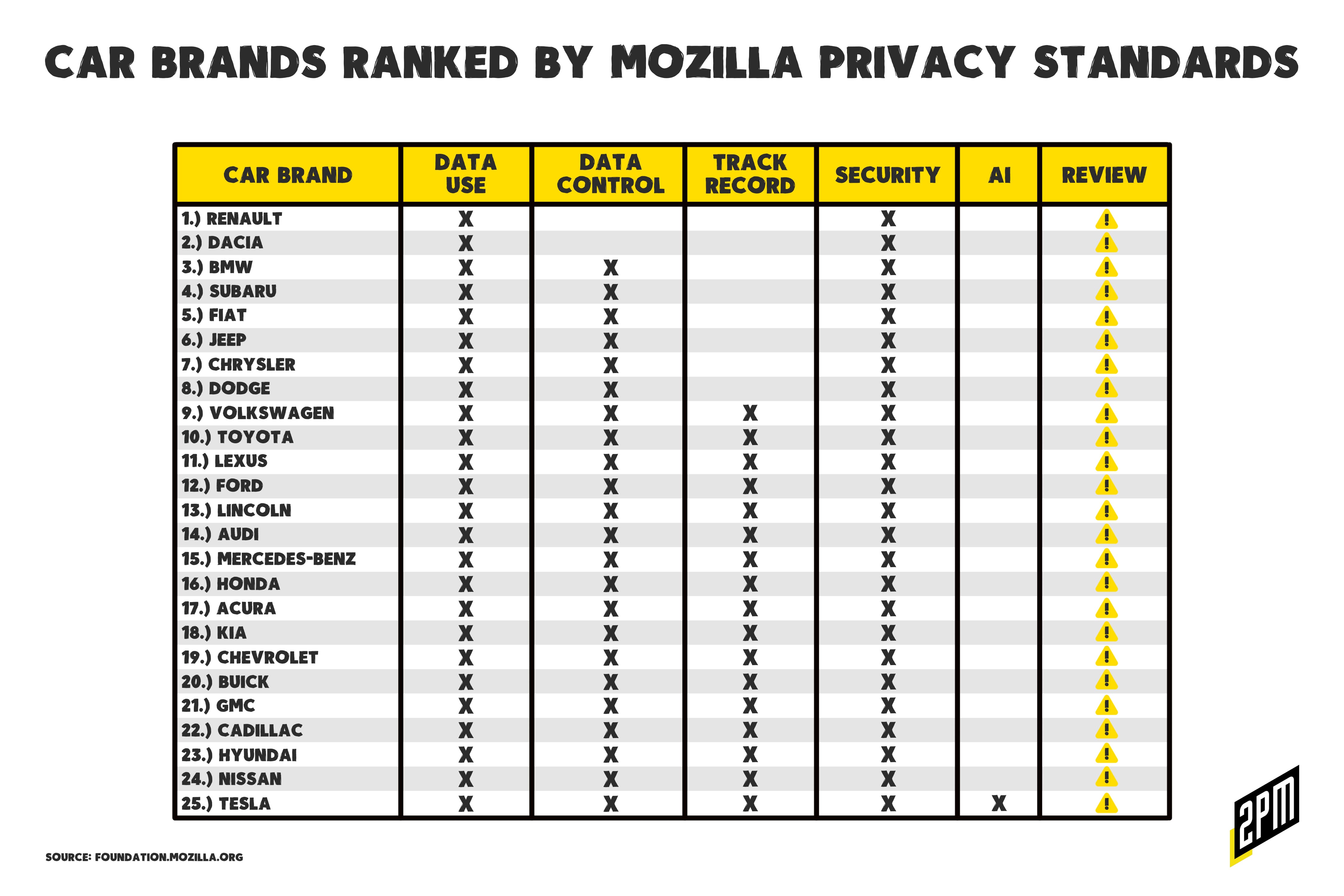
But why were car manufacturers not facing the same scrutiny and backlash as social media platforms? Part of the answer lies in the murkiness and complexity of data collection practices in the automotive industry. Unlike the relatively transparent (though still complex) practices of traditional consumer tech companies, car manufacturers have a more convoluted ecosystem of privacy policies that are challenging to decode. The operating systems are incredibly complex – with controls over a wider range of functions: technical, chemical, and mechanical. Furthermore, consumers often don’t view their vehicles as potential threats to their privacy, unlike their smartphones or computers. Automobiles are the ultimate trojan horse.

The introduction of GDPR, CCPA, and Apple’s privacy innovations have undoubtedly reshaped the digital landscape, particularly in the realms of advertising and data collection. While it forced a pivot for social media giants and retailers, leading to a decline in advertising precision, it also brought to light industries that were previously flying under the radar. The automotive industry, with its current trajectory, stands as a stark reminder that the fight for data privacy is far from over. As technological advancements continue to blur the lines between different sectors, it becomes paramount for regulatory bodies to stay vigilant, ensuring that all industries, irrespective of their nature, respect the privacy rights of consumers.

Por Web Smith | Editado por Hilary Milnes com arte de Alex Remy e Christina Williams

Memo: Amazon Wireless

It was a shift that changed the technological world. It’s been analyzed, written about, and even adapted into a recent film (which was pretty great, I might add).

First, the Blackberry came along and changed handheld computing forever. And then Steve Jobs gave one speech in 2007 that led to the demise of the company that once possessed 45% of the smartphone market. Founded in 1984, Blackberry released its first phone in 1999. With 85 million users, Research In Motion (Blackberry’s creator) peaked in 2013. By 2016, that number was down to 23 million.

The full reason, of course, was more than the speech. We all know that. Sure, the phone was amazing. It was coveted; back then AT&T was the aspirational carrier because only it could serve you an iPhone on a silver platter. The deal that Apple struck with then-Cingular Wireless funded its own investment into its wireless data infrastructure. I would posit that it was the reformatting of carrier economics that determined the next 15 years of computing. Jackie McNish, author of Losing The Signal: The Extraordinary Rise and Spectacular Fall of Blackberry wrote:

If the rise and fall of BlackBerry teaches us anything it is that the race for innovation has no finish line, and that winners and losers can change places in an instant.

The recent reports of Amazon exploring the possibility of offering a wireless plan for Amazon Prime subscribers have sparked significant interest and speculation. There are several reasons why Amazon would pursue such a deal, drawing parallels to Apple’s strategy with Cingular to outmaneuver the market leader in 2007. On January 10, 2007, one day after the fateful speech, the New York Times explored the deal and its merits:

They considered an Apple-branded mobile phone service that would piggyback on the Cingular network, but rejected the idea. Then, a year ago, they settled on the final concept, an Apple-made phone for subscribers of Cingular, which is owned by AT&T.

In that spirit, this essay examines the potential implications for Amazon Prime and the broader data and hardware industries.

Rationale behind Amazon’s Wireless Idea

Let’s dive right into the why. Here’s what Amazon wants to do.

Enhance Prime Membership: Amazon’s primary objective is to bolster loyalty among its Amazon Prime subscribers, who are its most valuable customers. By offering a wireless service as an additional benefit, Amazon seeks to increase the value proposition of Prime membership and reinforce customer retention. In shades of Apple’s original deal with Cingular, Bloomberg reports lead one to believe that Amazon would be welcomed with opened arms.

The carriers aren’t really in a position to say no to Amazon. Having poured billions of dollars into super-fast, high capacity 5G wireless networks, the mobile operators have

Gain a strategic competitive advantage: With the emergence of Walmart+ as a lower-cost alternative to Prime, Amazon faces intensified competition. A wireless service offering could serve as a differentiating factor, positioning Amazon ahead of its competitors and attracting new customers.

Leverage existing infrastructure: Amazon has a vast infrastructure through its AWS division, which provides cloud computing services. By collaborating with wireless carriers, Amazon can leverage this infrastructure, minimizing the need for costly network development and accelerating its entry into the wireless market.

Comparing This to Apple’s Strategy with AT&T

To draw a parallel between Amazon’s potential wireless venture and Apple’s partnership with AT&T, we need to examine Apple’s early dealings and its resulting impact on the market.

Apple’s approach was a departure from the prevailing smartphone strategy dominated by Blackberry. While Blackberry focused on providing a secure and efficient platform for email and messaging, Apple envisioned a device that could seamlessly integrate multiple functions and deliver an unparalleled user experience. Key factors that contributed to Apple’s success were four-fold.

The iPhone introduced a revolutionary touch-based interface with a large, vibrant display and intuitive gestures, replacing the physical keyboards and stylus-based systems common at the time. This simplified and enhanced the user experience. Apple also introduced the App Store, a platform that allowed third-party developers to create and distribute applications for the iPhone. This vast ecosystem of apps expanded the capabilities of the device, attracting both developers and users.

Unlike Blackberry, which primarily focused on productivity features, Apple emphasized multimedia capabilities. The iPhone offered an integrated iPod for music playback, a robust web browser, and a high-quality camera, appealing to a broader consumer base. And Apple’s iconic design, sleek form factor, and cohesive branding contributed to the iPhone’s desirability.

Apple’s innovative approach disrupted the market, capturing the attention of consumers who sought a more versatile and engaging smartphone experience, as well as a more stylish and premium device. Blackberry, caught off guard by the iPhone’s success, struggled to adapt quickly, leading to a decline in market share and eventual loss of its leadership position.

Apple’s exclusive agreement with what is now AT&T was a strategic move that enabled it to focus on a single carrier and create a seamless user experience. This approach allowed Apple to negotiate favorable terms and collaborate closely with AT&T to invest in digital data infrastructure, supporting the iPhone’s success. Remember, there were critics who suggested that this partnership was ill-advised:

Iain Gillott, analyst with IGR, speculates that users will get frustrated with the slower EDGE network particularly since some of the new smartphones operate over higher-speed networks such as HSDPA or 1xEV-DO. “It makes no sense to me,” Gillott says. While the iPhone boasts Web surfing, Yahoo email and other slick-looking applications, an EDGE network connection – with average speeds ranging from 80 kbps to 110 kbps – is not appropriate support for what is supposed to be a game-changing handset.

Apple’s subsidization strategy helped to broaden its user base and provide new revenue via the monthly payments for hardware. But more importantly, it helped AT&T raise the capital required to improve upon its Edge Network.

If Amazon were to follow a similar path, it could choose to acquire a wireless carrier or invest in its own infrastructure. This would grant Amazon greater control over the network and allow for tailored services, aligning with its customer-centric approach. Alternatively, Amazon could collaborate with existing carriers, providing them with access to its extensive customer base and leveraging their existing technologies.

Implications for Prime and the Data Plan Industry

If Amazon were to go through with this plan, there would be a ripple effect throughout the industry – as there always is when Amazon makes a bold move. Here’s what would happen.

Strengthen Prime Membership: By adding a wireless service to its Prime subscription, Amazon would further differentiate its offering from competitors, potentially increasing Prime membership growth and retention. Prime members would benefit from a seamless integration of services and an affordable wireless plan, amplifying their loyalty to Amazon.

Disrupt the data plan industry: Amazon’s entry into the wireless market has the potential to disrupt the existing data plan industry. By leveraging its immense customer base, Amazon could attract customers away from traditional carriers, leading to potential subscriber loss for established players. The introduction of lower-cost or even free plans for Prime members could significantly alter market dynamics and pricing structures.

Boost wholesale revenue for carriers: While Amazon’s entry may pose a threat to traditional carriers, it could also present an opportunity for them. Collaborating with Amazon as a wholesale partner would enable carriers to tap into Amazon’s vast customer base, potentially generating increased revenue from wholesale deals. Moreover, carriers could benefit from increased traffic to their 5G networks, providing a boost to their investments in network infrastructure.

As Amazon explores the possibility of launching a wireless cell phone plan for Prime subscribers, the strategic motivations become clear. By enhancing the value proposition of Prime membership and disrupting the data plan industry, Amazon aims to solidify its position as a leader in the e-commerce and entertainment sectors. By drawing parallels to Apple’s successful approach with AT&T, Amazon could utilize a similar strategy to forge deeper connections with customers and gain a competitive advantage.

If Amazon proceeds with its wireless initiative, it would likely capitalize on its existing infrastructure, collaborate with established carriers, and leverage its vast customer base. This would allow Amazon to offer Prime members affordable wireless plans or even free options, attracting and retaining a large user base while potentially disrupting the data plan industry.

Amazon’s potential move into the wireless market holds significant strategic implications for both Amazon Prime and the data plan industry. It could further solidify Amazon’s position as a dominant player in the digital spaces, increase customer loyalty and engagement, and potentially disrupt traditional carriers’ market share. As the negotiations and discussions continue, it will be intriguing to observe how the market reacts and how the wireless industry responds to the potential entry of one of the world’s largest retailers.

With one of the largest membership bases in all of the digital industries, this development has the potential to follow behind the advent of the Blackberry and the iPhone’s eventual disruption of the space. Amazon’s involvement in this business could further the iPhone’s lead, it could provide Android with the volume to gain on Apple, or it could even provide Amazon with the platform to re-launch its own phone (maybe a phone with physical buttons, who knows). Either way, carriers are unnerved by the news.

Por Web Smith | Editado por Hilary Milnes com arte de Alex Remy e Christina Williams