
No. 276: Wish Granted

facebook-ad copy 2

Founded in 2011 by ex-Google employees Danny Zhang and Peter Szulczewski, Wish has been a rocket ship of an eCommerce startup. And in certain circles, you’ll hear them referred to as an Amazon competitor – a moniker that often welcomes jeers from industry insiders. I mean, who can overcome the lead that Jeff Bezos has built? If not Alibaba or Walmart, the answer is probably no one.

This being the case, no other commerce company has scaled GMV (gross merchandise volume) faster that the San Francisco based giant. They are playing for keeps. And through an act of savvy partnership development and Magic Johnson’s wizardry, Wish is in position to take advantage of a sizable shift in brand fortune.

The company is now seven years into their journey. In 2016, Wish reportedly turned down a $10 billion all-cash offer from Amazon on “single-digit billions” in revenue after just three years. How? Wish sells very costly goods for rock bottom prices. But the majority of the products sold in the app are cheap goods sold for even cheaper prices. It’s a strategy that seems to be working for the company that’s now worth north of$8 billion.

The company is reportedly relatively light on infrastructure and since most vendors are sellers based in Asia, the app’s 400 million users don’t anticipate Amazon’s style of quick shipping. One of the leaders in mCommerce, the app is often the number one shopping app in 42 countries.

Wish is among just a handful of e-commerce upstarts that are positioned to offer serious competition to Amazon, which dominates online shopping in the US. Jet.com raised a boatload of funding and invited a ton of hype, but was soon sold to Walmart for $3.3 billion. Now it’s up to companies such as Wish, sports-focused Fanatics, wholesaler Boxed and a few others to offer new online alternatives.

Wish targets its wares toward lower-income shoppers, providing them an entry point to join the e-commerce trend, albeit without the speedy deliveries or top-shelf selection of Amazon. There’s growing competition for that market, though, with Walmart expanding its online presence and Amazon creating more services for people receiving government aid.

Ben Fox Rubin, CNET

The company’s good fortune has not come for free. Thanks to hundreds of millions raised in venture capital, Zhang and Szulczewski have been able to market like titans. One of those early backers is GGV Capital, a firm that has its pulse on new retail. GGV also seems to be one of the few that operate with the understanding that Asia has a leg up on the American eCommerce industry. Online retail adoption is higher in Asia (20%+ vs. our 9%). In countries like China, their nation’s poor view eCommerce as their first commerce option rather than their last. This is a sharp contrast to America where Amazon’s Target and Amazon Prime users are more than likely upper middle class.

Wish is addressing this disparity in their own way. And the contrast in customer service, product quality, and logistics efficiency can be jarring to American consumers who’ve only experienced the luxuries of higher end eCommerce service. To combat these perceptions, Wish advertises quite a bit. And their history of advertising his been of legend in the eCommerce startup space.

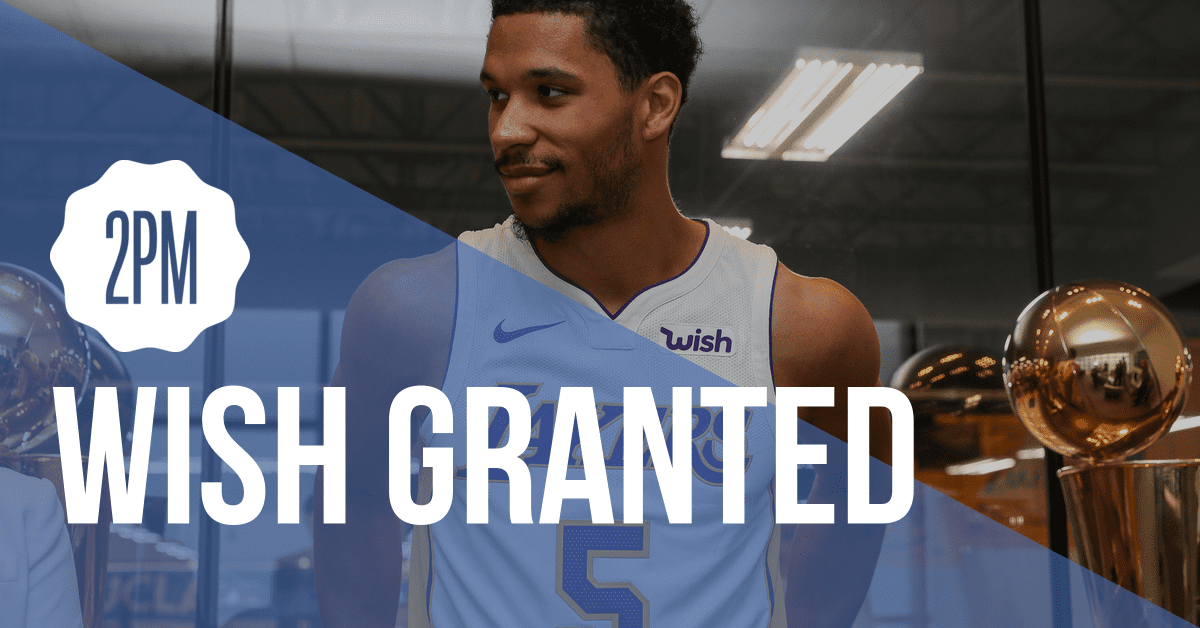
The highest profile of these efforts have been the deal between Wish and the Los Angeles Lakers. Wish placed a lofty bet on the future of a then-below average organization.

First, the Wish shopping app made a splash by spending $100 million a year on Facebook ads. Then it sponsored the high-profile Mayweather-McGregor boxing match. Now, Wish is betting big on the return of the Showtime era to the Los Angeles Lakers. The startup, which has quickly built one of the most popular shopping apps in the world, has signed a deal to place its logo on Los Angeles Lakers jerseys.

Wish is spending between $12 million and $14 million a year on the deal, according to the Sports Business Journal, which also gives it some sponsorship rights inside the Staples Center and the Lakers’ new training facility.

Jason Del Rey, Recode (September 2017)

Fast forward, nearly a year later, and it seems that the eCommerce giant has had a wish granted. The cofounders bet that the Lakers organization could return to previous glory, generating multiples of return on their $12-14 million commitment per year in exchange for the logo placement. In year one of Wish’s agreement, the company paid an estimated $7-9 million over the value that the company received from its sponsorship media value. I anticipate that in year two, Wish will receive a 2-3x ROA. Just how much of an impact does James have on sponsorship jersey rights? We’ve broken down the economics below.

[table id=14 /]

With Lebron’s recent signing, the new face of the organization will move the Los Angeles Lakers from number five to number one overall in jersey sponsorship value. The anticipated $25 million in advertising value that Wish is set to generate in 2018-2019, on top of other advertising efforts, may finally push Wish into a mainstream media conversation dominated by few.

Wish could finally become ubiquitous in an America that sees Target, Walmart, and Amazon as the only cost effective online retail options. “Like any young global brand, we are looking to build legitimacy and trust,” says Sam Jones (Managing Director of Partnerships). “We felt using leading sport stars and placing products from our platform into the narrative…was a good way to start telling that story globally.”

The timing couldn’t be better for Wish. The San Francisco company is working towards an improved company culture and a highly anticipated IPO.

Read more of the issue here.

By Web Smith | About 2PM
No. 275: YouTube goes commerce

facebook-ad copy 2
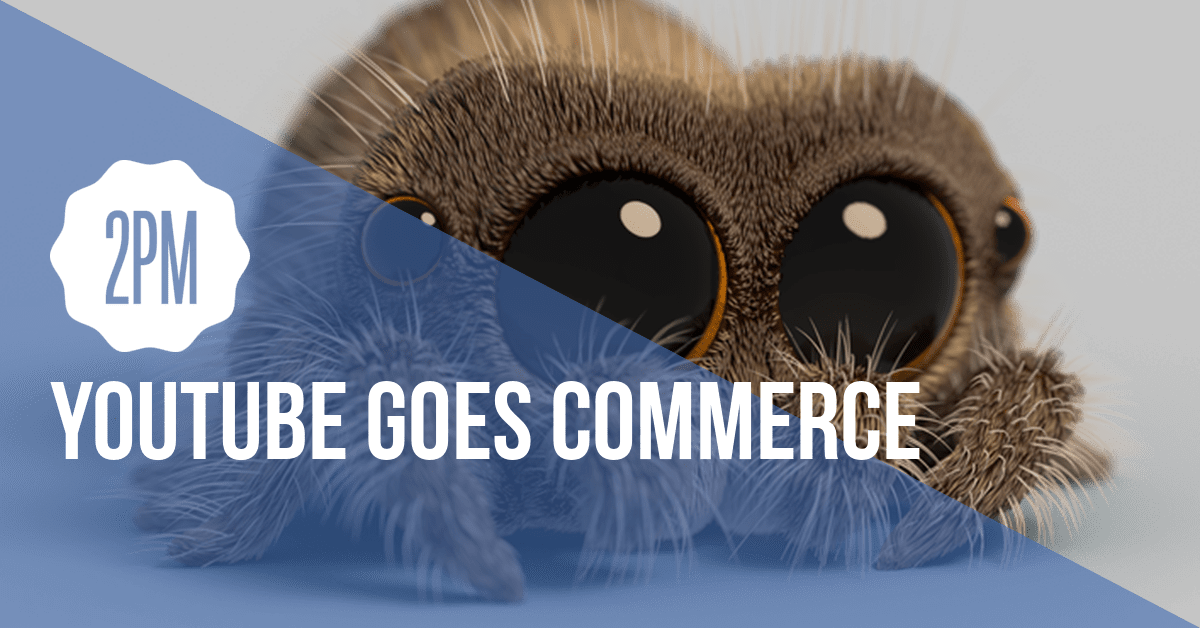
Pictured: YouTube sensation “Lucas the Spider”

YouTube creators have been frustrated with the platform’s ad operations, as of late. YouTube legend and videographer Casey Niestat has nearly 10 million YouTube subscribers, the embattled Pewdiepie has 64 million, the famed MKBHD has 6.5 million, and Logan Paul has nearly 18 million (and an eight figure online store). In addition to the proceeds driven by advertising to an audience of those respective magnitudes, creators have been increasingly reliant upon merchandising for a steady stream of revenue. In a flash, a YouTube creator showed the world just how powerful an online retail operation can be for creators.

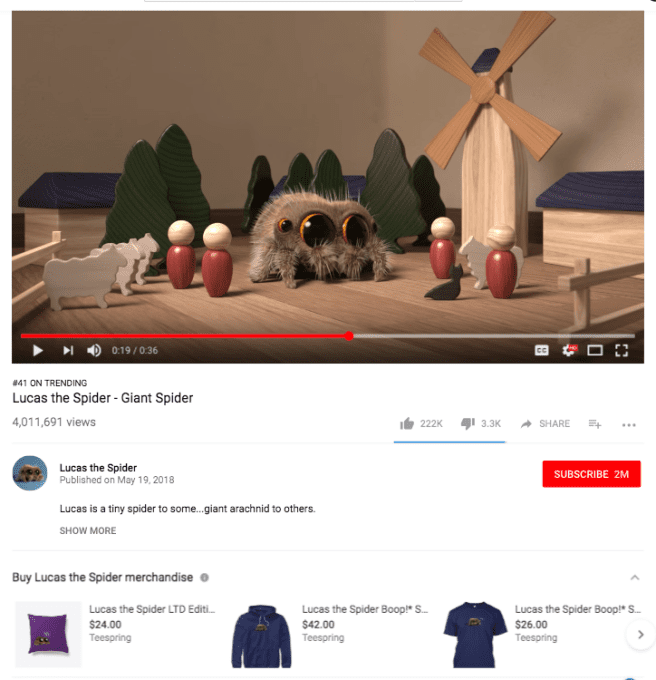
Joshua Slice is a former Disney employee and, currently, the creator and animator of the Lucas the Spider YouTube phenomenon. With a relatively smaller community of 2.4 million YouTube subscribers, the first 18 days of his embedded store achieved an astounding open. The creator of Lucas the Spider, launched a Kickstarter-esque campaign on Teespring (in addition to a full store). The plushie product sold around 60,000 units, netting Joshua $1 million in profit in just 18 days. This 60,000 unit tally was one of twenty available SKUs.

Lucas-The-Spider
Teespring’s integration provides in-line eCommerce for creators

In June 5’s Member Brief No. 16: Patreon’s Signal, our research led me to the following conclusion:

We believe that Patreon’s acquisition of Kit signals a potential uptick in M&A and partnership activity throughout the creator space. Kickstarter acquired Drip in March of 2016 and will likely pursue a merchandising solution for its stable of creators to mirror Patreon. YouTube is positioning its platform to compete with Patreon, Instagram, and Shopify, as well.

According to Tech Crunch’s June 5, 2018 article:

The deal also could help Patreon stay ahead of YouTube and Facebook, which are encroaching on its subscription patronage model. Patreon now has 2 million patrons backing 100,000 creators. It paid out $350 million over its first five years through 2017, and expects to send creators another $300 million in 2018, while taking a 5 percent cut.

Twenty days later and revisiting the Member Brief seems a bit prescient. With the newly announced partnership between YouTube and Teespring, Patreon’s most recent move is already behind the curve. The acquisition of Kit didn’t move Patreon any closer to shipping merchandise for its over 100,000 partners.

Patreon is well-positioned to be the leader in one-stop-shops of monetization for content creators. Kit can be a transformative partner for them, intensifying YouTube and other creator networks’ need to bolster their revenue operations. Commerce will become an increasingly important platform tool in a race to stay competitive for top creators. Activity over the next six to twelve months will determine which creator networks seek out the services of the aforementioned merchandising logistics companies: through partnership, by way of a joint venture, or through an out-right acquisition.

Member Brief No. 16: Patreon’s Signal

Prior to this eCommerce rollout, YouTube recently launched the same type of membership service that Patreon offers its creators. What does this mean for creator-based platforms? Patreon’s M&A signaled a period of consolidation and will continue to lead to the siloing of services for top creators. According to Byron Jones of the Music Network, “During the tests, Teespring reported an 82% success rate for YouTube users and an average 25% rise in item sales for each.”

Track the growing merch database

The initial numbers are gaudy and Teespring’s PR has been persistent. Their recent success has sent ripples across the industry. And to be fair, it was an enormous win for them because newer YouTube creators will now be incentivized to remain loyal to YouTube’s offerings.  It’s more than likely that some of YouTube’s creators will consider shifting from other storefronts to YouTube’s Teespring offering. It’s even possible that creators like Logan Paul (who has a sophisticated eCommerce operation in place) will consider testing inline retail on their YouTube channels.

But this partnership is clearly a shot across the bow for Instagram and Patreon. While Instagram is all-in on Shopify’s seamless integration and growing into YouTube’s space, Patreon is still in need of a merchandising partner and an exclusive creative partner that can help them in the short term. Consolidation will continue.

Read more of the issue here.

By Web Smith and Meghan Terwilliger | About 2PM

No. 274: Merch has become fashion

facebook-ad copy 4
Cofounders of Everybody.World

The word merch is synonymous with throwaway. Or at least it used to be. In 2PM’s leading story, Quartzy discusses the changing demographics that have influenced the types of products that luxury brands sell. Gone are the days when famed fashion houses like Gucci focus solely on traditional luxury fashion. Today, their products reflect an affinity for sweat pants, tennis shoes, and modern t-shirt patterns.

This has trickled on down to the merchandise industry. Younger millennials and Gen Z’ers wear merch as a fashion statement and luxury has adopted this burgeoning trend. For merch providers, this means that the American Apparel / LA Apparel aesthetic has given way to something new patterns, styles, and definitions of inclusivity.

2PM recently took a deep dive into the types of merchandising campaigns that are moving the concept of merch away from throwaway and towards luxury. In this archived brief, we explored everything from platforms used to preferred t-shirt patterns and blanks.

Member Brief No. 11: Mega Merch 101

Social media and the normalization of digitally vertical native brands have enabled artists and influencers to create online retail brands as a primary source of revenue. In this report, we will break down best practices – including some insights from our editor’s work with a certain Youtube creator.

Bain Capital released a 2017 report on global luxury that emphasized this shift driven by millennial consumers. Here is an important excerpt:


The Millennial State of Mind: Success in the next decade requires brands to refocus on their customers to better anticipate and cater to their needs. The younger generation will be key as millennials and Gen Z will represent 45 percent of the global personal luxury goods market by 2025. Still, when analysing behaviours, it is more correct to talk about a “millennial state of mind,” which is increasingly permeating across all generations and is thus more a psychographic phenomenon rather than a purely demographic one.

Read the rest here.


To summarize Bain Capital, the Gen Z interpretation of luxury fashion has permeated throughout the entire industry. This has affected consumer industry across footwear, accessories, and apparel. There are merch providers that are well-positioned here.

Business of Fashion’s wrote a recent feature on the two founders of Everybody.World. The write up did a masterful job of explaining how one merch provider built a direct-to-consumer brand that fueled their high growth wholesale business. By working with a curated selection that represents the zeitgeist. This includes: style contributors, graphic designers, a well-designed basics line, and the one staple that has become the go-to for festival merchandisers.

Quality, too, has become increasingly important as concert merch has evolved from souvenir to fashion statement, underscored by merch-like pieces released by luxury brands including Gucci, Balenciaga and Vetements. “The demand is absolutely higher than when I started doing this six years ago,” said Allen, who sourced roughly 70,000 pieces of merch for 2018’s Coachella Valley Music and Arts Festival. “And the expectations for the product itself are definitely higher.”

That’s why, this year, Allen looked beyond the typical “blank” T-shirt companies — think Gildan, Bella Canvas and Hanes — to boost Coachella’s offering.

Read more here (unlocked)

Cofounders Iris Alonzo and Carolina Crespo have done an extraordinary job of positioning the Everybody.World brand by building a strong direct-to-consumer business. Something that LA Apparel head Dov Charney is having problems with, this second time around. Due to the successes that they’ve had with wholesaling their famed ‘trash tee’ for $2.90/unit, wholesale traction has allowed the two founders to grow a substantial, higher-margin, direct-to-consumer business. Their main vehicle has been zeitgeist-driven basis and unexpected collaborations with contributors (even Virgil Abloh is listed on the site).

In Q2, merchandise drops have grown to become a major part of the creator narrative. Beyonce’s Coachella performance and her subsequent eCommerce drop was studied in Member Brief No. 11. And above, you’ll see high profile merchandise drops to include: Kanye West, Kid Cudi, and Nas.

As creators continue to emphasize merchandising as an extension of their art (and business), it’s imperative for providers to observe the shifts in the meaning of luxury and how Gen Z consumers have begun to shape the merchandise-turn-fashion industry. For the time being, tees are no longer a dress-down device. And it’s not just about what’s on the shirt, these days. Patterns and fit matter more than ever.

Blanks are no longer viewed as commodity products to a growing segment of American buyers. In fact, the industry is supplying a key component of Gen Z’s fashion identity. There are several providers that are well positioned to grow with the youngest of American consumers.

Read more of the issue here.

By Web Smith | About 2PM
Editor’s note: the next 2PM database (releasing 6/21) will include the most notable of merchandising providers to include Pittsburgh, Pennsylvania’s “Blank” run by Michelle Sharp. This will be a growing database. Join the executive membership for access.