

This member brief is designed exclusively for Executive Members, to make membership easy, you can click below and gain access to hundreds of reports, our DTC Power List, and other tools to help you make high level decisions.
No. 264: Welcome Common Thread
2PM has the privilege of working with a new corporate partner [1] for Q2 2018. Common Thread Collective is one of 2PM’s noted eCommerce agencies, notable for what they are doing on behalf of digitally vertical native brands. Demand generation for eCommerce is an oft-discussed topic on 2PM. There are three styles of content x commerce strategies. The most talked about models:
(1) publishers who are building an eCommerce as a revenue source:
- Goop | shop.goop.com
- Barstool Sports | store.barstoolsports.com
- Uncrate | uncrate.com/supply
- Gear Patrol |store.gearpatrol.com
(2) vertical brands who insource content-publishing to bolster organic traffic, improving net promoter score (NPS):
- Huckberry | huckberry.com
- Glossy | intothegloss.com
- Rogue | roguefitness.com/theindex
- Bevel | getbevel.com/bevelcode
There is a third way that brands interact with top-of-the-funnel consumers. And it centers around connecting brands to influencers, using messaging to develop content that resonates with prospective buyers. From there, it’s about harvesting first-party data to develop one on one relationships with consumers. Here is a highlight from a recent 2PM Executive Member Brief that should provide context for you:
Member Brief No. 3: The Attention Stack
First-party data (FPD) is information compiled and stored by by DNVB’s, media groups, and marketplaces. FPD describes your brand’s visitors, customers, and loyalists. Because companies with FPD have a prior relationship with their customers, they are in a position to use the data, to include names, addresses, email, demo, and gender — to communicate directly with them. First-party data is what is stored in your brand CRM. The attention stack is what your brand and data-minded operatives work to build by harvesting this data.
There isn’t just one way to approach the attention stack or the collection of first-party data. Here’s a look at one of Common Thread Collective’s methods.
- Step one: understand the brand’s existing and potential customers.
- Step two: recognize who influences the brand’s potential customers.
- Step three: configure the most efficient and effective approach to reaching potential consumers with the influence that CTC has cultivated on behalf of your brand. Invite them to engage with your brand.
- Step four: drive them to conversion or re-engage and retarget with the previously engaged consumer with dynamic product ads.
Given the importance of building the eCommerce sales funnel (i.e. the attention stack), I sought out an agency partner that would allow 2PM to observe their work with DNVB’s and mainstream retailers. Over the next three months, 2PM will examine the processes that have worked for their brands.
As Facebook begins to address their data controversy, agencies like Common Thread Collective will be the first to adjust, better serving their brand partners who are dependent upon Facebook’s marketing data to drive numbers at the bottom of the sales funnel.
Why should you know Common Thread?
Their approach to optimizing a brand’s attention stack is working and it’s working well. On top of this, their culture is truly unique. Prior to settling in on agency life, the group of managing partners focused on two areas of business that remain pivotal to their work: product entrepreneurship and professional athletics. The CTC partnership includes the former founders of Power Balance and are the existing owners of Qalo. Common Thread’s key clients are: Diff Eyewear, QALO, Theragun, 511 Tactical, 47 Brand, and Owl Cam.
Many of CTC’s influencers were introduced to brands through the partners’ personal network for professional sports contacts. And influence is vital because CTC’s approach to bolster product sales is driven by social proof. There are two reasons that the average American consumer purchases a product: (1) low pricing (2) recommendations from someone that they trust.
We believe social networks are fueled by human interactions and video content, so to be great at social advertising you have to be able to create human content. We create content and activate influencers in unique and scalable ways.
Taylor Holiday, Managing Director
Growing their own eCommerce brands, in house, is an additional datapoint that sets them apart. The founding team operates a holding company of micro-brands under their 4×400 incubator umbrella, to include: Slick Products, Opening Day, and FC Goods.
By building an attention stack for their own brands, it provided them with a deeper understanding of the economics that determine paid media’s best practices at scale. Common Thread Collective has skin in the game and proving sales efficacy on your own products is not often seen in the agency space. And their work is serving them well, Common Thread Collective’s typical return on advertising (ROA) ranges anywhere between a 4.06x to 8.3x ROA.
Elephant in the room: Facebook changes?
The success of digital ad buys depends heavily on the troves of data that Facebook has on consumers. Given that Facebook could face regulation, this could spell trouble for retailers who are dependent upon Facebook’s ability to influence product sales. The common fear is that Facebook will begin to roll back some of the data collections that allow the best brands and agencies to do their work.
My top priority has always been our social mission of connecting people, building community and bringing the world closer together. Advertisers and developers will never take priority over that as long as I’m running Facebook.
Zuckerberg, Testimony before U.S. Congress
Considering that greater than 70% of Common Thread Collective’s ad money under management is with Facebook and Instagram, Common Thread will be at the forefront of the agencies tasked with managing these potential changes. We’ll continue to discuss those developments here. In the meantime, learn more about Common Thread by clicking the logo below:
Read more of the issue here.
By Web Smith | Web@2pml.com | @2PMLinks
No. 252: 10 to Observe in Content and Commerce
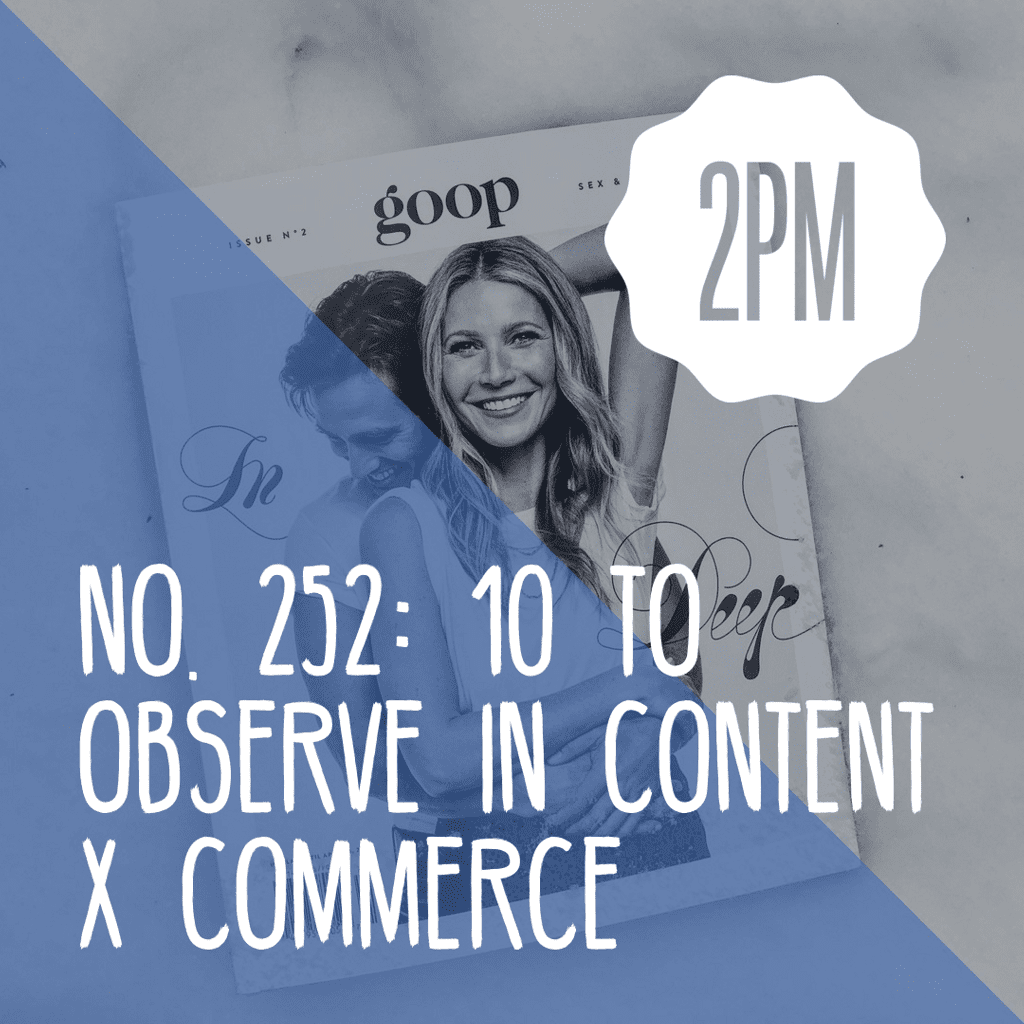
She who controls supply and demand will rule the internet. Publishers are recognizing that they must become whole ecosystems to thrive and commerce is a key component (again).
The ‘content and commerce’ movement was supposedly dead when Ben Lerer (Thrillist) and Jason Ross (JackThreads) chose to part ways. With this failure (hint: it really wasn’t a failure), it emboldened many in publishing to proclaim that commerce didn’t work.
Across newsrooms, from coast to coast, many publishing executives ignored investing in eCommerce between 2014-2017. Affiliate marketing teams were prioritized over ad sales teams and as a result, well-written articles went from literary showcases to collages of products to purchase. As ad sales continue to dwindle and affiliate sales remain on shaky ground, many of the healthiest digital publishers had a paradigm shift of sorts:
- How do we gain independence from platforms like Facebook?
- How do we hedge against falling ad sales and a weakening affiliate market?
- How do we foster community within our readership?
For many non-subscription and subscription digitals alike, merchandising has been used to address each of these questions. By building community, publications become a destination. Digiday covered this phenomenon, “The story behind that New Yorker tote bag.”
The must-have signifier of urbane sophistication in 2017 wasn’t Yeezys or torn jeans. It was a tote bag that The New Yorker gives to new subscribers.
The bag itself isn’t new — it’s been a gift the glossy has given out since 2014 — but thanks to Donald Trump and an iconic design, the bag became a hit. The magazine’s marketing department has distributed over 500,000 of them to new subscribers and existing ones, who soon started asking for bags of their own.
Continue reading “No. 252: 10 to Observe in Content and Commerce”