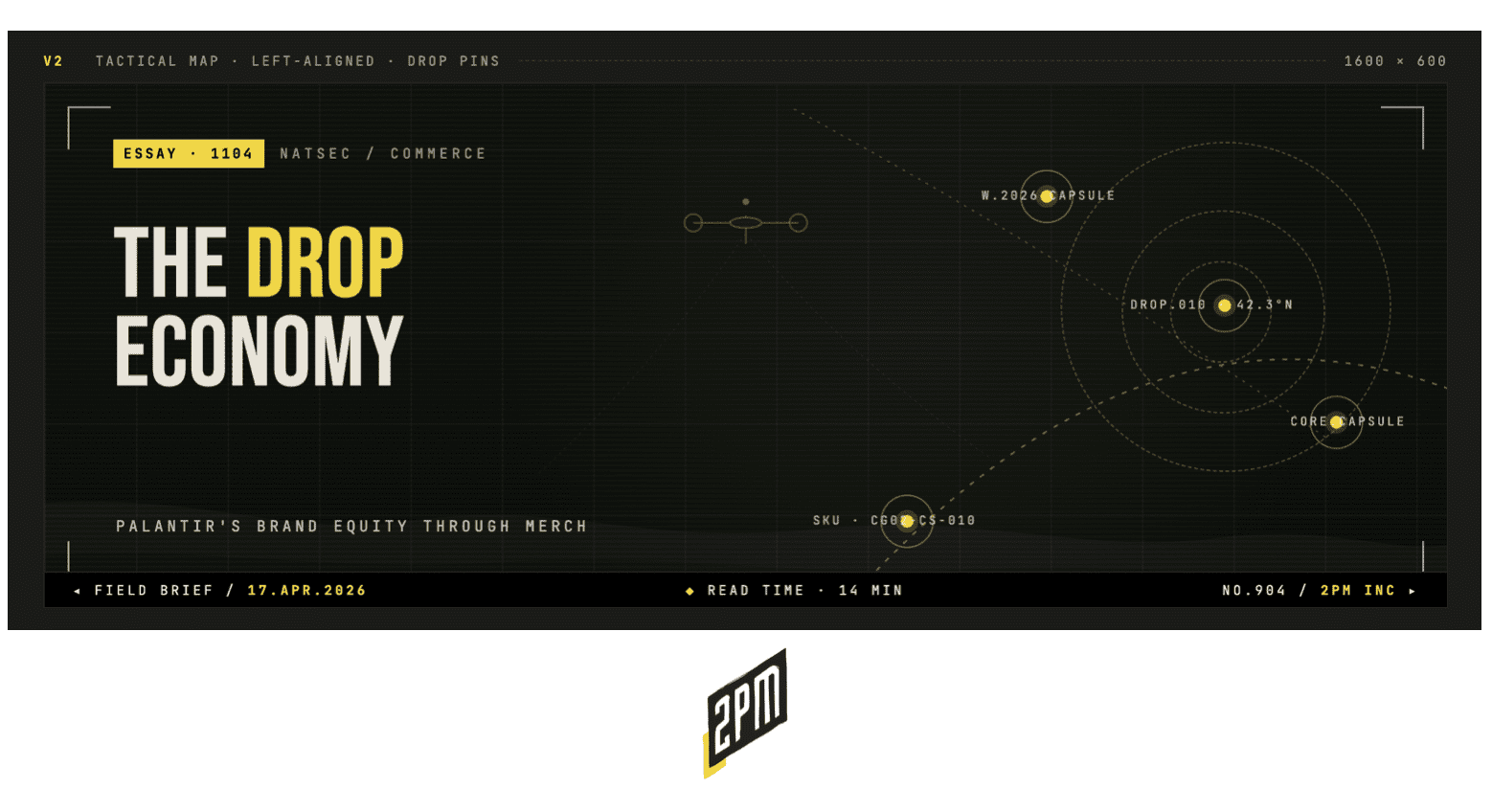
Palantir turned a merch store into the most important brand-equity case study in commerce; Shopify was pivotal. This essay is a feature post in an upcoming edition of the 2PM Newsletter.
It’s cool to hate Palantir. The brand operation suggests that there is a silent majority of those who cheer on the brand, its CEO, and the mission it keeps. If Edward Bernays, the father of propaganda, were alive today: he would note the software company’s public relations strategy as: dynamic, thought-provoking, unique, and effective. He once wrote:
Modern business must have its finger continuously on the public pulse. It must understand the changes in the public mind and be prepared to interpret itself fairly and eloquently to changing opinion.
The most instructive commerce experiment of 2026 is not happening at a DTC brand, nor is it happening inside a major retailer. It is happening at store.palantir.com, a merch storefront run by a defense and data company headquartered in Denver, built on Shopify, and operated by a team that has publicly stated its objective is to break even rather than generate profit. That such a store exists is worth noting; that the store has generated more cultural and editorial coverage in eighteen months than most CPG brands earn in a decade is the story worth studying. Palantir is not selling apparel, nor is it selling accessories or flag patches. Palantir is selling a worldview, and the apparatus through which that worldview is priced, scarcity-controlled, and distributed into a community of believers is the same infrastructure that powers Drake’s, Kith, J. Press, and a quarter of a million other merchants around the world.
This detail, that the most ideologically American commerce project in the country runs on a Canadian eCommerce platform, is the first of several contradictions worth sitting with. It is also the first piece of evidence in the larger argument this brief intends to make: that the deterministic economy I outlined in January, in which agents rather than persuasion select the brands consumers transact with, has a sister framework in the cultural economy, in which scarcity and narrative discipline select the brands consumers internalize as identity. Palantir operates at the intersection of both. The store at store.palantir.com is what that intersection looks like when it is built well.
Palantir is not selling apparel; it is selling a worldview, and Shopify is the infrastructure that makes the worldview purchasable.
The store is an answer engine before it is a commerce channel.
Ask ChatGPT, Claude, or Perplexity about Palantir’s consumer brand and you do not get a product catalog in response. What you receive is something closer to a dossier: lifestyle brand, defense contractor, cult following, scarcity drops, handwritten notes from the CEO, “defend the West,” made in the USA. Every outlet that has covered the store, from Wired to Axios to Financial World, uses functionally the same vocabulary because Palantir’s own product copy and public statements wrote the script first, and the press, the fans, the critics, and eventually the language models repeat it back. This is how answer engine optimization actually works in practice. It is not the gaming of schema and structured data, though those matter at the margin; it is the construction of a narrative dense enough that every retrieval pass returns the same summary, and every summary reinforces the brand’s own framing of itself.
The FAQ page at store.palantir.com/pages/faq is a small masterpiece of this discipline. It is written not as a customer-service document but as an editorial artifact, structured as direct question-and-answer pairs that read as declarations rather than policies. Limited drops. Serialized inventory. No restocks outside the Core Capsule. No military or first-responder discounts, a notable refusal from a company whose customer base is heavily military and first-responder adjacent. No newsletter; instead, the instruction is to follow @palantirtech and @eliano on X. FedEx only; all sales final. Every answer preempts a question, and every answer is written in the voice of the brand rather than in the voice of support. The effect is that the FAQ becomes retrievable in a way that most FAQ pages are not; it becomes the authoritative source for how the store behaves, and answer engines treat it as such.
The architecture of the store itself is discoverable in ways that compound this effect. Drop 010 and W.2026 as release naming conventions. SKUs rendered as visible design elements on the page, treated as typography rather than hidden in metadata (CG02-CS-010, GC01-CAP-001 SS25 OG). A faux-terminal UI that logs each product view as though the site itself were a piece of intelligence software, which is of course the joke and also the point. Hidden products unlocked by terminal passwords that circulate on X and Reddit before each drop, a mechanic that turns the crawl into a scavenger hunt and every scavenger into a distribution node. These are not aesthetic flourishes; they are discoverable artifacts that show up in blog posts, get screenshotted in group chats, get quoted on Reddit, and become the connective tissue of how the brand is described across the web. Answer engines stitch those artifacts into the authoritative summary, and the summary is what every future customer receives when they ask the LLM what Palantir is.
Recommendation is a symptom; authority is the disease. The brand that controls the vocabulary answer engines use to describe a category owns the category, and Palantir has demonstrated that the control is not purchased with ad spend or won through link-building schemes. It is constructed through narrative discipline and the deliberate refusal to speak about the brand in any register other than the one the brand has chosen for itself.
Brand equity is now a function of what the brand refuses.
The default defense-contractor merch playbook is Lockheed Martin’s Skunk Works keychains and Boeing’s B-52 t-shirts, and the energy of that default is gift-shop energy, meant for employees and retiring colonels and the occasional enthusiast. Palantir rejected the default entirely, and the rejection is the lesson worth studying. The Palantir store is not a gift shop; it is a lifestyle brand that happens to be operated by an enterprise software company, and the distinction is load-bearing.
Consider the copy on the nylon shoulder bag that sits at $119 in the Core Capsule. The product is, functionally, a tote bag; it has two interior patch pockets, a modular velcro surface, a shoulder strap. Every tote bag has these things. The copy, however, refuses the word tote and substitutes a vocabulary drawn from technical performance apparel: cut, sewn and finished in the USA; highly functional design; modular. The refusal is ideological. Tote signals The New Yorker subscriber and the Trader Joe’s shopper, which is the wrong tribe. The refusal to use the word is a declaration that the customer purchasing this bag is not that person, and the customer purchasing this bag agrees with that declaration, which is why the bag sells out.
This is the principle I once argued for in a different context, when Rogue Fitness was still Rogue Fitness, and I had the fortune of being in the room as the company considered dropping “Fitness” from its main mark because the category of fitness was already losing cultural altitude and the brand deserved to be defined by something larger than a shrinking category. The argument then was the same argument Palantir is making now: a brand is defined as much by the vocabulary it refuses as by the vocabulary it adopts. Rogue dropped Fitness. Palantir refused tote. Both moves are the same move.
The second principle is scarcity as the product rather than scarcity as a tactic. Most items on the store sell out and are not restocked; only the Core Capsule replenishes, and even the Core Capsule operates on serialized inventory that rotates. The stated objective of the merch program, per Palantir’s head of strategic engagement Eliano Younes, is to break even rather than generate profit. Read that again. A publicly traded, $350B enterprise software company runs a consumer merch operation whose financial objective is zero, because the output is not revenue; the output is community infrastructure, and the community infrastructure is worth more to the company than whatever margin the shorts could have generated. A customer who owns Drop 010 is not wearing apparel; the customer is flexing a moment in time, a piece of brand history that cannot be re-acquired at any price. Scarcity, in this construction, is not a conversion mechanic; scarcity is the thing being sold.
The third principle is the CEO as brand. Alex Karp’s face appears, in grey watercolor, on a t-shirt underneath the word DOMINATE. His voice (or Shyam Sankar’s) shows up in handwritten thank-you notes slipped into merch orders: Thank you for your dedication to Palantir and our mission to defend the West. The future belongs to those who believe and build. And we build to dominate. His earnings-call remarks read as if they were written to be printed on a garment six months later, which is either extraordinary message discipline or a tell about how the company actually thinks about the relationship between its capital markets communications and its consumer communications. Most enterprise CEOs are held at arm’s length from the consumer brand for good reasons; Karp is the consumer brand, and the customer is buying the conviction rather than the cotton.
The fourth principle is manufacturing as ideology. Made-in-the-USA production is not a supply-chain disclosure in this context; it is a worldview declaration, and the higher costs that come with it are a feature rather than a bug. Younes has publicly attributed the pricing to tariffs and domestic production costs, while declining to disclose specific factory partners, a refusal that reads as operational discipline to the faithful and as opacity to the critics. Palantir is comfortable living in that gap, because the gap is where the community is manufactured. The customer who cares about American production will fill in the story; the customer who cares about supply-chain transparency was never going to be the customer anyway.
The merch store is an investor relations channel that happens to accept Apple Pay.
The cumulative result of these four principles is brand equity that the equity markets now price into the underlying stock. Retail shareholders track the drops with the same attention they track the quarterly earnings; the X and Reddit communities that circulate drop passwords and screenshot Karp’s notes are the same communities that move after-hours volume on PLTR. Shares are up roughly 300% year-to-date on broader AI and defense tailwinds, and it would be dishonest to attribute that move to a merch store. It would be equally dishonest, however, to ignore that the merch store is part of the cultural apparatus that makes Palantir a retail-investor favorite rather than merely an institutional holding. The store is, in effect, an investor relations channel that happens to accept Apple Pay, and the IR channel runs on Shopify.
Platform selection is brand selection, and Palantir chose correctly.
Consider the contradiction on its own terms. A company whose entire brand is built on American exceptionalism, defense primacy, Western civilizational survival, and technical sovereignty chose a Canadian eCommerce platform as the infrastructure for its consumer storefront. The choice was not made because Shopify is Canadian; the choice was made because Shopify is the only platform in the category that could support the operating model Palantir’s brand demanded. This is the part of the Palantir case study that operators should study most closely, because the principle generalizes well beyond Denver and well beyond defense.
The drop mechanics Palantir relies on, scheduled releases, password-gated products, inventory caps, serialized SKUs, the ability to sell out deliberately rather than scramble to restock, are supported natively on Shopify in a way they are not supported on Magento, BigCommerce, or most headless React builds. The Drop 010 launch would have collapsed a headless implementation running on a commerce backend that was not designed for demand spikes of the kind that cult commerce produces. Shopify’s platform absorbs those spikes; Shop Pay compresses the checkout to a single tap, which matters enormously when the inventory is limited and the window to convert is measured in minutes rather than days. The choice of platform is, therefore, the choice of operating model. Palantir could not have run this brand on the wrong infrastructure, regardless of how good the brand work was upstream.
The theme and UX flexibility of modern Shopify allows the storefront to read as a bespoke commerce experience even though it is built on standard platform primitives. The faux-terminal aesthetic, the ↳ Index navigation pattern, the visible SKUs, the drop naming conventions, all of these are constructed on Shopify primitives but they do not read as Shopify primitives; the platform disappeared into the brand, which is the highest compliment a platform can earn from a brand operator. The only visible platform artifacts on the live storefront are the cookie policy link pointing back to shopify.com and the cdn/shop/ paths on the image URLs, and Palantir made no attempt to hide these. The narrative is the brand; the infrastructure is a utility; the utility is Shopify.
Every brand operator still running on a legacy headless stack because an agency sold them on future-proof architecture five years ago, or because an engineering leader wanted to build something bespoke, or because the board was told that scale required a custom solution, should study this storefront. Palantir is a company with the technical sophistication to build anything it wants on any infrastructure it chooses; it chose Shopify. The choice is the strongest possible signal that the platform argument has ended, and that the remaining question for most brands is not whether to be on Shopify but what kind of brand the Shopify operating model allows them to become.
The mechanics beneath the mission are available to anyone.
The Palantir case is not replicable in its specifics, and it would be a mistake to pretend otherwise. No sparkling water brand is going to sell apparel on defend the West; no meat subscription is going to put its CEO’s face on a shirt and clear inventory in four hours; no beverage or personal care or athleisure company has access to the particular cultural lightning Palantir has captured in a bottle. The mission is not replicable, and attempting to replicate it will produce embarrassment. The mechanics beneath the mission, however, are absolutely replicable, and they are what operators should be extracting from this case study rather than the surface aesthetics.
The first mechanic is that the brand which controls the vocabulary answer engines use to describe a category will own that category for the remainder of the decade, and the control is constructed through editorial discipline rather than SEO spend. Every product page, every FAQ answer, every press response, every founder quote should be written as though it will be ingested by an LLM and repeated back to a future customer, because that is precisely what will happen. Most brands publish copy written by customer service for keyword coverage; the brands that win the next cycle will publish copy written by editors for narrative coherence.
The second mechanic is that scarcity, properly constructed, produces earned media at zero marginal cost, and earned media is the strongest signal available to the retrieval layer that an entity matters. Drops generate news events; sold-out SKUs generate stories; handwritten notes generate screenshots. A brand that can produce a calendar of drops is a brand that can produce a calendar of editorial coverage, and the editorial coverage is the compounding asset. The operational lift to run drops is real but not prohibitive, and the platform supports it natively.
The third mechanic is that platform selection is brand selection, and the operating model the brand demands is the first specification in the RFP rather than the last. Too many operators still treat the commerce platform as a back-office infrastructure decision, negotiated by procurement, scored on feature matrices, and selected on total cost of ownership over five years. The Palantir case demonstrates that the platform decision is, in fact, a brand decision, and the brand decision precedes every other decision. The brand demands a particular operating model; the operating model requires a particular set of primitives; the primitives are available on one platform at scale; the platform is selected because it is the only platform that allows the brand to exist as the brand intends to exist.
The fourth mechanic is the one most operators will find hardest to internalize, because it inverts the assumption that commerce is a revenue function. Palantir’s merch program is explicitly a break-even operation, and its value to the company is measured in community density and cultural gravity rather than in gross margin. Most operators cannot run a break-even program because their boards will not allow it, and their boards will not allow it because the boards do not yet understand that the community density and cultural gravity produced by a well-run drop program are the leading indicators of the retrieval-layer visibility that will determine which brands exist in the agentic economy and which brands do not. This is the argument that has to be made inside every brand operator’s organization over the next eighteen months, and the Palantir case is the exhibit.
The worldview is theirs; the mechanics are available to anyone paying attention.
Palantir is running a drop economy on Shopify, writing the vocabulary that answer engines use to describe a category, and converting stockholders into a congregation. They are doing it with a team small enough to fit in a conference room, on infrastructure that is available to anyone with a credit card and a willingness to learn the platform. The worldview is theirs; the mechanics are available to anyone paying attention. The deterministic economy is here, and the cultural economy that operates alongside it is here as well. The brands that will still exist in 2030 are the brands that have understood, by the end of this year, that both economies are the same economy, and that the merch store at store.palantir.com is what that economy looks like when it has been built correctly. Looks can kill.
Research and Writing by Web Smith