

Members: Car Brands Ranked By Privacy Standards

Temporarily unlocked. In a world increasingly driven by data, connectivity, and seamless integration of technologies, it’s no surprise that our vehicles are evolving to become the most intimate products we own. These are not just modes of transportation; they’re an extension of our digital lives, seamlessly integrated with our personal and professional activities.
In the annals of ancient mythology, the Greeks infiltrated the walls of Troy not through force, but with guile and deception in the form of a wooden horse on wheels. This iconic Trojan horse has since become a symbol of subterfuge, a strategy of infiltration under the guise of a gift. Fast forward to our digital age, and we see vehicles evolving into not just machines of transportation but highly complex mobile computing platforms. Beneath the sheen of these sophisticated interfaces lie intricate webs of power, influence, and control that have not just consumers but automakers themselves navigating a modern-day Trojan scenario.
But is this infiltration a benign integration or a strategic takeover? Drawing parallels between ancient myths and modern mobility, this essay delves into the role of Blackberry, the intricacies of automotive software, and the potential implications of having consumer-electronics giants at the wheel of our automotive future.
When researching this technological revolution, BlackBerry, once primarily known for its secure email services and qwerty smartphones, emerged as a frontrunner in facilitating the infrastructure that makes our cars smarter. According to data from BlackBerry, their QNX system, a high-performance real-time operating system (RTOS), offers automakers a top-tier level of functional safety for automotive applications. It taught me a lot about the complexity of everything from in-car entertainment systems to how we control our vehicle’s traction settings.
Recent advancements in car connectivity, such as Apple CarPlay and Android Auto, have changed the in-car experience. These systems allow drivers to project their smartphone interfaces onto the vehicle’s infotainment screen, offering navigation, media playback, and various other apps in a familiar format. But there’s more to these systems than meets the eye. But despite the rising prominence of consumer electronics giants like Apple and Google in the automotive space, it’s essential to understand that the bulk of a car’s software isn’t controlled by these companies. Advanced systems like ADAS, autonomous driving functions, and various other modules have their distinct software, adding layers of complexity and function to the vehicle’s operating ecosystem.
As vehicles become smarter and more integrated with our daily tech, there’s a sophisticated interplay between different software ecosystems. One of them is now under increasing scrutiny. Mozilla, once known for its eponymous internet browser, is making news for another reason.
The advent of the internet and the subsequent boom of social media platforms led to an entirely new age of advertising. Through targeted ads, companies could tap into a gold mine of personal information, allowing for unprecedented precision in reaching potential customers. However, with the introduction of the General Data Protection Regulation (GDPR) in Europe, this seemingly boundless frontier faced new limitations. The retail industry, heavily dependent on the granular data offered by giants like Facebook, Google, and Snapchat, felt an immediate impact. Yet, surprisingly, while these tech behemoths were forced to change their strategies, car manufacturers emerged as the most flagrant violators of privacy norms.
Let’s take this from the beginning of the privacy movement.
GDPR and Early Implications
The primary objective of GDPR was to give European citizens more control over their personal data. Companies would now need explicit consent from users before harvesting their data. This posed a direct challenge to the advertising models of Facebook, Google, and Snapchat, which were hinged on the ability to collect vast amounts of personal data to deliver tailored ads. In a 2018 2PM report on the ramifications, I explained:
All roads lead to increased ad spend for retailers with Amazon at the behest of Google and Facebook. Amazon has a distinct advantage in so much that the entire commerce workflow can happen within their walls. We anticipate greater efficacy through Amazon’s channels. Especially considering that the United States will pass its own version of Europe’s GDPR Act within the next five years.
It’s been five years and I was wrong. America has yet to enact a federal law that directly parallels Europe’s. But state by state, stringent acts have been passed. And corporations like Apple have taken it upon themselves to enact privacy practices; 2PM has covered Apple’s post iOS 14.5 era extensively (parts (I-III linked here). Prior to this iOS change, retailers, who once enjoyed a rich influx of consumer data, enabled them to pinpoint advertising efforts efficiently. Since then, digital marketing has been a body of murky water. With platforms like Facebook having to limit data collection practices in compliance with Europe’s GDPR and Apple’s institution, the detail and depth of consumer insights available to retailers were diluted. The fine-grain targeting, which allowed companies to deliver ads to highly specific demographic segments, was curtailed, leading to what many in the industry perceived as a decline in advertising efficacy. A product’s ad that would have once seamlessly appeared in the feed of a consumer whose online behavior indicated interest in such products was now less likely to find its mark. The degradation of advertising accuracy was an unintended second-order effect of GDPR, but it was palpable.
Today, retail media has taken the place of the momentum builder that was Facebook and Google advertising. But there was a privacy oversight that I did not foresee.
The Automotive Industry: A Privacy Conundrum
While social media platforms and retailers were grappling with these new regulations, another industry was silently and rapidly morphing into a behemoth of data collection: the automotive industry. According to an investigation by Mozilla and follow-up reports by the Washington Post and Quartz, car manufacturers were collecting more data than ever before. These reports painted a grim picture, where the modern car was likened to a “computer on wheels,” gobbling vast amounts of data about its drivers and potentially all of its occupants.
Cars, with their sophisticated infotainment systems, sensors, and connectivity features, were capturing data ranging from driving patterns and destinations to personal conversations and even, alarmingly, indications of a driver’s sex life. Mozilla’s research found that every one of the 25 car brands they examined was collecting more data than deemed necessary. To add to the consumer’s woes, most car manufacturers were sharing, and in many cases selling, this data to third parties. Such extensive and intrusive data collection far outstripped even the most data-hungry social media platforms pre-GDPR. Here is the report card:
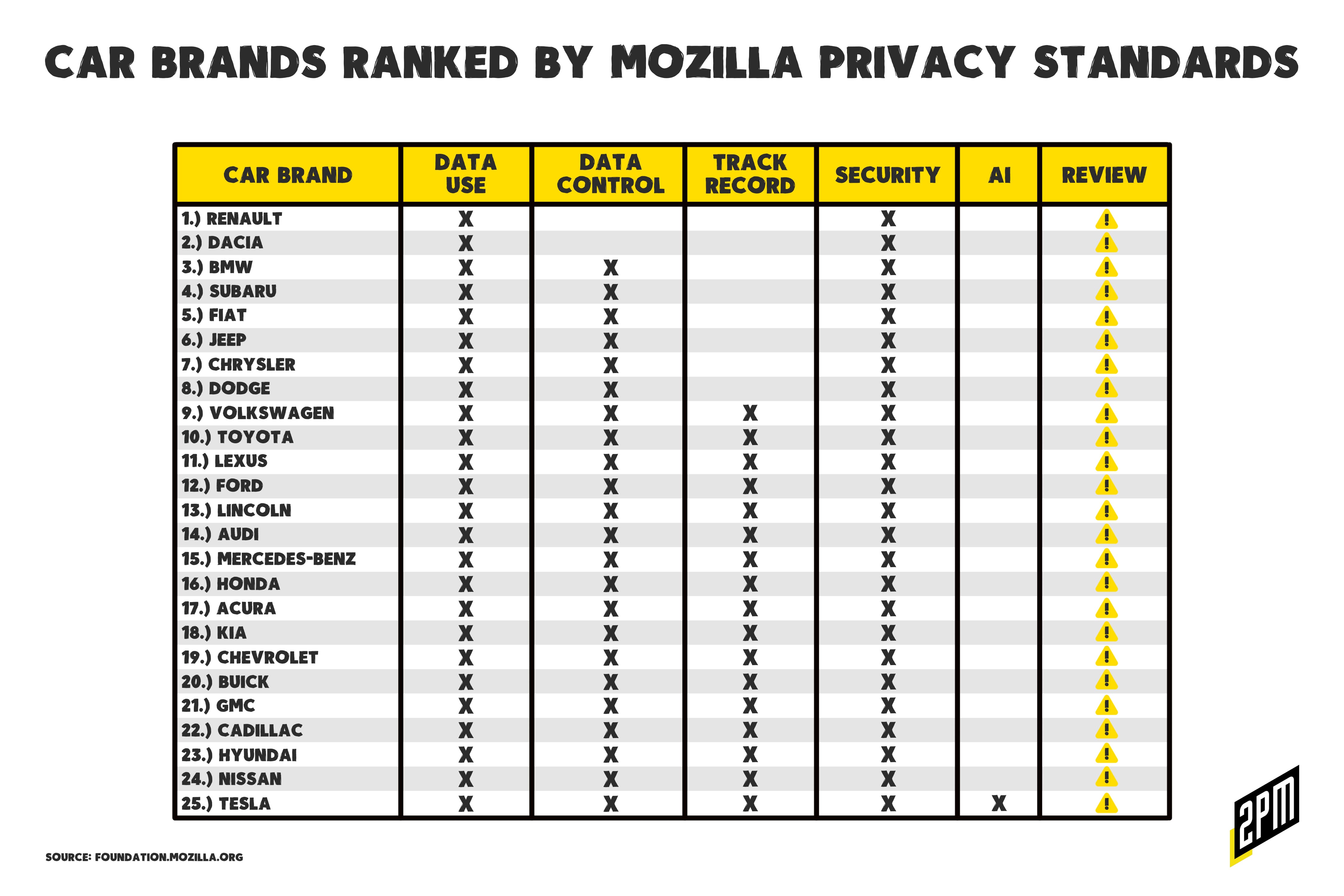
But why were car manufacturers not facing the same scrutiny and backlash as social media platforms? Part of the answer lies in the murkiness and complexity of data collection practices in the automotive industry. Unlike the relatively transparent (though still complex) practices of traditional consumer tech companies, car manufacturers have a more convoluted ecosystem of privacy policies that are challenging to decode. The operating systems are incredibly complex – with controls over a wider range of functions: technical, chemical, and mechanical. Furthermore, consumers often don’t view their vehicles as potential threats to their privacy, unlike their smartphones or computers. Automobiles are the ultimate trojan horse.
The introduction of GDPR, CCPA, and Apple’s privacy innovations have undoubtedly reshaped the digital landscape, particularly in the realms of advertising and data collection. While it forced a pivot for social media giants and retailers, leading to a decline in advertising precision, it also brought to light industries that were previously flying under the radar. The automotive industry, with its current trajectory, stands as a stark reminder that the fight for data privacy is far from over. As technological advancements continue to blur the lines between different sectors, it becomes paramount for regulatory bodies to stay vigilant, ensuring that all industries, irrespective of their nature, respect the privacy rights of consumers.
作者:Web Smith | 编辑:Hilary Milnes,美术:Alex Remy 和 Christina Williams
品牌:下一个关注点(微塑料)

零售业的整个细分市场都在滴答作响。在不久的将来,由于公众情绪的变化和日益严峻的挑战,未能适应的运动休闲公司将处于不利地位。今日家纺》解释道:
一项针对 527 名美国成年人的定量在线调查发现,49% 的人熟悉 "微塑料 "一词,这些成年人最有可能将塑料袋(76%)和来自保健及美容产品的微珠(61%)视为微塑料污染的制造者。略高于半数(52%)的人知道聚酯等合成材料制成的衣服会对微塑料污染问题产生影响。(更多信息)
到 2028 年,严重依赖微塑料的零售品牌将面临反弹和认可度下降的问题。服装业因使用从石油中提取的塑料纤维而臭名昭著。大多数服装(包括瑜伽裤、夹克等)中约 70% 的材料都含有尼龙、聚酯纤维和类似的不可生物降解纺织品。目前,美国环境保护署指出,这些纺织品中只有约 15%得到回收利用。
随着环保意识的增强和立法压力的加大,品牌在维持以廉价、不可生物降解材料为基础的商业模式方面可能会遇到挑战。正如变革市场基金会的乔治-哈丁-罗尔斯(George Harding-Rolls)所强调的,严重依赖合成纤维的超快时尚品牌将首当其冲,如果通过立法限制这类材料的使用,它们的商业模式可能会被淘汰。危险材料杂志》(2021 年 2 月)的一篇有趣文章指出:
随后,我们估计全球平均每周人类可能通过各种接触途径摄入 0.1-5 克微塑料。
像 Reformation 这样的公司已经在铺平道路,他们制定了大胆的目标,尽量减少合成材料的使用。他们与 Kintra Fibers 等初创公司合作,探索从玉米中提取生物可降解聚酯等替代品。然而,如何扩大这些创新的规模,以满足当前对合成纤维的需求,将是一个巨大的挑战。
5 月中旬,Lululemon 对澳大利亚初创公司 Samsara Eco 进行了少数股权投资,此举是对服装行业不断变化的可持续服装理念的一个重要回应。这项为期多年的承诺标志着 Lululemon 首次涉足回收利用领域,展示了利用酶将旧纺织品回收利用为新纺织品的转变。Lululemon 希望通过这种酶解工艺,将损坏或废弃衣物中的废旧尼龙和聚酯转化为新系列的材料。
我认为,这只是在更大的伤口上贴了一张创可贴。时尚品牌的传统回收方法包括机械回收和化学方法。然而,这些方法都有其缺点,从依赖原始塑料来保持质量,到分解聚合物所需的高能量,不一而足。相比之下,Samsara Eco 公司采用的酶解方法可以在碳中和、低热的环境中有效分解塑料。由于这种创新方法能够有效回收利用现有塑料,因此有可能减少对新塑料生产的需求。
在时尚界努力应对对微塑料的依赖之际,这种方法的意义不言而喻。根据《Vogue》杂志最近的一篇文章,我们约有三分之二的服装是由聚酯、尼龙、腈纶和氨纶等合成材料制成的。这些从化石燃料中提炼出来的材料不仅会向环境中释放微塑料,而且需要几个世纪的时间才能降解。
因此,具有先进技术特性的有机纺织品的兴起将引领未来的新趋势。
业界从原生聚酯向再生聚酯过渡的方向是正确的,各大品牌承诺到 2025 年采用再生聚酯。然而,这种聚酯主要来自塑料瓶,使回收过程从闭环系统变为线性系统,基本上是将这些材料在时装中使用后直接送往垃圾填埋场。时尚产业,尤其是运动休闲产业,正处于一个十字路口。随着消费者越来越意识到服装选择对环境的影响,他们要求更多可持续发展和环保的选择。

合成纤维的使用量持续上升。但是,到 2028 年,该行业对含有微塑料的合成纺织品的严重依赖将不得不大幅减少,甚至消除,以确保以目前的形式生存下去。这时,具有先进技术特性的有机纺织品将占据主导地位,成为未来的新趋势。
微塑料困境
正如《洛杉矶时报》所概述的,"超细纤维 "这个曾经是多功能清洁产品的代名词,如今却成了环境的噩梦。这些超细纤维主要由涤纶和腈纶等合成材料组成,在洗涤过程中脱落后,会进入我们的海洋、河流和湖泊。微塑料无处不在,甚至在我们的食物链和水源中都被检测到,这引起了令人担忧的健康问题。慢性炎症、癌症和不孕不育只是这些微小颗粒侵入人体系统后的一些潜在风险。
如果考虑到微纤维一旦进入环境,就几乎无法挽回,那么问题的严重性就更大了。
解决方案的出现:酶技术
随着微塑料问题的日益严重,领先的时尚品牌和初创企业开始探索解决这一危机的创新方案。Lululemon 与 Samsara Eco 的合作标志着这一历程的关键时刻。在这里,有机纺织品与技术的结合有望带来变革性的解决方案。
Lululemon 承诺使用 Samsara Eco 的酶驱动技术,这不仅体现了向循环时尚的转变,还强调了行业内对可持续解决方案日益增长的需求。这项技术可以有效地将使用过的尼龙和聚酯混合物分解成与新时装系列相匹配的形式。由于服装材料中令人震惊的 70% 都含有合成的石油衍生纤维,因此这种举措不仅值得称赞,而且势在必行。
为什么选择酶法解决方案? 机械回收等传统方法在使用寿命和效率方面存在局限性。它们还需要添加原始塑料,进一步加剧了微塑料问题。而化学方法则需要消耗大量能源。然而,酵素解决方案却能改变游戏规则。据 Samsara Eco 公司的保罗-莱利(Paul Riley)介绍,这种技术需要的热量较少,能有效分解塑料,使其与原生质量材料一样好。随之而来的碳足迹减少也是一大优势。
这种进步并非孤立存在。亚马逊(Amazon)、卡夫亨氏(KraftHeinz)和巴塔哥尼亚(Patagonia)等全球巨头与研究机构的合作正在快速推动这些基于酶的解决方案的开发。值得注意的是,京都技术研究所(Kyoto Institute of Technology)发现的堺Ideonella sakaiensis 201-F6细菌证明了正在取得的重大进展。
未来之路
像 Carbios 和 Protein Evolution 这样的初创企业与著名时尚品牌合作,将重新定义时尚的未来。通过倡导酶回收利用,它们证明了时尚产业确实可以与环境共生。
然而,尽管未来前景广阔,但过渡不会一蹴而就。它需要时间、投资和包括消费者在内的所有利益相关者的共同努力。正如《洛杉矶时报》的报道所指出的,拟议中的洗衣机设计变更包含了捕捉微纤维的过滤器,这展示了所需的整体方法。
随着消费者倡导更加环保、注重健康和可持续发展的时尚理念,时装业转向以有机纺织品为基础、辅以尖端技术的做法将不仅仅是一种趋势,而是一种必然。正在进行的合作、技术进步和投资凸显了时装业充满希望和可持续发展的未来。虽然酶法回收有望减少纺织品废弃物,但更广泛的时尚产业必须正视对微塑料的依赖。到 2028 年,一场巨变即将来临,重点应放在创新、可持续替代品和解决生产过剩的根本问题上。
在快速演变的市场环境中,不适应环境的零售品牌可能会被边缘化。
作者:Web Smith | 编辑:Hilary Milnes,美术:Alex Remy 和 Christina Williams