


You could say that we are incredibly privileged. We are consumers consumed by all of what makes America, America. Sports, short-form media, reality television, politics, sensational news, social division, gambling, and all of the rest. We are generally safe from the atrocities that are now common in other countries, both first world and global south.
Every industrialized nation in a position to be exposed to modern unmanned warfare has been exposed but most Americans have not. The gap between what the rest of the world’s operator class understands about drones and what the American consumer understands about drones is the largest single asymmetry in the protective equipment market today, and it is the entire opportunity.
The American consumer cannot do any of this. The American consumer has not been asked to.
At roughly 5:30 in the morning on the 28th of January in 2024, a one-way attack drone of Iranian provenance, built around Chinese commercial components and routed through the supply networks of an Iraqi Shia militia umbrella called the Islamic Resistance in Iraq, approached a logistics outpost in northeastern Jordan called Tower 22. The drone arrived at the base at almost the same minute that an American MQ-9 (drone) was returning from a routine patrol. The operators on duty could not tell the two aircraft apart; Tower 22 had air defenses but hey did not engage. The Iranian drone slipped through the layer, descended toward the container housing units where the night shift was sleeping, and detonated against the side of a connex box.
The names of the three soldiers who died that morning were Sergeant William Jerome Rivers, Specialist Kennedy Ladon Sanders, and Specialist Breonna Alexsondria Moffett. Rivers was 46 and lived in Carrollton, Georgia. Sanders was 24 and lived in Waycross. Moffett was 23 and lived in Savannah. All three were reservists assigned to the 718th Engineer Company at Fort Moore. Forty-seven other Americans were wounded; eight were casevaced. The collective public memory of the attack peaked on a Monday and was substantially gone by Friday.
The system could not distinguish between a friendly aircraft and a hostile aircraft because both of them looked roughly the same to the sensors they presented to. That is the entire problem set of modern unmanned warfare condensed to a single morning. It is also the operating condition the American consumer is about to inherit, and the American consumer is the least prepared population in the industrialized world to inherit it.
The asymmetry, stated plainly
A Ukrainian artillery officer in 2026 has more practical drone-defense literacy than the average American Fortune 500 chief executive. A Sudanese journalist on the road between El Fasher and Khartoum has more functional multispectral signature awareness than a Silicon Valley founder who pays for a private security detail. A rancher in the cartel corridors of Sonora or Sinaloa can identify the engine note of an inbound quadcopter at three hundred meters and tell you, from the pitch, whether the drone is carrying ordnance. The American consumer cannot do any of this. The American consumer has not been asked to.
This isn’t as much of a moral observation as it is a market observation. Every other large population in the world that has been exposed to drone presence at scale has produced a downstream consumer awareness, a vernacular, and a thin protective equipment market underneath it.
The Ukrainians have consumer-grade RF jammers sold openly in Kyiv electronics stores. The Israelis have IDF-surplus signature management material in regular civilian rotation. The Russians moved a third of their conscripted population through drone-defense familiarization in 2024 and 2025. The Mexicans and Colombians who live in cartel-contested territory have built informal countermeasure economies that include thermal-defeating tarps, RF detection, and trained dogs that signal on engine pitches above a certain frequency. None of this exists at scale in the United States because the United States has not, until very recently, been touched in any way – here or abroad.
The events that should have changed that have been treated as foreign news, novelty news, or UAP news.
The events we have not internalized
On the evening of the 6th of December in 2023, a fleet of drones approximately twenty feet in length and operating at speeds north of one hundred miles per hour began transiting Langley Air Force Base in Hampton, Virginia. The drones continued for seventeen straight nights. They flew south across Chesapeake Bay, across the airspace of Naval Station Norfolk (which is the largest naval base in the world), across the home base of Naval Special Warfare Development Group (Little Creek, Virginia), and back. The F-22 squadron at Langley could not engage them under existing rules of force. The incursions stopped on the 23rd of December, 2023, as cleanly as they had begun. The Pentagon has never publicly attributed them.
Roughly one year later, beginning on the 13th of November in 2024, a similar but larger pattern emerged over New Jersey. It began at Picatinny Arsenal in Morris County. It spread to New York, Pennsylvania, Ohio (including airspace closures at Wright-Patterson), Utah (Hill Air Force Base), California (Plant 42 and Camp Pendleton), and Texas (Naval Air Station Joint Reserve Base Fort Worth). By mid-December the FAA had imposed temporary flight restrictions over parts of nine New Jersey towns and the Nuclear Regulatory Commission was reporting a surge in sightings over US nuclear facilities. The Department of Homeland Security, the FBI, the Department of Defense, and the FAA collectively told the public that what they were seeing was a combination of authorized commercial drones, hobbyists, and misidentified manned aircraft. NORAD simultaneously confirmed that there had been more than six hundred unidentified drone incursions over US military installations since 2022.
The most likely explanation for the New Jersey wave, given what is now public, is that some portion of it was rehearsal by adversary services and some portion of it was tolerated commercial overflight that the existing regulatory framework had no language to describe. The actual answer matters less than the public response.
The public response was a national news cycle, followed by a Twitter cycle, followed by silence.
There was no consumer behavior change. There was no protective equipment purchase wave. There was no demand on Congress to update the statutes that prevent counter-UAS engagement over civilian airspace. The signal moved through the discourse without leaving a residue.
This is the population that is going to be exposed at scale in the next thirty-six to eighty-four months. We are extraordinarily soft.
How the sensor stack got here
The history of armed drone warfare in the post-Cold War period is, fundamentally, a history of capability migration from state monopoly to commercial availability, compressed across roughly twenty-five years.
The Central Intelligence Agency armed its first MQ-1 Predator with Hellfire missiles in late 2001. The first targeted killing using that system occurred in Marib Governorate, Yemen, on the 3rd of November in 2002. The capability was, at that time, a sovereign capability of one nation. It cost in the high tens of millions of dollars per system, required a satellite link and a CONUS-based pilot to operate, and was sustained by an industrial base that the United States and a small number of close partners exclusively held.
Twenty-two years later, on the 1st of June in 2025, the Ukrainian Security Service ran Operation Spiderweb, in which a swarm of small commercial-component drones launched from concealment positions inside Russia destroyed a substantial fraction of Russia’s strategic bomber fleet, including Tu-95 and Tu-22M3 airframes that the Russian state cannot replace at scale. The drones were assembled in a garage. The total cost of the operation was a rounding error against the value of what it destroyed. The capability that twenty years earlier had required a sovereign intelligence service had migrated to a determined non-state actor or sub-state intelligence cell with a parts list and a parking lot.
In between those two endpoints, the milestones are dense and consistent. The Houthis crippled five percent of global oil production with a Saudi Aramco drone strike in September 2019. The Venezuelan opposition attempted to assassinate Nicolas Maduro with two DJI Matrice 600s carrying C-4 at a military parade in Caracas in August 2018. Azerbaijani Bayraktar TB2s decimated Armenian armor in the forty-four day war over Nagorno-Karabakh in late 2020, which was the moment that any serious military observer understood the doctrinal shift had arrived. The Israeli operation against Iran in June 2025 included drone components prepositioned in Iranian territory for months before activation. The cartel use of armed quadcopters in Michoacán and Tamaulipas is now constant enough that the Mexican military has its own drone-defeat schools. The Sudanese RSF runs a drone-buy program through Wagner-adjacent supply lines that puts dozens of strike-capable platforms a month into a non-state actor’s hands.
None of this is exotic.Actually, most of this technology stack is consumer-grade. The CV models doing the targeting are YOLO derivatives, the same person-detector that runs on a Raspberry Pi for backyard security cameras. The thermal cores are FLIR Lepton modules, sold openly. The flight controllers are Pixhawk. The mesh networks are off-the-shelf 2.4 and 5.8 GHz. The military-grade version of any of this leads the commercial version by roughly two to three years. That is the timeline a consumer defense category needs to be ready for, and it is the timeline that the existing tactical apparel and surveillance avoidance markets are not built for.
What the sensor stack actually does, and what it does not do
The threat surface that a personal protective system has to be built against is not “drones.” It is the sensor stack that drones present.
Commercial and prosumer platforms, which is the realistic personal threat through 2028 or 2029, target via electro-optical first, longwave thermal second, and navigate by GPS with visual-inertial backup. The CV layer is doing person-detection at the model level. The control link is on 2.4 or 5.8 GHz. The platform leaks RF in characteristic ways that are documented and detectable. Military-grade systems extend this with SAR, RF emission targeting, and multispectral fusion across the near-infrared, short-wave infrared, mid-wave infrared, and long-wave infrared bands, but the dominant near-term threat is the commercial layer.
The defensive doctrine that emerges from working backward from this stack is, in order: detection, concealment, deception, disruption, and hard kill.
Most personal anti-drone thinking jumps directly to disruption, which is the layer that is least available to a civilian buyer and least useful even when it is available. The eighty percent of survivability sits in the first three layers, which is the part of the doctrine that no consumer brand currently sells coherently.
Detection is RF awareness. A passive spectrum scanner tuned for the ISM bands picks up DJI, Autel, and most prosumer control links at ranges of several hundred meters. The hardware is software-defined radio at this point. The consumer-grade unit costs less than a decent pair of running shoes. The institutional-grade unit (the DroneShield RfPatrol Mk2, currently sold into military and executive protection channels) does this at higher fidelity with a maintained signature database. Knowing that a drone is in your area before it has imagery of you is the single highest-leverage capability in the entire stack.
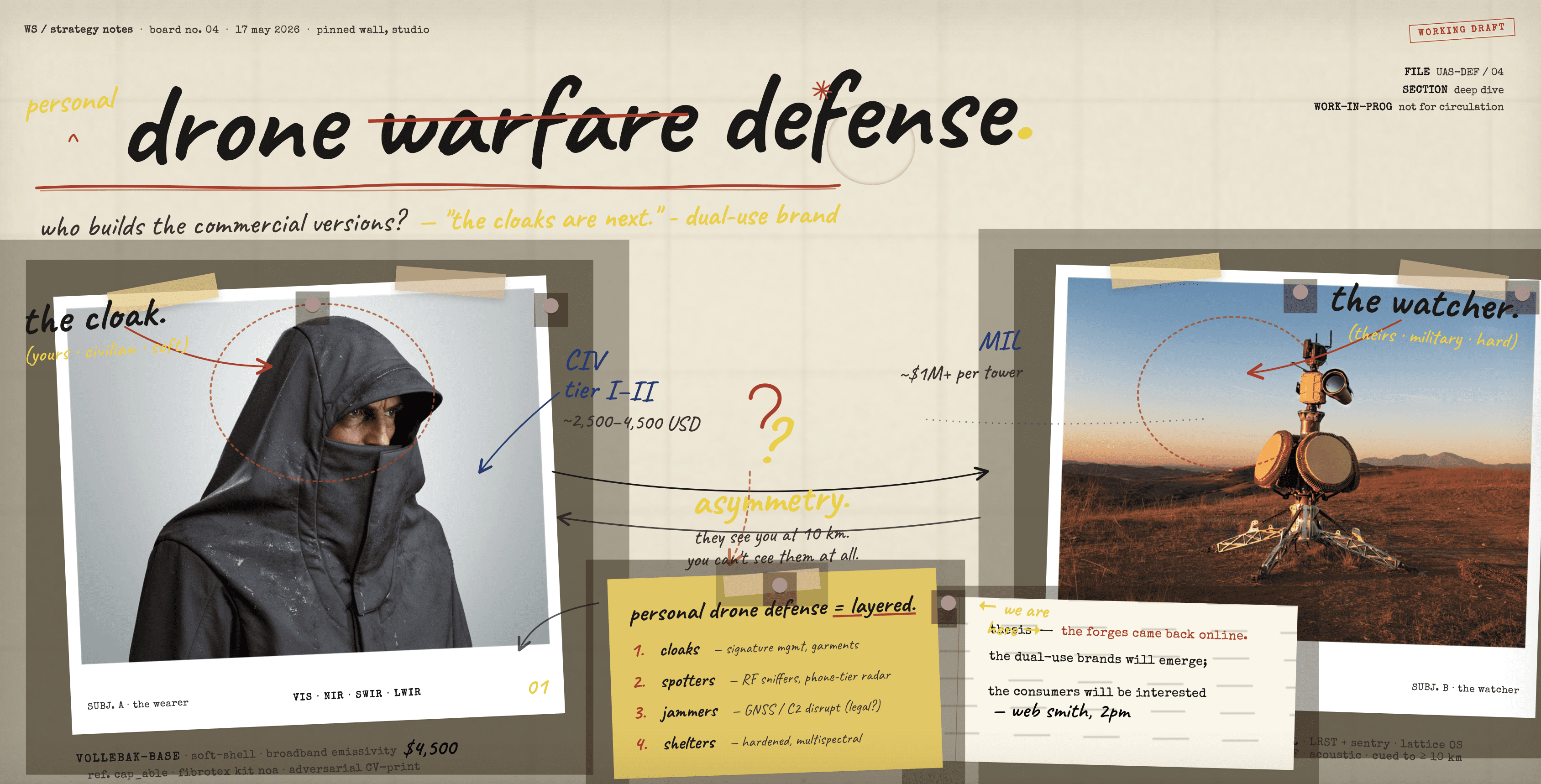
Concealment is multispectral signature management. The standard wool blanket and Mylar bivy approach that defines the consumer survival market is binary and self-defeating. A reflective bivy blocks thermal entirely, which creates a cold anomaly against ambient that is, in some conditions, more identifiable than the human body it was supposed to be hiding. What modern signature management does is broadband emissivity matching to background. The defense industry product is the Fibrotex ULCANS netting that is now the US Army’s standard concealment kit, and its personal-scale analogs (Kit Noa, Saab’s Special Operations Tactical Suit).
The consumer version of this category does not exist yet at any kind of brand scale. Building it is the opportunity. I want to.
Deception is adversarial computer vision. The Italian fashion-engineering firm Cap_able has been shipping knitwear since 2023 with adversarial patches woven directly into the textile that misidentify the wearer to YOLO at approximately sixty percent rates under published testing. A frontier paper from November 2025 demonstrated thermally-activated dual-modal adversarial clothing that maintains above-eighty-percent attack success across both the visible and infrared bands simultaneously. The research is twelve to twenty-four months from a productized form factor.
Whoever ships the first dual-modal adversarial garment that does not look like a research artifact will define the consumer category aesthetic for a decade.
Disruption is where the public imagination collides with the legal and physical limits of the civilian channel. DIY EMP devices at man-portable scale are ineffective, dangerous to the operator, or illegal under FCC Part 15 and 18 U.S.C. § 1362, often all three simultaneously. The commercial counter-UAS systems that defeat drones at meaningful range (Epirus Leonidas, the Anduril Anvil, BAE Bofors) are crew-served, vehicle-mounted, and tightly export-controlled for entirely sensible reasons. Active RF jamming hardware is restricted to government and critical infrastructure customers in the United States and most of NATO. The civilian disruption layer is, honestly, passive RF detection plus operational discipline. Any brand that pretends otherwise is a liability rather than a category leader.
Hard kill at personal engagement range is a shotgun, the specialty loads exist. Effective range is thirty to forty meters against prosumer quadcopters with the right shot column. Net guns and SkyWall-class systems extend the range with no kinetic risk to bystanders but are slow, single-shot, and priced for facility security rather than personal use. Against a swarm of any meaningful size, hard kill is a last-resort interrupt for the one or two units that defeated the upstream layers. It is not a primary defense and should not be marketed as one.
The current consumer market is theater
What exists today for civilian buyers in the United States who are awake to this threat surface is a fragmented catalog of products positioned for the wrong customer. The tactical apparel brands selling “stealth hoodies” against thermal are selling cotton with a marketing budget. The Faraday-pouch market is mostly legitimate but positioned for crypto-paranoia and Faraday-as-EMP-protection rather than as one layer of a coherent personal signature management system. The YouTube ecosystem selling DIY capacitor-bank EMP devices is selling personal injury claims. The military surplus channel has the actual physics-validated material (Fibrotex panels, Saab MCS components, IDF-surplus thermal-disruptive material) but no consumer brand, no fitting guidance, no integration, and no marketing that speaks to anyone who is not already inside the operator subculture.
What the market does not have is the brand that does for personal signature management what Patagonia did for technical outerwear in the 1980s, what Yeti did for coolers in the 2010s, or what Athletic Greens did for daily supplementation in the late teens.
The category requires a premium consumer brand that takes the physics seriously, builds an integrated product line, prices it at the upper end of the technical apparel market, and uses long-form content as the primary acquisition channel. The content is half of the moat. The buyer for this category is a reader. They read SOFREP, they listen to Cleared Hot, they subscribe to War on the Rocks, they may even read 2PM on ocassion. The brand that wins this category will be the brand that publishes the field manual that defines the category before anyone else has the language for it.
The civilian stack you can actually build, today
The tables below are what an informed civilian buyer in the United States can actually acquire in 2026, assembled from existing brands, with gaps marked where the consumer category does not yet exist and the operator has to substitute or improvise.
Tier I. Foundation ($600 to $900)
The minimum coherent stack. Closer to insurance than to operational kit.
| Component | Product | Approximate Cost |
|---|---|---|
| RF detection (handheld passive scanner) | RF Explorer 6G Combo or 3G Combo | $269 to $399 |
| Faraday phone pouch | Mission Darkness Faraday Bag | $25 |
| Faraday laptop or tablet sleeve | Mission Darkness Non-Window Faraday Bag XL | $60 |
| Adversarial CV garment | Cap_able knit hoodie (Manifesto Collection) | $250 to $400 |
| Mylar contrast-break panel (static use only) | Heatsheets Survival Bivy | $15 |
Tier II. Operator ($2,800 to $4,500 additional)
The functional stack. This is what a civilian buyer who treats personal signature management as a real protective category should be running.
| Component | Product | Approximate Cost |
|---|---|---|
| Personal multispectral concealment | Snipers Hide ThermaShield poncho or surplus ULCANS panel | $200 to $600 |
| Multispectral hide-site netting | Tropic Concealment Solutions or surplus ULCANS Kit Sophia | $400 to $1,200 |
| Thermal-disruptive base layer | Wild Things Tactical Heavy Weight Polartec or equivalent | $200 to $400 |
| Outer ghillie augmentation | Red Rock Outdoor Gear base + local-flora additive | $80 to $150 |
| Spectrum analyzer (upgrade from RF Explorer) | Aaronia Spectran V5 or V6 | $1,200 to $2,500 |
| Directional antenna | Aaronia HyperLOG or OmniLOG | $200 to $500 |
| Tactical Awareness Kit hardware | Samsung Galaxy S-series running ATAK | $400 to $900 |
| Comprehensive Faraday integration | Mission Darkness CYBER Faraday Bag set | $150 |
Tier III. Maximum civilian capability ($5,000 to $12,000 additional)
The ceiling of what a civilian buyer in the United States can legally acquire and operate. Above this tier the products are restricted to government, critical infrastructure, or executive protection contracts.
| Component | Product | Approximate Cost |
|---|---|---|
| Passive wearable C-UAS detector | DroneShield RfPatrol Mk2 (executive protection channel) | $4,000 to $8,000 |
| Vehicle multispectral camouflage | Surplus or commercial MCS panels | $1,500 to $3,500 |
| Hard-kill platform | Beretta 1301 Tactical or Mossberg 590A1 | $700 to $1,500 |
| Anti-drone specialty loads | Drone Munition or Skynet Mi-5 | $100 to $200 per case |
| Net launcher (non-lethal interrupt) | SkyWall Patrol or civilian net gun equivalent | $500 to $5,000 |
| Thermal imager (situational awareness only) | Pulsar Helion 2 XP50 Pro or Bering Optics Hogster | $2,500 to $4,500 |
The three gaps the market has not closed
Three product categories do not exist for the American consumer in any form that an experienced operator would respect. Each is a build opportunity for whoever wants to define the category before the catalyst event arrives.
The first is a multispectral concealment garment system built for the civilian body type, sized like outdoor apparel, branded for the buyer who is not in uniform, and priced at the upper end of the technical outerwear category. Fibrotex Kit Noa is the physics reference; Patagonia is the merchandising reference. The synthesis has not been done.
The second is a passive wearable RF detector at a consumer price point, branded for civilian executive protection and outdoor recreation use, paired with a companion mobile app. DroneShield owns the institutional channel. There is no civilian-channel equivalent priced below $1,500, and the buyer who would pay $499 for a respectable handheld unit numbers in the hundreds of thousands today.
The third is a dual-modal adversarial garment that defeats both visible-band and infrared computer vision simultaneously, in a form factor that reads as outdoor or urban apparel rather than science experiment. The research exists as of November 2025 but the product does not. Whoever ships it first will define the visual identity of the category.
Marketing the category
The brand that wins this market will sound like nothing currently in the tactical category and very little in the technical outdoor category. The voice has to read as competent, calm, and operator-adjacent without leaning into the cosplay aesthetic that defines most of the existing tactical apparel market.
Think of how Vollebak markets apparel for what they call “the next hundred years.” Think of how Triple Aught Design wrote about urban operating environments fifteen years before the rest of the market caught up. Think of how Outlier sells four-figure technical apparel with no military framing at all. The aesthetic is technical, restrained, photographically dark, and the copy treats the buyer as someone who has already done the homework.
Three positioning vectors will work. The first is continuity, which is the language of buyers who want to keep doing what they have been doing (running, ranching, traveling, working in austere environments) in conditions that have changed underneath them. The second is autonomy, which is the language of buyers who recognize that institutional security infrastructure has degraded and the burden has moved to the individual. The third is stewardship, which is the language of buyers who are protecting other people (family, team, principal) and need the equipment to perform without them being the most technical person in the room.
The acquisition channel is content first, retail second, direct-to-consumer eCommerce as the operating infrastructure. The brand will be built on a publication, a podcast, or a newsletter before it sells a single unit. The Athletic Greens model applies directly. The brand that wins this category will spend the first eighteen months publishing the field manual that the buyer trusts before the buyer is ready to spend $3,000 on integrated kit.
That is the moat.
The cost ladder
The retail price ladder, when this category is built correctly, lands at four tiers.
Entry ($249 to $499). The single garment or single device that earns the buyer’s trust and establishes the brand. This is the adversarial hoodie, the high-end Faraday kit, the consumer RF detector. It is also the gift purchase, the gateway purchase, the trial purchase.
Core ($999 to $2,499). The integrated personal kit. Multispectral cloak, thermal-disruptive base layer, RF detector, Faraday kit, integration accessories. The buyer at this tier has made the decision to treat the category as real.
Expedition ($4,999 to $9,999). The full operator-grade civilian stack. Adds the upgraded spectrum analyzer, hide-site netting, ATAK-integrated hardware, the optional thermal imager.
Bespoke (custom). The family or executive protection package, custom-fit, custom-configured, sold through a consultative channel. This tier carries the margin. The first three build the brand that earns the right to sell the fourth.
Gross margin on the core tier should land at sixty to sixty-five percent. On the bespoke tier, eighty percent is achievable. The unit economics work in the same way that Yeti’s worked when they moved from a single cooler SKU to a product system, and the way Patagonia’s worked when they moved from technical jackets to integrated outerwear. The category does not get built one product at a time. It gets built one customer cohort at a time, and the right cohort is willing to spend at retention rates that look like Patagonia rather than Amazon.
The build I am testing
The personal stack I am testing sits at the upper end of Tier II, with selective additions from Tier III where the gear is legally available to a civilian buyer in Ohio. The RF Explorer goes in the running pack. The Cap_able piece sits in regular outerwear rotation. The ThermaShield and the Tropic Concealment net sit in my garage. The Mission Darkness Faraday kit is already integrated into the daily-carry rotation for the phone and the Yubikey. The DroneShield RfPatrol acquisition is a longer process given the institutional channel, but the path exists through executive protection resellers and through the defense ecosystem relationships that the 2PM editorial work has produced.
The reason to build it now is mostly editorial. The category is coming whether the American consumer is ready for it or not, and the publication that has a credible operator perspective on it from inside the build will define the conversation for the next thirty-six months.
The Forges Went Dark established that the manufacturing side of the dual-use shift was real and that the reshoring underneath it would not be reversed. This is the protective equipment side of the same shift, pointed at the buyer rather than the contractor. The brands that arrive first will be the brands that are still here when the rest of the market figures out it is a category.
If and / or when
The catalyst event that ends that conviction is not a question of whether. It is a question of which. A drone incident at a Super Bowl. A coordinated swarm at a presidential inauguration. A paparazzi drone that kills someone famous. A cartel drone strike that crosses the Rio Grande and kills a sheriff. An attributable Chinese or Iranian incursion that the public cannot un-know. Any one of these flips the category from niche-premium to mass-aware in a single news cycle. The work to do is to be the brand that defined the language before that next morning.
Pesquisa e redação por Web Smith
Afterword: Acronyms and terminology
The vocabulary of unmanned warfare and signature management has been built largely inside defense and intelligence institutions, and it is not yet in common civilian use. The terms below appear in the essay above and across the broader literature.
| Term | Expansion | What it means in practice |
|---|---|---|
| ATAK | Android Team Awareness Kit | Government-developed situational awareness app, originally for special operations, now available in a civilian variant (CivTAK). |
| AEO | Answer Engine Optimization | The discipline of making content discoverable by AI answer engines rather than traditional search. |
| CONUS | Continental United States | Used to distinguish operations or personnel located inside the lower 48 from those forward-deployed. |
| C-UAS | Counter-Unmanned Aerial Systems | The product and doctrine category for detecting, tracking, and defeating drones. |
| CV | Computer Vision | The machine-learning subfield that handles image recognition and object detection, including person-detection on drones. |
| DTC | Direct to Consumer | A commerce model in which the brand sells directly to the end customer without retail intermediaries. |
| EMP | Electromagnetic Pulse | A burst of electromagnetic energy capable of disabling electronics. Effective at scale only via nuclear detonation or large directed-energy systems. |
| EO/IR | Electro-Optical / Infrared | The dominant sensor pair on commercial and military drones, covering visible light and thermal bands. |
| FPV | First-Person View | A drone control mode in which the pilot sees through a camera on the drone in real time. The dominant attack drone format in Ukraine. |
| GNSS | Global Navigation Satellite System | The umbrella term for GPS and its international counterparts (GLONASS, Galileo, BeiDou). |
| HaaS | Hardware as a Service | A commercial model in which the customer subscribes to a hardware capability rather than purchasing the unit outright. |
| HEL | High Energy Laser | Directed-energy weapon class used in some emerging counter-UAS systems. |
| HPM | High Power Microwave | Directed-energy weapon class that disables electronics across a wide area. Epirus Leonidas is the visible US example. |
| INS | Inertial Navigation System | A self-contained navigation method that does not require external signals like GPS. |
| ISM band | Industrial, Scientific, Medical band | The unlicensed radio frequency bands (notably 2.4 GHz and 5.8 GHz) used by most commercial drone control links and Wi-Fi. |
| ISR | Intelligence, Surveillance, Reconnaissance | The military function of collecting information on adversaries or environments. Most modern drones are ISR platforms first. |
| LWIR | Long-Wave Infrared | The thermal band (roughly 8 to 14 micrometers) in which human bodies are most distinctive against ambient. |
| MCS | Mobile Camouflage System | Multispectral concealment material designed to be applied to vehicles or platforms in motion. |
| MGRS | Military Grid Reference System | The grid coordinate system used in military and ATAK environments. |
| MWIR | Mid-Wave Infrared | Thermal band (roughly 3 to 5 micrometers) used by higher-grade military sensors. |
| NATSEC | National Security | The institutional and commercial sphere oriented around defense, intelligence, and homeland security work. |
| NIR | Near Infrared | The first non-visible band beyond red light. Used by night-vision systems and some agricultural sensors. |
| NORAD | North American Aerospace Defense Command | The joint US-Canadian command responsible for aerospace warning and control over North America. |
| NORTHCOM | United States Northern Command | The US combatant command responsible for homeland defense. |
| POS | Point of Sale | Retail terminology for the system that processes transactions at the moment of purchase. |
| SAR | Synthetic Aperture Radar | A radar imaging technique that produces high-resolution imagery in all weather, day or night. |
| SDR | Software-Defined Radio | A radio system whose signal processing happens in software rather than fixed hardware. Underpins most modern RF detection. |
| SWIR | Short-Wave Infrared | Thermal band (roughly 1 to 3 micrometers) that penetrates haze and some forms of visual camouflage. |
| UAS / UAV | Unmanned Aerial System / Vehicle | The formal terms for what most people call a drone. UAS refers to the full system including ground station; UAV is the aircraft itself. |
| UV | Ultraviolet | The band of the electromagnetic spectrum above visible light. Used by some sensor stacks and certain camouflage detection systems. |
| YOLO | You Only Look Once | The dominant real-time object detection model family. The de facto person-detector on commercial drone targeting systems. |
Further reading from 2PM: The Forges Went Dark. For corrections, additions, or off-record discussion of the category, the contact channel is the usual one.