Member Brief: Virgil, The Polymath

On occasion, we unlock member briefs for wider consumption. To support 2PM’s wider work, you can become a member

This essay was originally written on an October day while seated on a bench in New York’s Madison Square Park. When I would travel to the city, I would visit museums with people who inspired me. But on that particular day, time was short. I had two hours to spare and I wanted to make them count, so I chose to make my own museum of sorts. I put my AirPods in, hit play on what would turn out to be one of Virgil Abloh’s final DJ sets.

For the first hour and 14 minutes, I researched his years between 15 and 41. And then the tone of the DJ set’s flavor of music shifted for a few minutes and inspired me to write what you’ll read below.

To me, the moment represented the feeling in a museum when you feel spoken to by art. You relate to the context of what you see t in front of you and you look over to the person to your right and you explain it with a passion. As I switched from research to writing, I was “talking” to the person (you) on my right through written word.

These are my thoughts on one of the great polymaths of our time. The final three paragraphs were added upon his passing. This is for Virgil Abloh.

“An Idea I Had”

We are so quick to put women and men in a box that we fail to see the beauty when they do not fit in either one. For me, this is the fascination with polymathic types and there are few who fit the mold more than you. You are a mix between left brained and right. How did you strike a balance between the two?

I have so many questions.

How did the son of a Ghanaian seamstress and painter fit in at Boylan Catholic High School? Did you make yourself small for those years or did your prized grandiosity breakthrough the monotony of high school sameness? Did you say that you were from Chicago even though you were a suburban kid? What were your influences while you were there? Did you enjoy the school’s philosophy curriculum and its theology courses?

As an engineer at the University of Wisconsin, what was more difficult for you: Multivariate Calculus? Linear Algebra? Probability and Statistics? Differential Equations? Was earning your Civil Engineering degree your happiest moment at the time?

When you were at Illinois Institute of Technology studying for your Master of Architecture, which was a more important moment for you? Was it observing the construction of the building designed by Rem Koolhaas or the classes themselves? What, in you, made you look at the civil engineering in front of you and choose fashion for your primary form of expression? Did you ever get to speak to Koolhaas about his brand philosophy of selling a brand instead of marketing clothes? Did you visit his Beverly Hills Prada store?

I found your first moment of culmination. This is where your inspiration meets your influence meets your education meets your will.The blog that you called home, The Brilliance, highlighted the fact that nearly 13 years ago to the day, your first T-shirt entitled “Medallions en bleu” sold out in a week at Colette. Did you know that you could build a fashion empire before this moment or is this what it took to confirm it within yourself?

It was a smart first approach: a venerated name in fashion’s first city, a blank Champion, a beautiful design, and the extra care to redesign the size tag. Hypebeast wrote about it in 2008; back then, they needed to use your whole name.

Nearly one year later, Kanye West interrupted Taylor Swift on stage at the 2009 MTV Music awards. What did you say to the television when you saw the man who you met at a Chicago print shop make himself a villain before millions? Did you discuss it with West en route to Fendi in 2009? So many moments happened for you in this year. Fendi signed you to an internship alongside Kanye West. It was the year that this famed image was snapped by Tommy Ton during the Paris Fashion Week. You became the Creative Director of DONDA. At the time, few understood what you’d done, who you were, or what you would become.
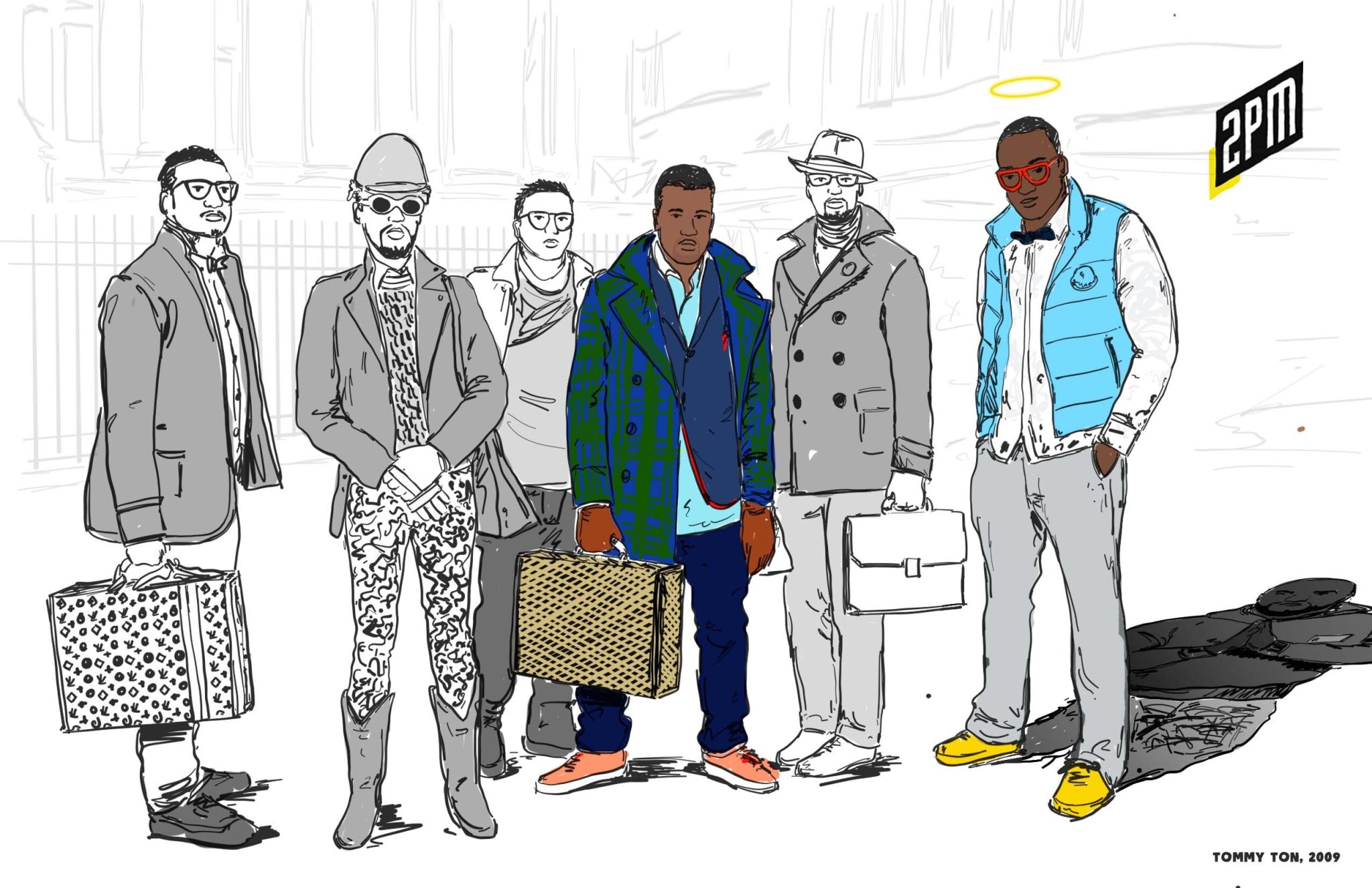
Virgil Abloh before he was Virgil, pictured alongside Kanye West in Paris (2009)

LVMH recognized you for the first time, that year, however. And you opened RSVP Gallery with Don C in Chicago. I attempted to run there from my hotel once, earlier this year. The Milwaukee street stretch to your storefront was a hard bargain and I ended up turning around at mile five. That’s about as close as I got to being in your presence, indirectly of course.

Did you become fast friends with Jay-Z when you designed the Watch The Throne album cover? Was the Ralph Lauren deadstock for your Pyrex Vision project your best investment? Is this the moment when you realized you were a true artist? For those who do not know, you shut down a company that was selling $40 tees for $550; you called it “an artistic experiment.”

Your next project is how most of us began to know you. You said this about Off-White.

In a large part streetwear is seen as cheap. What my goal has been is to add an intellectual layer to it and make it credible.

You accomplished this right as the tide began to shift in 2012, especially for women and men of color who wanted their contributions appropriately accounted for. Today, streetwear is widely applauded but back then, it was still a part of the streets.

The Gray Area Between Black and White

That’s the origin of the name Off-White, a brand that propelled you towards collaborations with Nike, Ikea, and a consumer sentiment that outranked Gucci’s. Nearly every American has seen your work by now, even if they didn’t know that it was you.

It would be just nine years since the moment LVMH CEO Michael Burke recognized your brilliance when on March 25, 2018 you stole the dream of your former mentor Kanye West. What was it like becoming the artistic director of Louis Vuitton’s menswear division? Was he upset with you? Did your friendship suffer?

I remember your first Louis Vuitton fashion show. I remember the Serena Williams outfits designed by you for that year’s US Open. And I remember how you helped Rimowa’s rise as the premiere luggage brand continue unabated.

Posthumous

I am sorry, Virgil. Cancer has deeply affected me and my family and I have a special hatred for it. I am not sorry for you, I am sorry for it. In the two years that you fought the disease with vigor and valor, you launched a monthly internet show devoted to your love of DJing. You launched your first solo museum exhibit at the MCA in Chicago. I had the book with me in Madison Square Park that day. Had I known you were in excruciating pain while producing for family, friends, and fans, I would have never set the book on the dusty park ground. I remember during the summer of 2020 when you were facing extreme scrutiny for a $50 donation that you made to that Miami-based art collective to cover George Floyd protestors’ legal costs. The internet skewered you while you were probably writhing in pain, silently and valiantly. You continued to contribute, you never made excuses for what was blown out of proportion, and God only knows what donations you contributed behind the scenes.

Today, Sotheby’s launched its official entry into the world of streetwear. Nine years ago, the affluent in your midwestern city would have laughed at the idea of your turning the tide of culture to include more faces, more types, more colors, and more styles.

You were an engineer-turned-architect who excelled in music and culture. You expressed your art and love of culture through fashion. The New York Times wrote:

In recent years, it could often appear as if there were several Virgil Ablohs, all working at the same time. [1]

And the New Yorker’s tribute to you began:

For the polymath, there is always a cardinal subject, a chief preoccupation around which all the other interests spin. For the fashion designer Virgil Abloh, the polymath of his cohort, who died on Sunday of a rare cardiac cancer, offensively too young, the center was architecture. [2]

You were a polymath but you likely never referred to yourself as such. We are so quick to put women and men in a box that we fail to see the beauty when they do not fit in one. Society wants us to fall within one of two categories, black or white. You created your own in off-white, the grayscale between the two colors. The masters are those who can travel between the two sides of the brain. What your life showed us is to keep yourself as close to the middle, using both sides at once.

I am sorry for your family’s pain but I am comforted knowing that you passed away knowing that you finished work that will make your life timeless. Your pace was exceptional and so was your life.

वेब स्मिथ द्वारा | संपादक: हिलेरी मिल्नेस | कलाकार: एलेक्स रेमी और क्रिस्टीना विलियम्स


Data: Black Friday Down

Updated. The writing was on the wall when holiday decorations hit sales floors in October. Thanks to persisting supply chain concerns, the holiday season began earlier than ever, which is impacting the bellwether statistics that retail industrialists rely on for forecasted investments. For the first time in history, online retail saw a reversal in year-over-year growth trends. On November 26, online shoppers spent $100 million less than they did on Black Friday 2020. Total sales fell $8.9 billion compared to last year according to Adobe Analytics. Adobe’s Lead Analyst Vivek Pandya:

Shoppers are being strategic in their gift shopping, buying much earlier in the season and being flexible about when they shop to make sure they get the best deals.

By some, the downward trend has been characterized as a contraction in eCommerce spend, but it will be remembered as a confirmation of a much larger shift in pandemic-era retail. In July’s Digital Supply Chain, I wrote about one of the changes that we’d see this fall.

This Black Friday season will see a narrative around short supply of physical goods and an emphasis on brand retailers offering NFT-based products that appeal to their most enthused consumers. Nike will sell digital shoes, Balenciaga will sell avatars for your child’s favorite multi-player game, and legacy companies will emulate the brilliance of the Bored Ape Yacht Club whose NFT sales provide access to a real-life community.

There were other contributing factors to retail’s declining Black Friday performance, and they were not exclusive to online retail. According to CNBC’s Lauren Thomas, Black Friday shopping in stores fell 28.3% from 2019’s levels. And Thanksgiving Day visits were down 90.4% from 2019 levels according to Sensormatic. It should be no surprise that the culprit behind the “down year” is actually a number of factors. The Adobe data indicates an 124% increase in out-of-stock levels. Consumers starting earlier may have taken the sting out of the November shopping event. In October 2021, I explained in No Stock For Chrismukkah:

This means Black Friday will look different. In previous holiday seasons, pricing incentives were the sales hook. This year, retailers won’t need to offer flash sales or free shipping: availability is the hook. Plainly put, if a quality product is available to ship before the holiday season, it will likely be purchased. This is what Lowe’s is signaling with their premature focus on Christmas. If they waited until the normal beginning of holiday cheer, there may not be the stock to support the spike in demand.

It’s not for a lack of trying. According to a Gallup poll, Americans intend to spend record amounts for Christmas; product availability is the problem. This forecasted spend is actually higher than pre-pandemic levels and 2020.

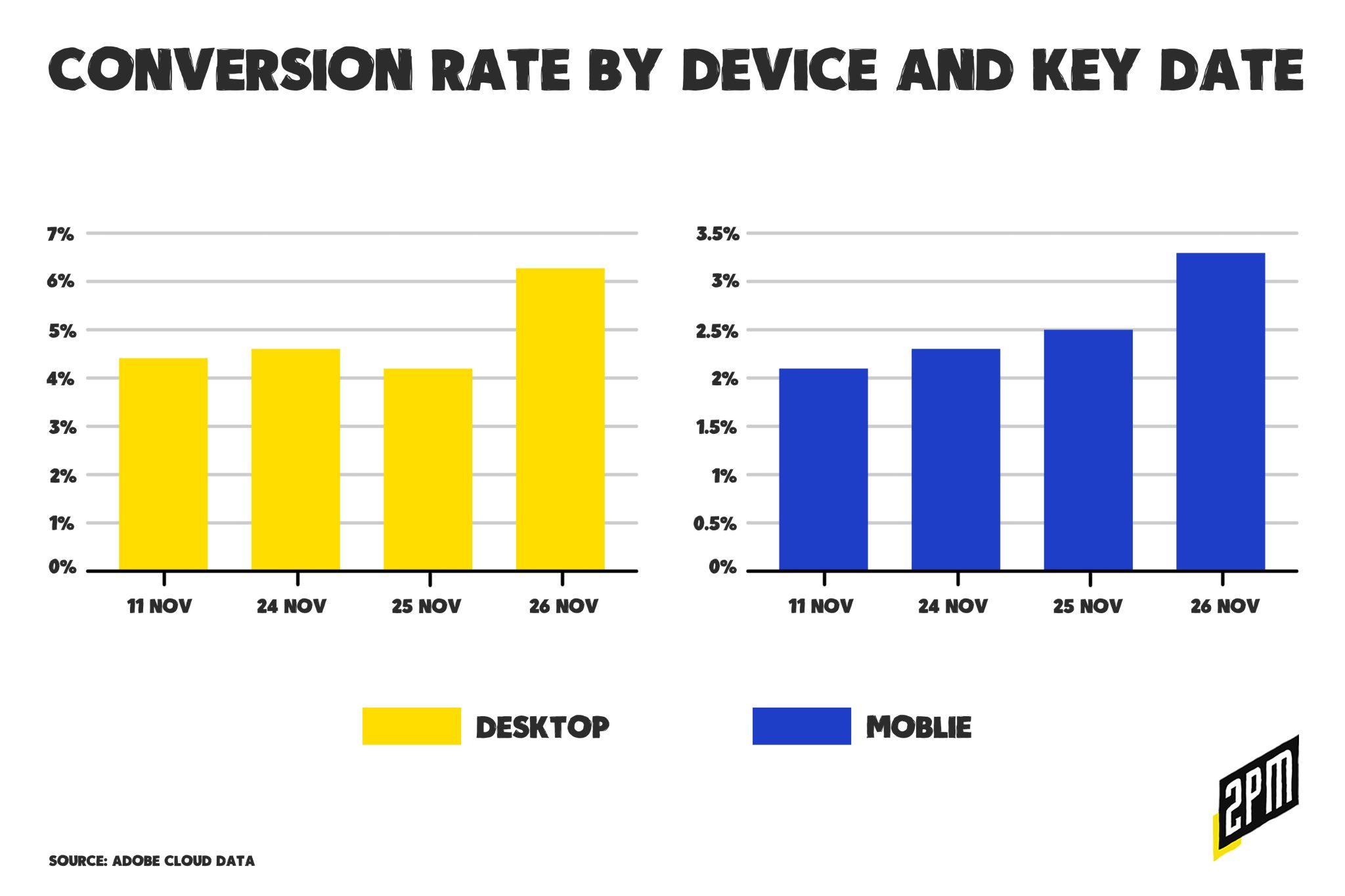
The other problem may be no problem at all. With spend spread over a greater period of time, even with supply chain concerns persisting, this holiday season may still set a new record in gross merchandising volume (GMV) between October and December 24. According to Adobe’s data, shoppers spent $3 billion or more 22 times so far this holiday season. Last year by this date, the GMV exceeded $3 billion just five times. There’s also conversion rates to consider:

The Black Friday conversion rates across the Adobe Sales Cloud spiked to extraordinary averages across desktop and mobile devices on Black Friday – a sign that there may still be an unmet need that Cyber Monday and beyond will account for. An elongated holiday season, fewer deals, and a supply chain under pressure are all contributing factors to America’s first Black Friday without a sales record. According to Adobe Analytics, shoppers spent $10.7 billion on Cyber Monday. This falls to 1.4% less than 2020’s record breaking Cyber Monday spend. When you consider the stay-at-home conditions of 2020, this figure is more of an accomplishment than it may seem to analysts. CNBC reports that November spend (through Cyber Monday) in the United States is up 11.9%, totaling $109.8 billion online.

Additionally, out-of-stock messages increased 8% over the week, signifying the culmination of a tumultuous season for supply chain workers and the retailers that rely on them. These out-of-stock messages are up 169% vs. 2020 figures and 258% higher than 2019.

The reality of these figures is nuanced; it could mean that demand could remain pretty strong and this year’s remaining sales volume will average out to finish higher than previous Q4 sales figures. There’s also the small chance that we’re just more grateful for what we already have.

By 2PM

Member Brief: StarDAO


This member brief is unlocked for all readers. To join 2PM, you can click here

Web3’s influence on retail is just beginning. Like Nike’s investments into digital goods and services, Starbucks is in position to become the consumer packaged goods leader in the next generation of the web.

Starbucks began as a coffee roaster, but today it’s just as much of a financial services company. Let’s look at Starbucks’ history of product innovation.

During the second wave of American coffee culture, Starbucks rose to prominence by borrowing the blueprint of its predecessor, Peet’s Coffee & Tea. Before Peet’s, espresso was purely an Italian product. Bolstering the availability of international beans, roasting styles, and drink preparations defined the second wave. To expand its product offerings and distribution, Starbucks acquired manufacturers, brands, and intellectual property (the Frappuccino trademark was acquired) over the course of 50 years and 32,660 stores. With the groundwork laid by Peet’s, the Starbucks supply chain and menu democratized the world’s coffee products, which were once exclusive to specific cultures. Today, coffee is on its third wave, which accounts for companies started after 2000. But there is no third wave without Starbucks and they just may make the biggest contribution to this latest wave yet.

The first wave of American coffee culture was probably the 19th-century surge that put Folgers on every table, and the second was the proliferation, starting in the 1960s at Peet’s and moving smartly through the Starbucks grande decaf latte, of espresso drinks and regionally labeled coffee. We are now in the third wave of coffee connoisseurship, where beans are sourced from farms instead of countries, roasting is about bringing out rather than incinerating the unique characteristics of each bean, and the flavor is clean and hard and pure.

Today, companies like Cometeer have stolen the spotlight. Former computer scientist Matt Roberts co-founded Cometeer in 2015 along with Doug Hoon and Karl Winkler, who each possess extensive backgrounds in engineering and product development. The brand went on to raise an initial $50 million and today, backed by a strong direct-to-consumer and subscription strategy, the brand is reported to be on track for high eight figures in annual revenue. The brand sells high quality, specialty coffees available in frozen pods. The genius of the company is its built-in loyalty: Cometeer is a monthly subscription product. But thanks to Web3 technologies, Starbucks’ notable loyalty strategy can improve in ways unforeseen just a few years ago.

Web3 and Loyalty

It’s no surprise that heritage companies like Nike and Starbucks are taking the leap into Web3. For now, Web3 conversations are concentrated on Web2 platforms. Much like Web2 platforms propel Web3 technologies (ConstitutionDAO / Twitter / Discord, anyone?), some analysts believe that Starbucks is the perfect candidate for a decentralized autonomous organization (DAO) to govern its robust loyalty program. The foundation already exists. In the last year, Starbucks’ 90-day active member count grew 28% totaling 24.8 million users. Additionally, Starbucks is currently ranked third in mobile order ahead. And spectacularly, Starbucks mobile users have prepaid balances that account for just over $1.4 billion in funds that amount to loans to Starbucks.

Consumers love Starbucks so much that they’re willing to make a deposit to redeem coffee at an unknown future date and time. Starbucks is essentially gaining access to an interest-free line of credit, one that equates to roughly 4% of the company’s total liabilities. [2]

Starbucks will be one of the first major retailers to tokenize its loyalty program. In a published thread on Web3, consumer investor Magdalena Kala explains as much:

Imagine earning Starbucks tokens as an early customer in Seattle and seeing their value appreciate over time as the brand expands nationally and internationally Or imagine getting actual equity allocation pre-IPO due to high token ownership. Those are all customer benefits, so why should brands care about tokenization? More governance, more ownership, and more value appreciation all shift the customer mindset from a regular rewarded customer to aligned shareholder, governor, and creator.

In a tokenized loyalty program, getting rewarded through company upside and having meaningful say in product direction is preferred over receiving free products or discounts. This encourages a more impactful customer behavior. [Original Thread]

What Kala is summarizing is the shift from traditional loyalty programs to ones that provide a “shareholder mentality enabled by tokenization.” We are likely to see this from a brand like Starbucks before a younger, more agile brand. Starbucks has an enormous, built-in community. There are few major retailers that could achieve what Starbucks can with its existing infrastructure. A loyalty DAO would mean new product ideas, governance over potential marketing tactics, and rewards based not only in short-term gain but long-term upside. The Starbucks loyalty program, with the help of the mobile app that totals 28.4 million quarterly users, could precede a fundamental shift in how Starbucks uses one of its most valuable assets. If Starbucks does tokenize its loyalty program, corporate governance would be tiered: traditional C-suite, stock-based premium shareholders, and the loyalty DAO.

The benefits

This week, a DAO attempted to raise $20 million to acquire one of the last remaining copies of the Constitution. The collection of internet friends, crypto enthusiasts, and history buffs surpassed $43 million in collected funds.

Like many viral crowdfunding campaigns over the previous decade, the trigger for oversubscription was a combination of a desirable product and the enthusiasm for participation. In the case of the ConstitutionDAO, the eagerness can also be attributable to fractional ownership of something monumental and the ability to govern its existence. Magdalena Kala had additional thoughts on this topic. While great in theory, Kala sees obstacles in the way for companies as large as Starbucks:

It’s a huge mindset shift and hard to do for companies with large teams, set cultures, or a vested interest in the status quo. Plus, execution is hard given our current regulatory environment which makes this particularly hard for publicly traded companies. But we may see some more adventurous young private DTC brands experiment. Even likelier, a new crop of brands will incorporate tokenization from day one.

CPG is an interesting use case but in my opinion, luxury brand use cases are even more interesting, esp when comes to “democratized exclusivity. That is the use of tokens to gate exclusive releases etc.

She is correct to be skeptical. There are three major barriers: technical execution, storytelling and onboarding, and regulatory limits. Smart contract developers are in short supply, a potential hindrance to technical execution. And then there is messaging. Will the average coffee consumer care about governance, involvement in brand guidance, or the added benefits that are associated with either. Kala adds:

We need tokenization-in-the-box startups (or at least great agencies specializing in this) to enable this product for interested founders.

Starbucks may be known as a second-wave coffee retailer but over its considerable time influencing America’s collective passion for coffee, Starbucks became one of the most impressive financial services companies. Few are better prepared for the leap from Web2 to Web3. On October comments to analysts, CEO Kevin Johnson agreed:

Through blockchain or other innovative technologies, we are exploring how to tokenize Stars and create the ability for other merchants to connect their rewards program to Starbucks Rewards. This will enable customers to exchange value across brands, engage in more personalized experiences, enhance digital services and exchange other loyalty points for Stars at Starbucks.

Johnson is speaking in the theoretical here. The idea of using Web3 to build the next phase of community will be one of the most storied developments for traditional retailers and Web2 companies alike. Starbucks has the DNA for this type of shift: the company is built atop of a passionate and loyal community. Now, imagine if they had the opportunity to govern, develop, or contribute in ways that only Web3 can facilitate.

Before, loyalty was paid in discounts. In the future, it may be paid with appreciation.

वेब स्मिथ द्वारा | संपादक: हिलेरी मिल्नेस | कलाकार: क्रिस्टीना विलियम्स और एलेक्स रेमी