


Every fitness boom sells the same product and it’s never the workout. It is the body of the best person doing the workout. The general population funds the category, but the category is priced off a few dozen physiques at the top of the pyramid, and when those physiques change shape the money moves with them.
In the late 2000s the shape was a Spartan king. In 2026 it is a man who stands close to six feet and weighs what a middleweight weighs, alongside a woman who can run a fast 10K and then push a loaded sled across a convention hall. The “race for clout” in fitness has a new silhouette, and in September one of the most consequential consumer investors in the world paid for a controlling position in it.
The Leonidas Trade
When 300 reached theaters in March 2007, the story that traveled furthest was about how the cast had been built. Mark Twight, an alpinist who ran a private gym in Salt Lake City called Gym Jones, had trained the actors and stunt crew in 2005 on a philosophy he summarized as “appearance is a consequence of fitness,” and the graduation test he designed became known as the 300 workout. Every men’s magazine printed it, and every man who read it went looking for a place to do it.
The place most men found was CrossFit. Twight had been among the first affiliate coaches after attending a seminar in 2003, and although he had formally parted ways with Greg Glassman before the film was released, the market never recognized the separation. Gym Jones was still considered CrossFit by nearly everyone who encountered it, because the workouts looked the same, the vocabulary was the same, and Glassman spent years insisting the method was his. The man who built the bodies ran an invitation-only gym in Utah, so the demand those bodies created flowed to the organization with a storefront in every mid-sized American city.
The numbers describe what a single aesthetic can do. CrossFit had 13 affiliates in 2005 and 250 by 2007, then roughly 5,000 at the end of 2012 and about 15,500 in 2018, each paying an annual fee to a company that owned no gyms and was certifying nearly 50,000 coaches a year at its peak. By the time the curve went vertical the sport had its own “Leonidas” in Rich Froning, who won four consecutive CrossFit Games from 2011 to 2014 at 5’9” and 198 pounds. Men did not join for the methodology. Rather, they joined because the king of Sparta and the Fittest Man on Earth had the same torso and beard, and a $150 monthly membership looked like the price of admission to it.
The Durden Standard
That torso is no longer the one men are chasing (though none of us would mind looking like Froning), and the reason is that the country started running again. This is the most potent running boom since the one that began with the jogging craze of the late 1960s and crested in the 1970s, and its scale is easiest to read in the ballot for a single race. The 2027 London Marathon drew 1.33 million applications, up 18 percent in a year and more than double the 578,000 who applied for 2024, after the 2026 edition produced the largest marathon field ever recorded. Strava reported that new clubs on its platform nearly quadrupled in 2025 to one million, and the run club has replaced the box as the place where a 27-year-old meets people.
A sport reshapes the bodies of the people who do it, and then the bodies reshape the ideal.
The data on the male ideal is survey-grade rather than census-grade, but it has pointed in one direction for a long time. An informal survey of more than 1,000 people in 2011 found that 73 percent of women rated Brad Pitt’s Fight Club physique the most attractive in a lineup, a result a later survey of a thousand respondents repeated. Pitt played Tyler Durden at a reported 5’11” and about 155 pounds, which is the build of a competitive club runner with a pull-up habit.
The more revealing number in that first survey is that half of the men chose a bodybuilder’s physique for themselves while almost none of the women did. For two decades men were training for an audience of other men. The running boom closed that gap, because the look that distance produces is the look the surveys had been describing all along. Pitt supplied the heavier version as Achilles in Troy three years before 300, which makes it a small irony that the Greek hero who lost the cultural argument in 2007 won it in 2026.
The Runner Who Can Carry Her Own
The women’s ideal has moved to the same place from the opposite direction. Researchers writing in the journal Sex Roles found that when women were asked to choose between a thin figure and a thin, visibly muscular one, the toned figure won in 2018, and the behavior has since caught up with the preference. Women on Strava were 21 percent more likely than men to log weight training in 2025, and women aged 20 to 29 were the single largest group of UK applicants to the London Marathon ballot.
Put those two facts together and you have described the elite Hyrox woman: a runner first, strong enough that the sled, the sandbag and the farmer’s carry do not break her stride. The format is eight one-kilometer runs with a functional station after each, which means half the race is running and the other half punishes anyone who only runs. Women now account for 38 percent of Hyrox entries, up from 24 percent in 2020.
Hyrox has, for now, eclipsed peak CrossFit as the cultural force in fitness. Its 2025-26 season ran to more than 100 events and over 1.4 million participants, which is more than three times the 415,000 who registered for the CrossFit Open at its 2018 high. CrossFit, by contrast, was put up for sale by its private equity owner in 2025, lost 13 percent of its affiliates in the twelve months after a fee increase, and was taken back off the market this summer without a buyer.
One-Way Traffic
The clearest evidence of where clout sits is the direction in which the athletes travel. Tia-Clair Toomey, Mat Fraser and Noah Ohlsen, who between them hold thirteen CrossFit Games titles and a decade of podiums, all lined up at Hyrox races in 2025, and Ohlsen came away saying that elite CrossFitters were “so far off” from the running pace that the format demands. Froning retired from the Games, rode the Leadville Trail 100 on a mountain bike and recently completed an Ironman. Heber Cannon, who spent years documenting the Games as one half of the Buttery Bros, went to Leadville and the recent Ironman, as well. And Fraser, who has not competed since his fifth title in 2020, announced in November that his return will come at the 2027 Leadville Trail 100 Run, a hundred miles on foot over Hope Pass, with no plan to go back to the Games. Are you sensing a trend here?
Nothing comparable moves the other way. The nearest example is Hunter McIntyre, the three-time Hyrox world champion, who appeared at the 2019 CrossFit Games as a wildcard, which is to say by invitation, before Hyrox had an elite field worth leaving.
The current Elite 15 are former swimmers, obstacle racers and track athletes, and none of them is spending a season trying to qualify for a CrossFit Games. The clout is no longer there.
When the idols of one sport treat another sport’s start line as the next credential, the question of which one holds the cultural lead has been answered by the people best placed to know.
A Rebuke in Body Mass
CrossFit’s programming favored a particular frame. Heavy barbell cycling, handstand push-ups and muscle-ups reward short levers and a low center of gravity, and the men who won most often were built accordingly: Fraser at 5’7”, Froning and Jeffrey Adler at 5’9”, each within a few pounds of 200. Running endurance was tabled, because a long run is the one test where that frame pays a tax on every stride.
Hyrox reverses the incentive. Half the race is running, the loads are fixed and moderate, and nothing on the floor requires a gymnast’s proportions. Here is the men by season according to this excellent resource. 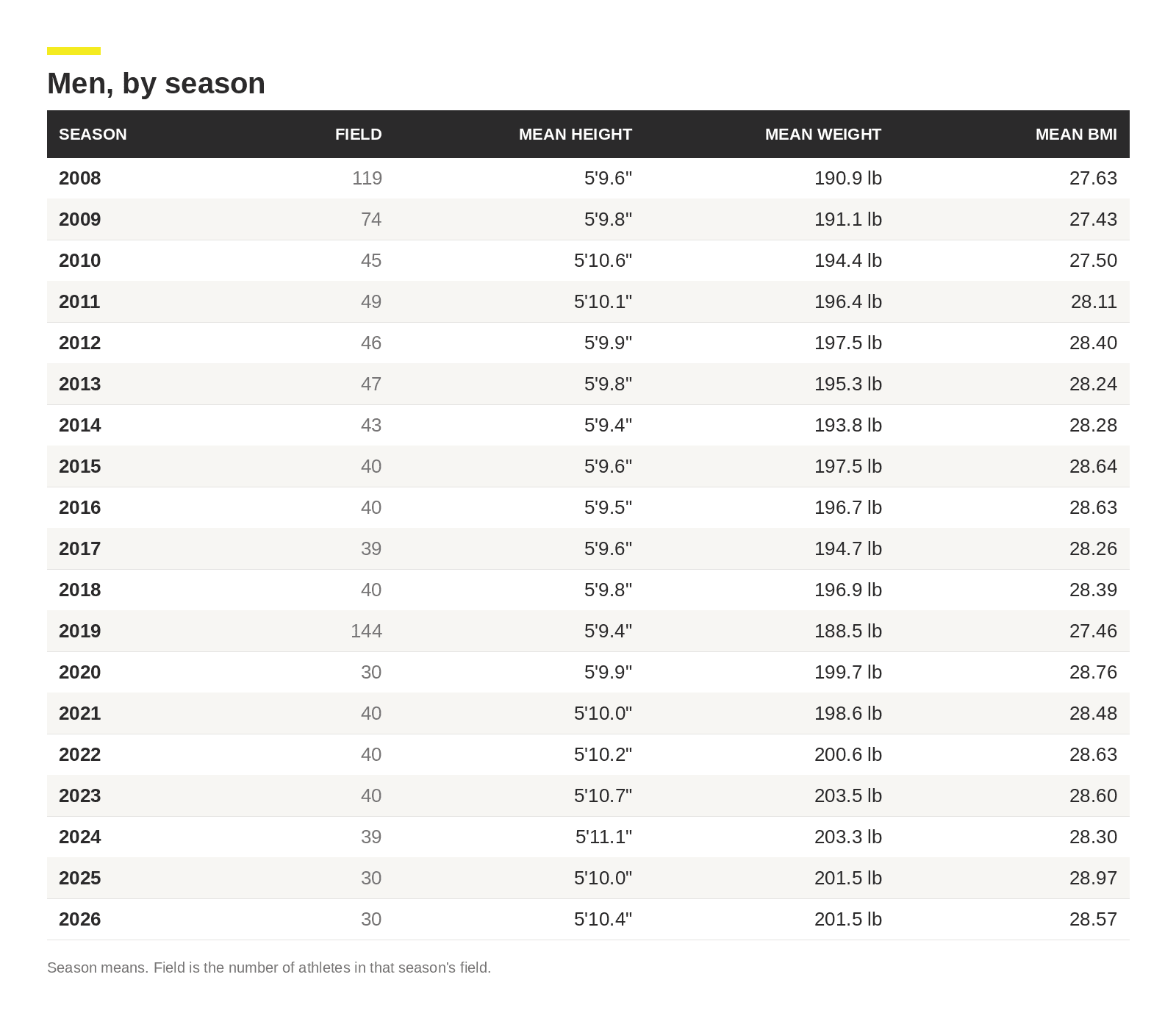
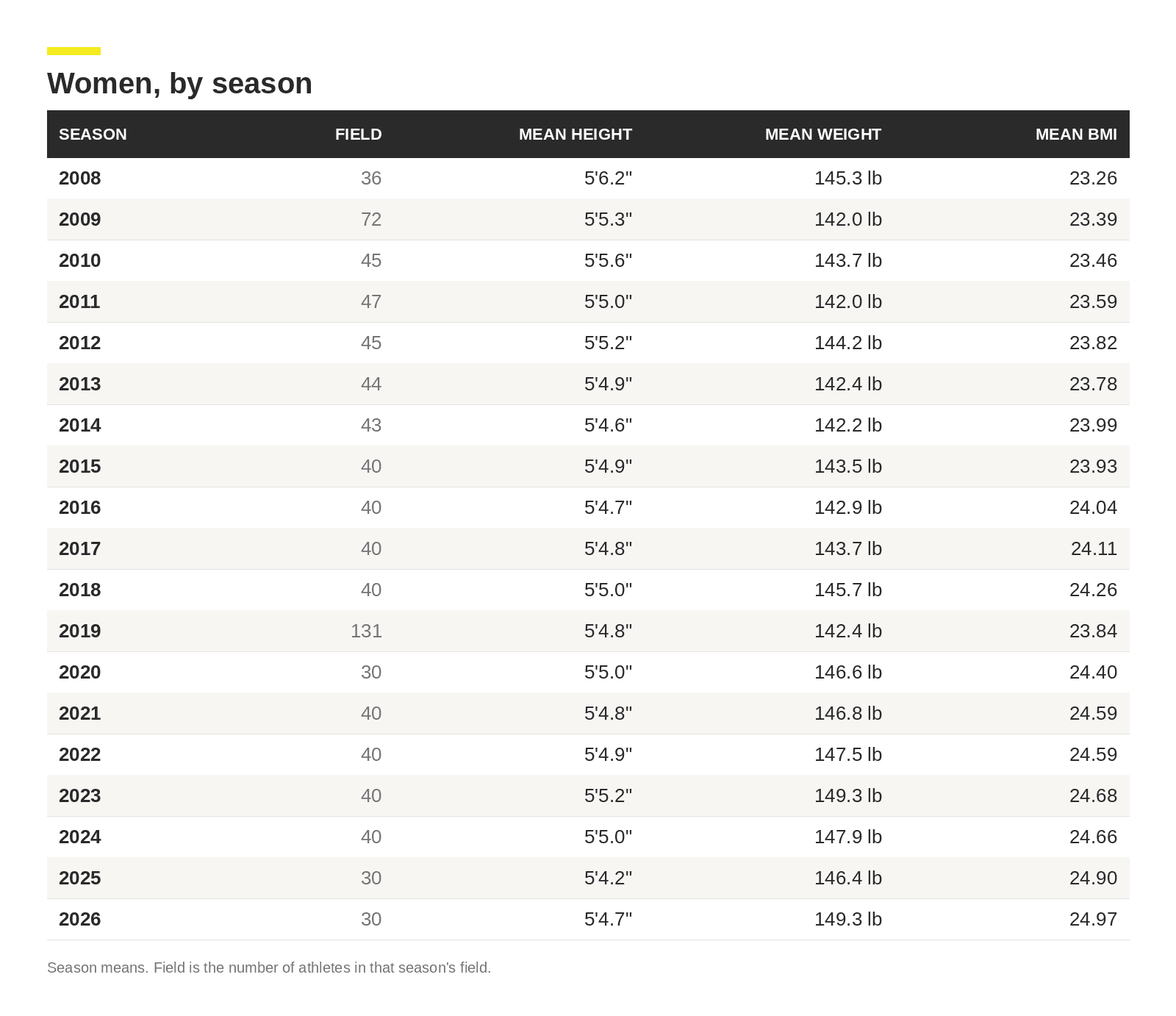

The elite Hyrox man is three inches taller than the Games field and 27 pounds lighter, and the cultural ideal that culture is converging on is lighter by another 25. The shortest man in this year’s Elite 15 stands 5’11”. He does not need jeans cut with extra room in the thigh or a shirt woven with four-way stretch to get over his shoulders, and that detail is worth more to the apparel industry than any sponsorship. A decade of menswear was engineered around the CrossFit body, from athletic-fit denim to the performance polo, and the body it was engineered for is no longer the one men are trying to build.
The Brands on the Start Line
CrossFit’s commercial partners were a barbell company (Rogue), a training shoe (Reebok) and a revolving protein tub sponsor (don’t get me started on this one). The brands Hyrox prefers tell you who it believes its customer is.
| Brand | Category | Position |
|---|---|---|
| Puma | Apparel and footwear | Official global partner through 2030 and title partner of the World Championships |
| Amazfit | Wearables | Exclusive smart wearable partner on a three-year global deal |
| Myprotein | Nutrition | Global nutrition partner |
| Centr | Equipment | Race equipment, from Chris Hemsworth’s fitness platform |
| Concept2 | Equipment | Rowing and ski ergometers, recently renewed |
| Red Bull | Energy and media | Athlete deals, coaching programs and event media |
| BYD | Automotive | Electric vehicle partner |
| Biotherm | Skincare | Partner |
| Maybelline | Cosmetics | Partner |
| HWPO Training, F45, Intersport | Training and retail | Partners; HWPO is Mat Fraser’s company |
The list outside the tent is just as instructive. Adidas has no Hyrox partnership and built a hybrid racing shoe, the Adizero Dropset Elite, anyway. On sponsors Alexander Rončević, the first man under 52 minutes, and its Cloudboom Echo sits alongside Saucony’s Endorphin Pro and Under Armour’s Reign as the shoes the community has chosen for itself. Puma’s chief executive told investors in February that Hyrox is a “lighthouse” partnership whose strategic value currently outweighs its revenue, which is how a company talks about an aesthetic it intends to borrow.
Second and Third Order Effects
On September 8 a consortium led by L Catterton, the consumer private equity firm backed by LVMH, acquired a majority stake in Hyrox from Infront Sports & Media alongside the founders and Jeffrey Katzenberg’s WndrCo, at a valuation reported near €600 million. The first order effect is obvious: more races in more cities, with Asia at the front of the queue. The effects that follow are the ones operators should be planning around.
The second order effects are commercial.
- Apparel gets recut. The stretch premium that defined a decade of menswear was a solution to a 200-pound frame on a 5’9” body. A leaner customer buys woven shorts, lighter tops and regular denim, and the independent running labels that already cut for him inherit a market the training brands spent years building.
- The training shoe becomes a racing shoe. The flat, stable cross-trainer was CrossFit’s signature product. Hyrox is run in plated running shoes, which moves the category to racing price points and hands it to the companies with the best foams. Adidas entering without a partnership is the proof.
- The gym floor is rebuilt. Hyrox licenses its format to more than 5,000 existing gyms instead of asking an enthusiast to sign a lease, which gives it the affiliate model without the real estate risk. Turf lanes, sleds and ergometers displace platforms and rigs, and the barbell economy that outfitted 15,000 boxes loses its growth engine to the companies that make the machines on the Hyrox course.
- The sponsor set widens to the brands L Catterton understands. A cosmetics company and a skincare house did not buy the CrossFit Games. They are buying an audience that is 38 percent women and two-thirds over 30, gathered in one hall for a weekend with a reason to spend. An owner with LVMH in its lineage will treat that hall as a channel, and the start line becomes a storefront in the most literal sense of linear commerce.
The third order effects are cultural, and they are less comfortable.
- Status moves from the look to the number. The lean ideal arrives in the same years that leanness became available by prescription. When the body can be bought, the credential shifts to what the body has done, and Hyrox is the same race in every city, so a finish time is as portable as a marathon time. CrossFit, constantly varied by design, never gave its members a number that traveled. Expect the time, the bib and the wearable that records them to carry more social weight than the physique itself.
- The ideal narrows as the audience broadens. Tyler Durden was filmed at a body fat level no clinician would recommend maintaining, and a movement that recruits through run clubs will hand that target to millions of people in their twenties. The gap between the elite outline and the customer’s own body has always been where this industry earns its margin, and the gap has rarely been wider.
- Clout becomes an asset on a fund’s timeline. Private equity bought CrossFit in 2020, near the top, and has spent the years since watching affiliates leave. L Catterton is paying for the same thing Berkshire Partners paid for, which is the cultural lead, and the cultural lead is rented from the athletes and the audience rather than owned. The pressure to add events, raise entry fees and extend the brand into every adjacent category is the pressure that tends to end a boom.
The Tide
The tide will turn again, as it did on the bodybuilders of the 1980s and on the box in the 2020s.
If leanness becomes cheap enough to be unremarkable, mass may become the scarce signal once more, and some future film will send men back to the squat rack looking for a different king.
Hyrox knows this, which is why it is racing to convert a moment into infrastructure before the moment passes. What does not change is the mechanism. The general population has never looked like Leonidas and does not look like Tyler Durden, and it will buy the membership, the shoe, the race entry and the shirt anyway, because what is for sale is proximity to the best body in the room. The operators who do well in each cycle are the ones who watch the podium, measure the people standing on it, and cut their patterns before everyone else notices the outline has changed.
Research and Writing by Web Smith