

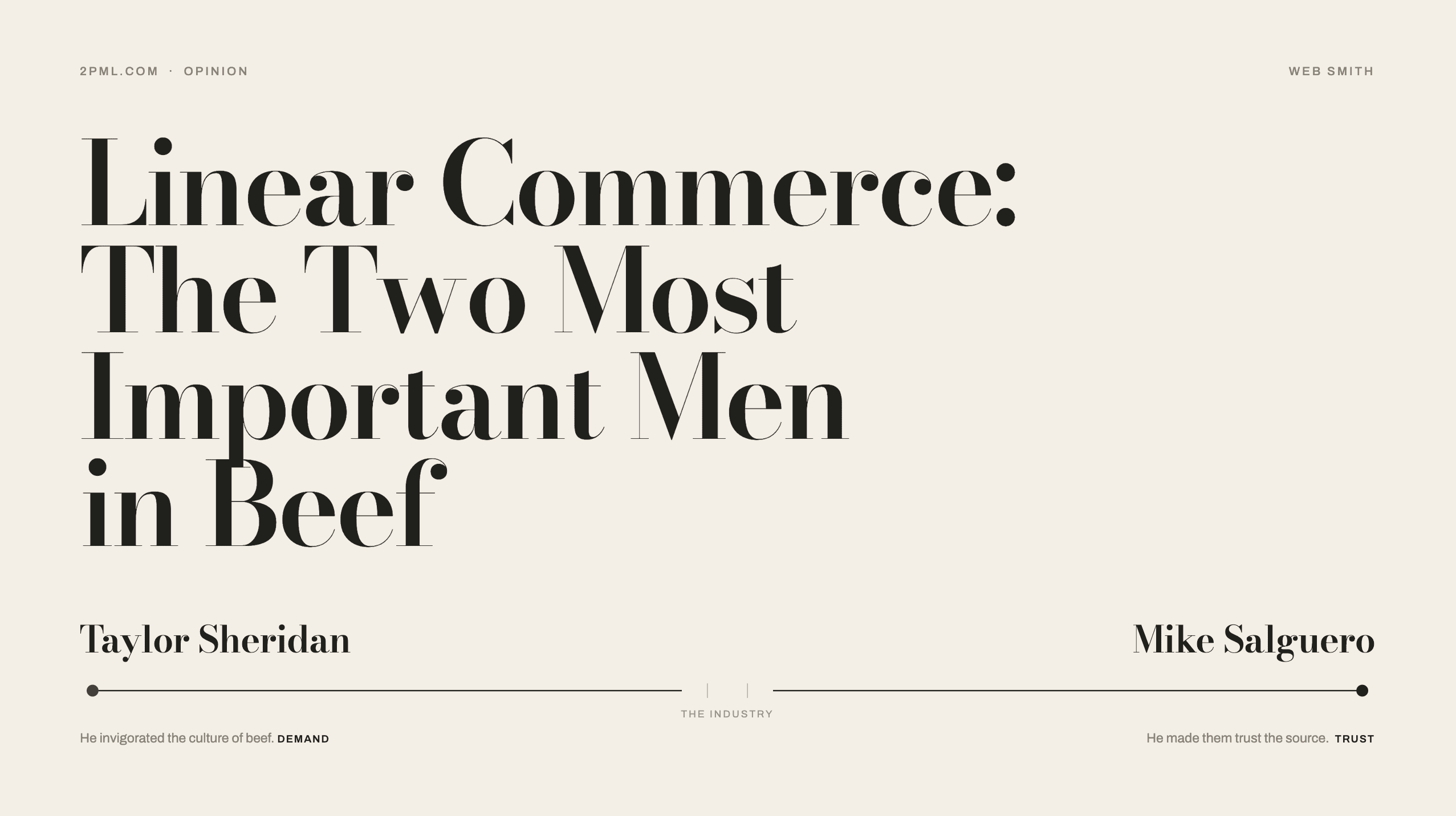
Americans do not eat more beef than they used to. The average person ate about 60 pounds of it last year, roughly the same as in 1950 and nearly a third less than at the peak in the late 1970s. Chicken passed beef for good in 2010, and the country now eats close to 100 pounds of it a year against 60 of beef. By every measure of the plate, beef is a mature category that stopped growing half a century ago. And yet its price just set a record, ground beef is up 72% since 2020, the national herd is the smallest since 1951, and demand has not cracked. It is a staple people eat no more of than their grandparents did, now priced like a luxury and still moving off the shelf. That gap is the whole story, because the thing selling beef is no longer hunger. It is meaning, and someone is manufacturing it.

The herd is the smallest it has been since 1951, and demand still will not break.
Ask who runs American beef and the honest answer is four companies. JBS, Cargill, Tyson, and National Beef control roughly 85% of processing, up from 36% in 1980. They are the chokepoint, and right now they are also losing money on the product, squeezed by the tightest cattle supply in three-quarters of a century. I wrote about this four-company concentration in 2022, the year Sysco sued them for price fixing; three years later they are the subject of a Department of Justice antitrust investigation. The packers move the tonnage but they have never owned the heart of the American beef consumer.
The two who do own it are the subject of an argument 2PM has been making since 2020, when I wrote that the line between media and commerce was dissolving: publishers would learn to sell, brands would learn to publish, and the advantage would settle on whoever fused audience and conversion into one operation. The example is more than a century old. Michelin sold more tires by publishing a guide that gave drivers a reason to wear them out, burnt rubber and a good dinner moving together.
Apply that to beef and the map redraws. The value sits at the two ends of the line. One end is the audience that creates demand. The other is the relationship that captures it and holds onto it. The middle, the feedlots and the packers and the eighteen-month commodity cycle, is turning into a pipe that carries other people’s value. One man holds each end, and the interesting thing about Taylor Sheridan and Mike Salguero is that they are arriving at the same place from opposite directions.
The timing makes both men matter more, not less. The USDA counted 86.2 million head on January 1, the fewest since 1951, and the beef cow herd that determines future supply sits at its lowest since 1961. Retail beef hit a record $9.64 a pound in April. Ground beef cleared $6.70, up about 72% since 2020, and ribeye is pushing $22. Through all of it, demand held; Americans are eating roughly 13% more beef than the country produces. A staple got 72% more expensive in five years and the consumer did not flinch, and when demand behaves like that, price is not the thing moving it. Meaning is. Someone is manufacturing the demand, and it is not the people raising the cattle.
Sheridan: the publisher who became a retailer
I wrote about Taylor Sheridan’s DTC gamble in December 2022, the week his fictional Duttons started arguing about beef margins on basic cable. The gamble paid off.
Yellowstone ran from 2018 to 2024 and routinely beat the four broadcast networks head to head. Its finale drew north of 11 million viewers in a single night, and the final-season premiere reached past 16 million across its airings. Stack the prequels, 1883 and 1923, on top of the rest of his slate and Sheridan is, by most measures, the most valuable creator working in television, a King Lear in a Stetson built at network scale.
He did not stop at filming the cattle business. He bought it. He holds Bosque Ranch in Texas, and in 2021 he led a group of investors to take the legendary Four Sixes off the market, a property whose divisions run to some 266,000 acres and rank among the better Angus operations in the country. He launched Four Sixes Ranch Brand beef, sold direct and sourced from the Sixes and a vetted network of ranches, and set 6666 sauces, seasonings, grills, and apparel beside it. There is a Four Sixes steakhouse on the floor of the Wynn Resort and Casino in Las Vegas. And recently, he stood in front of the National Cattlemen’s Beef Association and made the direct-to-consumer case to the cattlemen themselves.
The masterstroke is the part I flagged in 2022. In the final season, Sheridan wrote the DTC thesis straight into the script: Beth Dutton tells her father to stop selling the animal and start selling the cuts, to go vertical and reach the buyer directly, “because a live cow brings garbage money and a good steak brings thirty dollars.” Then the show pointed its audience at a real store selling real beef from his real ranch. It was native advertising at the scale of a broadcast network, and it cost him nothing. He does not buy ads; the show is the ad. He never argues that you should want beef, or the life that produces it. He makes you want both, by shooting the rancher’s life as the one worth having. This is the publisher-turned-retailer half of linear commerce, run further than anyone in or near Hollywood has managed.
The cruel irony is in the timing. Sheridan made the rancher aspirational at the exact moment the rancher is vanishing. The country lost roughly 17% of its cattle operations in five years, the median farmer is 58, and the herd is at a 75-year low. The story is running one way and the economics the other, and the gap between them, between how Americans feel about beef and what is happening to the people who raise it, is the prize. Sheridan holds it.
Salguero: the retailer who is becoming a better publisher
The other end of the line belongs to Mike Salguero, and he came at it from the opposite side.
He built the most trusted relationship with the modern beef consumer that exists, and he did it without a packing plant, a retail shelf, or a dollar of venture money. ButcherBox began in 2015 as a Kickstarter that raised $215,000 against a goal near $30,000. It has since grown past $600 million in annual revenue, profitable from its first sale, shipped to something like two million households, and never taken outside money. Salguero owns about three-quarters of it; his employees own close to a third. He turned a commodity into a subscription and a transaction into a relationship, and he taught a generation of buyers to ask where the animal came from. Oh, and by the way, ButcherBox’s retail distribution has begun to accelerate; it is now sold in Costco, Target stores, and a growing more.
That relationship is the asset, and inside it Salguero has found something no advertising budget can buy. His membership quietly includes hundreds of the most influential people in the country: athletes and founders, actors and broadcasters, military and intelligence operators, doctors who shape health policy, names from across the full width of American politics. None of them was paid, and none of them is an endorser. They bought the product and kept buying it, which is the one signal of quality money cannot purchase. A brand would normally spend years and a fortune to assemble a roster like that. It is already sitting in his customer file. The work now is the layer that activates it: an invitation-only tier with a concierge and first access for the members who matter most to the brand.
If companies like Good Ranchers sell to a political tribe, ButcherBox sells to a table full of asymmetrical ideals and opinions. His membership became the conduit. A company with that kind of relationship can carry its own message to market, which is the retailer becoming a publisher, built outward from the relationship the way Sheridan built inward from the audience.
He is aiming all of it at a thesis and a conviction. The thesis is that beef belongs at the center of American nutrition, arriving precisely as the GLP-1 era trains the country to treat food as something to minimize. The conviction came the hard way. Salguero used to distrust corporations, then decided the answer to bad corporate behavior was not to leave the system but to build something disciplined enough to win inside it. The problem was never capitalism; it was carelessness. Retail is extending the relationship now, through Target and Costco, then Whole Foods and Kroger and Publix, toward thousands of doors and a billion dollars in revenue. He has the one direct line into the American household, and he is turning that line into an amplified channel.
The convergence
Set the two against each other and the same shape appears. Sheridan built the audience and bolted commerce to it; Salguero built the commerce and is bolting the audience to it. Both are walking toward one position, the company that owns the story, the relationship, and the sale inside a single loop. That is linear commerce finished, and in beef, two men are most of the way to it from opposite starts.
The older name for the method is Bernaysian. A century ago Edward Bernays sold America a heavier breakfast by getting doctors to recommend it, and bacon and eggs became the national meal. He called the method propaganda before the word curdled, and meant by it the manufacture of demand through trust and narrative rather than the pitch. Sheridan manufactures the desire; Salguero manufactures the trust. Neither one sells beef the way the business sold it for a hundred years, by the pound and the case and the shelf. They sell meaning, and in a market where a staple costs 72% more than it did five years ago and the demand still holds, meaning is the only thing that explains the chart. Salguero, for whatever it is worth, built the company on “free bacon for life”, a move Bernays would have admired.
The question worth watching is not what the packers do or where the herd bottoms out. The next contest in beef is not the shelf, and it is not the box. It is the answer.
When a shopper asks an AI agent where to buy the best beef, the win goes to whoever can prove, in structured and verifiable detail, where the product came from, and that is an operations problem before it is a story problem – it is the problem Salguero has spent a decade solving. The two halves of this loop are not equally hard to hold. An audience can be rented or bought, and brands assemble one every day with a campaign and a checkbook. The operation underneath ButcherBox cannot be bought at any price. Salguero ships frozen protein to two million households on a cold chain that does not fail, keeps them on subscription, and turns a profit doing it, on revenue per employee most of his venture-funded peers never reach, without having raised a dollar to get there.
He has the grocery shelves opening at Target and Costco, and he already holds the verified provenance the agent will ask for. Sheridan can manufacture the wanting but he cannot build that, and wanting without the operation to capture it runs downhill to whoever has built one. Sheridan made America crave the culture of beef again through years of sustained propaganda. Salguero is the one who can put it on the porch, next month and the month after, at a scale and a margin no story can fake.
I believe that when the loop finally closes, it will close around the operator.
Opinion By Web Smith